
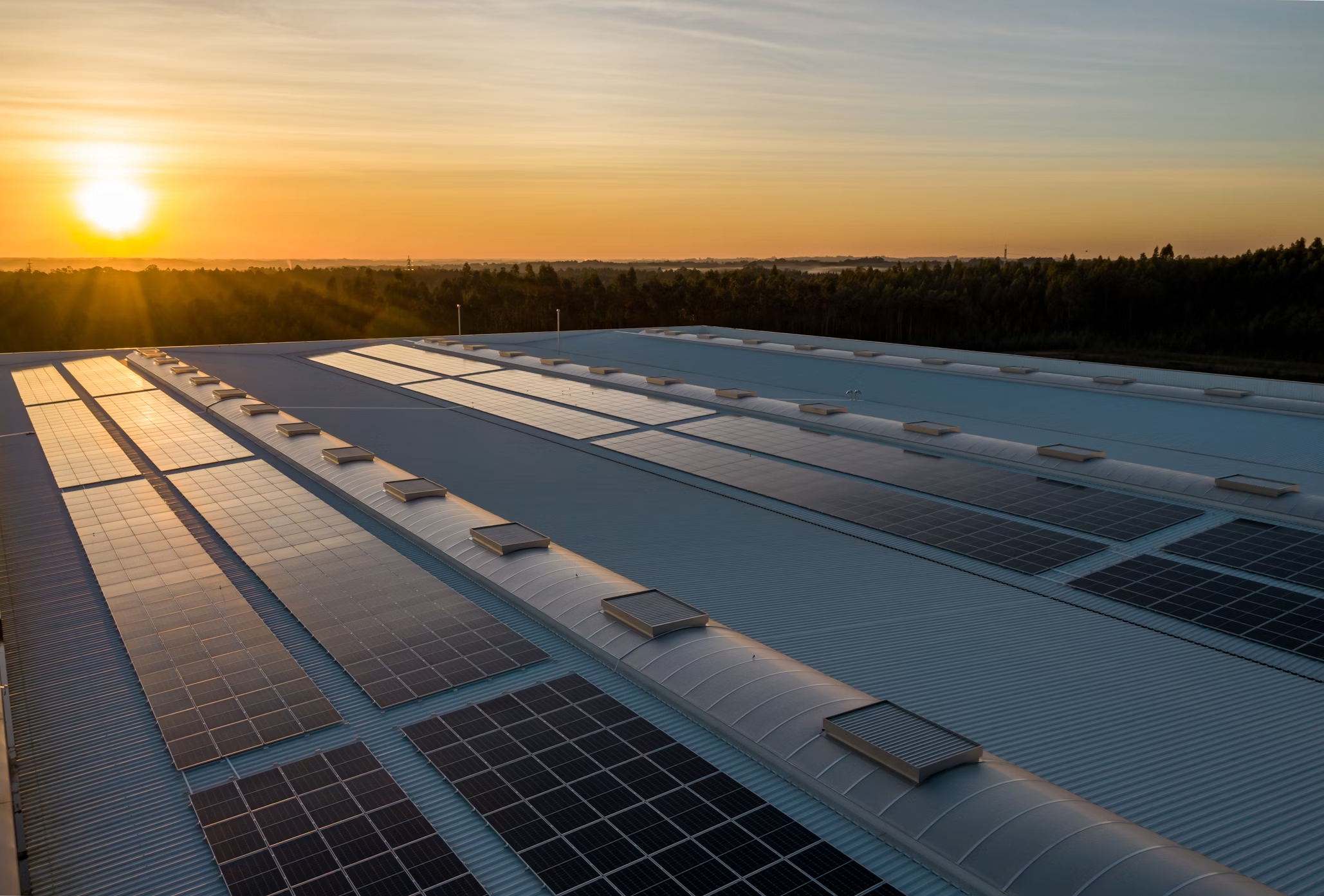
If you are buying a home battery in Australia in August 2026, the federal Cheaper Home Batteries Program is the main thing paying for it, and in most states it is the only thing. On top of that, only three places still have a live state or territory battery incentive: New South Wales, Western Australia and the ACT. South Australia has a retailer-run virtual power plant incentive. Queensland, Victoria, Tasmania and the Northern Territory have no open state battery scheme as at 2 August 2026.
Below is the detail, dated and sourced, so you can see what your quote should actually include.
Every scheme at a glance
Status checked 2 August 2026. Values are approximate and move with certificate prices, so treat them as a guide.
| Scheme | Where | Status at 2 Aug 2026 | Roughly worth | Stacks with federal? |
|---|---|---|---|---|
| Cheaper Home Batteries Program | Australia wide | Open | About $258 to $272 per usable kWh for the first 14 kWh (May to Dec 2026) | This is the federal one |
| Peak Demand Reduction Scheme battery activities | NSW | Open, rules changed 1 July 2026 | Commonly around $1,000 to $1,500 off a home battery | Yes |
| Solar Homes battery loan | VIC | Closed to new applications since 2025 | Nothing new available | Not applicable |
| Battery Booster | QLD | Closed and fully subscribed since 2024 | Nothing new available | Not applicable |
| Home Battery Scheme | SA | Closed since 1 September 2022 | Nothing new available | Not applicable |
| REPS virtual power plant incentive | SA | Open, offered through energy retailers | Reported up to about $2,050 | Yes |
| Residential Battery Scheme rebate | WA | Open | Up to $1,300 (Synergy area) or up to $3,800 (Horizon Power area) | Yes |
| Residential Battery Scheme loan | WA | Open | Interest free loan up to $10,000 | Yes |
| Energy Saver Loan Scheme | TAS | Closed to new applications since September 2025 | Nothing new available | Not applicable |
| Sustainable Household Scheme | ACT | Open | Low interest loan, reported up to $15,000 rising to $20,000 from 1 July 2026 | Yes, it is finance not a rebate |
| Home and Business Battery Scheme | NT | Closed, funding fully allocated | Nothing new available | Not applicable |
The federal Cheaper Home Batteries Program
This is the big one. It started on 1 July 2025 and runs to 2030. It does not pay you cash. It creates small-scale technology certificates (STCs) for your battery, your installer sells them, and the value comes off your invoice before you pay, the same way the solar panel rebate works. We cover that mechanism in our STC explainer.
How much it is worth right now
The number of certificates depends on your battery’s usable capacity and an STC factor set by the government. For installs between 1 May 2026 and 31 December 2026 the factor is 6.8 certificates per usable kWh.
STCs trade at up to $40 each and most installers get somewhere in the high thirties, so the discount lands at roughly $258 to $272 per usable kWh on the first 14 kWh. In plain numbers, as at 2 August 2026:
- A 10 kWh battery earns about 68 certificates, worth roughly $2,600 to $2,700 off the price.
- A 13.5 kWh battery earns about 92 certificates, worth roughly $3,500 to $3,700.
- A 20 kWh battery earns about 120 certificates, worth roughly $4,600 to $4,800.
Across common household sizes that is around 30 per cent off the installed cost. For the rest of the bill, see our guide to what a solar battery costs in Australia.
The size tiers that started on 1 May 2026
Before May 2026 every kWh earned the same rate. Not any more. The certificates now taper as the battery gets bigger, which was done to stop people oversizing just to chase the rebate.
| Usable capacity band | Share of the STC factor applied |
|---|---|
| 0 to 14 kWh | 100 per cent |
| Above 14 up to 28 kWh | 60 per cent |
| Above 28 up to 50 kWh | 15 per cent |
| Above 50 kWh | Nothing |
So the first 14 kWh is the best value part of any battery. A 30 kWh battery does not get twice the discount of a 15 kWh one. It gets far less.
The step down schedule
The other 1 May 2026 change was the pace. The rebate used to step down once a year. It now steps down every six months through to the end of the program in 2030. The factor is locked in by your installation date, not your deposit or contract date. The published schedule runs like this.
| Installation period | STC factor per usable kWh |
|---|---|
| Jan to Apr 2026 | 8.4 |
| May to Dec 2026 | 6.8 |
| Jan to Jun 2027 | 5.7 |
| Jul to Dec 2027 | 5.2 |
| Jan to Jun 2028 | 4.6 |
| Jul to Dec 2028 | 4.1 |
| Jan to Jun 2029 | 3.6 |
| Jul to Dec 2029 | 3.1 |
| Jan to Jun 2030 | 2.6 |
| Jul to Dec 2030 | 2.1 |
The next cut is on 1 January 2027, from 6.8 down to 5.7. On a 13.5 kWh battery that is roughly $1,000 of difference for the same hardware.
One honest caveat. These factors come from industry reporting of the Clean Energy Regulator’s published schedule. We could not load the federal department’s own program pages while writing this, so confirm the current factor with your installer before you sign.
Who qualifies
- Usable capacity between 5 kWh and 100 kWh, with certificates only created on the first 50 kWh.
- The battery must be paired with rooftop solar. New or existing panels both count.
- The battery must be on the approved product list and be capable of joining a virtual power plant. You do not have to actually join one.
- Installation by an accredited installer. Accreditation moved from the Clean Energy Council to Solar Accreditation Australia in 2024.
- One claim per property.
- No income test and no application form. Your installer handles it.
Sources: Cheaper Home Batteries Program, DCCEEW and Small-scale technology certificates for batteries, DCCEEW.
New South Wales
NSW is the one state with a battery incentive that sits directly on top of the federal discount for ordinary households. It comes through the Peak Demand Reduction Scheme, run by NSW Climate and Energy Action.
What it is. You do not apply. An approved provider creates peak reduction certificates for your battery and passes the value back as a discount on your invoice, the same way STCs work.
Who qualifies. The household activity covers batteries from 2 kWh up to 28 kWh of usable capacity. Bigger systems fall under separate business and apartment activities. The scheme rules were rebuilt on 1 July 2026, with the commercial categories following on 1 September 2026.
Roughly what it is worth. Reporting through 2026 puts the household benefit at around $1,000 to $1,500 off a typical home battery, scaling with size.
Does it stack? Yes. Batteries earn NSW peak reduction certificates and federal STCs, and a NSW install can claim both.
One thing we could not settle. Sources published after the 1 July 2026 rule change disagree on whether you still need existing rooftop solar to claim the household battery incentive. Ask your installer to confirm against the current PDRS rule before you commit.
Victoria
There is no Victorian battery rebate or battery loan open as at 2 August 2026.
Solar Victoria’s interest free battery loan closed to new applications in 2025 after the program passed its target, and Solar Victoria’s own buyers guide now says plainly that it is no longer accepting applications. Victorians get the federal discount and nothing else on the battery itself.
The Solar Homes panel rebate and the hot water rebate are still open, but they are separate products and do not apply to storage. The Solar Homes household income threshold also dropped from $210,000 to $150,000 a year for applications submitted after 30 June 2026, so some households that qualified last year no longer do.
Source: Solar Homes Program, Solar Victoria.
Queensland
There is no Queensland state battery rebate open as at 2 August 2026.
The Battery Booster program, which offered up to $4,000 to households under an income cap, was fully subscribed and closed in 2024. Queensland has not announced a replacement.
This matters, because several solar and comparison sites still advertise a live Queensland battery rebate of $3,000 or $4,000. We found pages doing exactly that while researching this article in August 2026. If a salesperson quotes you a Queensland state battery rebate, ask them to show you the current program page on qld.gov.au. Queenslanders do get the federal discount, and because the state sits in a sunnier certificate zone the panels side of a solar and battery package tends to earn a little more than in the southern states.
South Australia
The SA Home Battery Scheme, the most generous state battery subsidy in the country when it launched in 2018, closed to new applications on 1 September 2022 and is not coming back. The South Australian Government’s own page confirms the closure.
What South Australia still has is a virtual power plant incentive delivered through the Retailer Energy Productivity Scheme (REPS), worth up to about $2,050 based on 2026 reporting, and it stacks with the federal discount. The catch is that you do not apply to the government. It is offered by participating energy retailers as part of a VPP deal, so the value and terms depend on which retailer you sign with, and joining a VPP means giving them some control over when your battery charges and discharges.
Source: Home Battery Scheme closed, SA Department for Energy and Mining.
Western Australia
WA has the most straightforward state top up in the country and it is open.
The WA Residential Battery Scheme started on 1 July 2025. Batteries installed before that date are not eligible.
- Synergy customers, meaning most of Perth and the south west, get up to $1,300.
- Horizon Power customers, meaning regional WA, get up to $3,800.
- The maximum applies to a battery with usable capacity between 5 kWh and 10 kWh.
- You must join a virtual power plant. That is a condition, not an option.
- There is also an interest free loan of up to $10,000 over three to ten years with no early repayment fee, capped at a household gross income of $210,000. The rebate itself is not income tested.
- It stacks. WA’s own material gives an example of a 10 kWh battery getting the full $1,300 state rebate and about $5,000 once the federal discount is added.
Tasmania
There is no Tasmanian battery rebate or battery loan open as at 2 August 2026.
Tasmania’s Energy Saver Loan Scheme, which offered interest free finance that could be used for batteries, closed to new applications in September 2025, earlier than planned. See Energy Saver Loan Scheme, ReCFIT for the current position. Tasmanian households get the federal discount only.
Worth saying plainly: Tasmania has the weakest battery payback in the country because of lower daytime solar output and a relatively low peak tariff.
Australian Capital Territory
The ACT does not offer a battery rebate. It offers cheap money instead, and it is open.
The Sustainable Household Scheme provides a low interest loan that can be used for batteries, heat pumps, efficient appliances and electric vehicles. Reporting through 2026 puts the ceiling at $15,000, rising to $20,000 from 1 July 2026, repaid over ten years, at 3 per cent for general applicants since 1 July 2025. There is also a Home Energy Support program for concession card holders covering a share of solar and heat pump costs.
Because it is finance rather than a subsidy, it stacks cleanly. The federal STCs come off the price first and the loan covers what is left. We could not load the ACT Government’s climatechoices.act.gov.au page to confirm the 2026 ceiling and rate directly, so check the current terms there before you plan around them.
Northern Territory
The NT Home and Business Battery Scheme is closed. Its funding was fully allocated and it is not taking new applications as at 2 August 2026. When it ran it paid a grant per kWh of usable capacity up to a capped maximum, but published figures for the final round differ between sources, so we are not quoting one.
The NT Government has not announced new funding, so plan your purchase assuming no territory grant. The upside is that Darwin earns the highest federal certificate value in the country on the panels side of a package because of its solar zone rating.
Source: Home and Business Battery Scheme, NT Government.
How to make sure you actually get the discount
Your installer applies the federal discount, so the only way to check you received it is to read the quote.
- Ask for the battery’s usable capacity in kWh, not the nominal or nameplate figure. Certificates are worked out on usable capacity and the two numbers are not the same.
- Ask for the STC value as a separate line, not buried in a “special price”. If it is not itemised, you cannot tell whether it was passed on.
- Check the install date, not the quote date, against the step down table above. A quote in December that installs in January is worth less.
- In NSW, WA or SA, ask which state incentive is included and how it is being claimed.
- Get at least three quotes and compare line items, not headline numbers. Our guide on how to compare solar quotes walks through what to line up.
To start with installers who work in your area, browse the directory by region.
FAQ
Can I claim the federal battery rebate if I already have solar panels?
Yes. Existing rooftop solar counts. You do not need to buy new panels to get the battery discount, though the battery does have to be paired with a solar system at the property.
Is there still a Queensland battery rebate in 2026?
No. The Queensland Battery Booster program closed in 2024 once its funding was fully allocated, and there is no replacement as at 2 August 2026. Queenslanders get the federal discount, which is not income tested and needs no application. Be careful with third party sites still advertising a live Queensland rebate, because several were doing so in August 2026.
Should I wait for a better rebate or buy now?
On the federal discount alone, waiting costs you money. The factor now steps down every six months, so a battery installed in January 2027 earns roughly 16 per cent fewer certificates than the same battery in December 2026. The counter argument is that hardware prices have been falling, so the two can partly cancel out. Get quotes now and compare against the step down date.
Do I have to join a virtual power plant?
For the federal discount, no. Your battery must be capable of joining one, but taking part is optional. For the WA scheme, joining a VPP is a condition. For the SA REPS incentive and parts of the NSW scheme, the value is tied to a VPP or aggregator deal. Read what control you are handing over before you sign.
Can I claim a state rebate and the federal one together?
Yes, where the state scheme is open. The NSW, WA and SA incentives all sit on top of the federal discount rather than replacing it, and the ACT loan is finance so it stacks by definition. Victoria, Queensland, Tasmania and the NT have no open battery scheme to stack.
Is a bigger battery better value under the new rules?
Not per kWh. Since 1 May 2026 the first 14 kWh earns the full rate, the next 14 kWh earns 60 per cent, capacity above 28 kWh earns 15 per cent, and anything above 50 kWh earns nothing. Size the battery to your evening usage, not to the rebate.
Related reading
- what a VPP is and whether to join one
- the feed-in tariff tracker
- the average Australian electricity bill
About this research
This is independent desk research by Solar Cobber. We did not visit sites, request quotes or accept payment for inclusion. Figures are dated and sourced, and pricing and policy details change, so confirm current terms directly before you sign anything.