
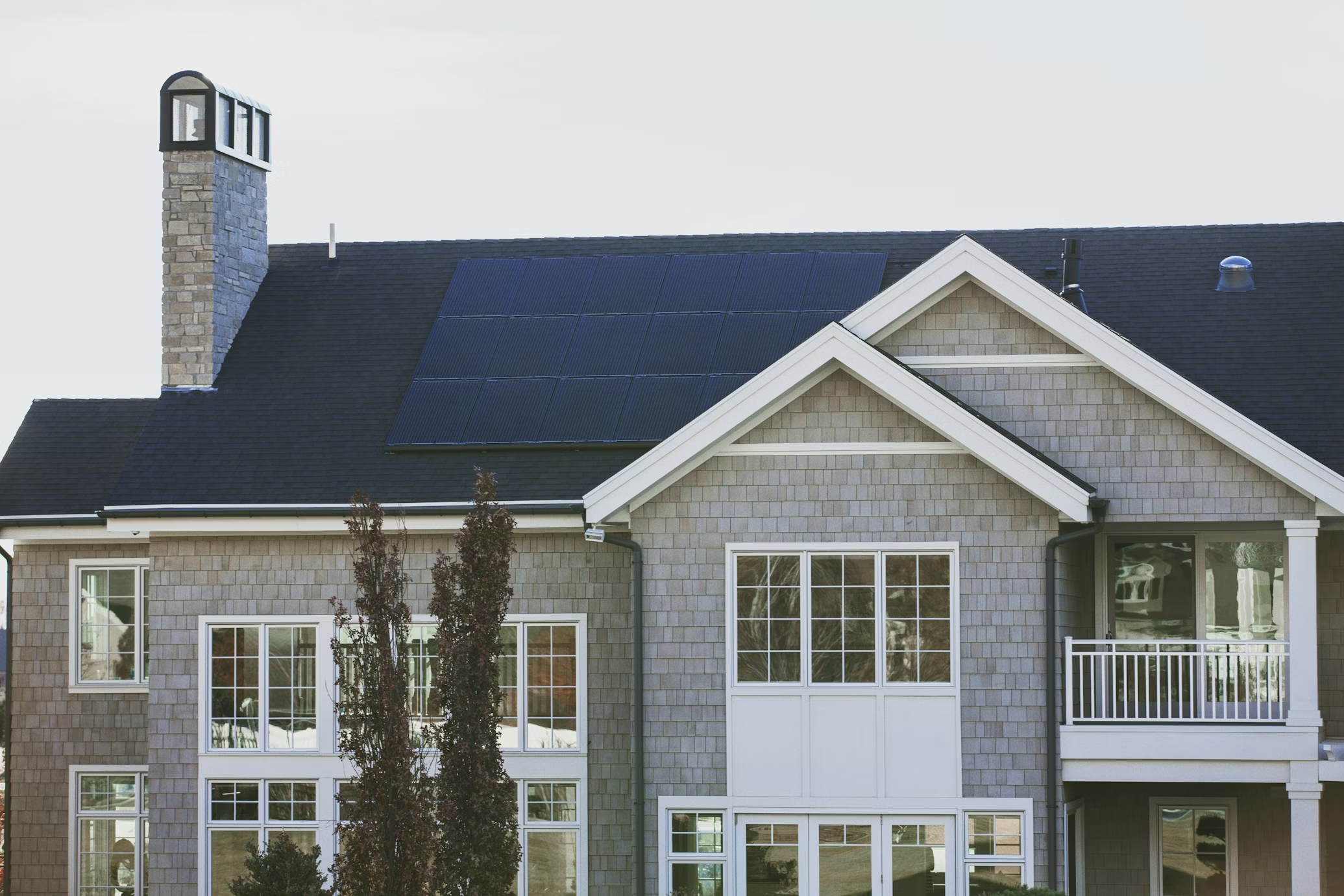
Across most of Australia, peak electricity is late afternoon and evening, usually somewhere between 3pm and 9pm. Off-peak is overnight, and in a growing number of networks the cheapest window of all is now the middle of the day, roughly 10am to 4pm.
The exact hours depend on your distributor, not your state. This guide covers the three tariff types you can be put on, the real peak and off-peak windows network by network, and the part almost nobody explains properly: how a time of use tariff changes whether solar and a battery are worth it for you.
The three tariff types, in plain language
Your bill has two halves. A daily supply charge you pay no matter what, and a usage charge for every kilowatt hour (kWh) you pull from the grid. Tariff types are just different ways of pricing that second half.
Flat rate (single rate)
You pay the same cents per kWh at 2am, 2pm and 7pm. Simple, predictable, and no reward for shifting when you use power.
Time of use
The day is split into windows with different prices. Peak is the dearest, off-peak is the cheapest, and shoulder sits in between. Some networks now add a fourth window in the middle of the day, called solar soak, solar sponge or super off-peak, which is cheaper again.
You need a smart meter for this. In most networks a smart meter now means you get put on a time of use tariff by default.
Demand
A demand tariff has a lower usage rate, plus a separate charge based on your single highest half hour of grid use inside a set window that month. It is not about how much power you use overall. It is about your worst spike.
Ausgrid measures the highest 30 minute period of use between 3pm and 9pm, then multiplies that kilowatt figure by the number of days in the month. It only applies in summer (November to March) and winter (June to August), according to Ausgrid’s demand pricing page. In Queensland, Energex measures the demand window from 4pm to 9pm every day.
Demand tariffs punish one bad habit hard. Running the ducted air conditioner, the oven, the dryer and an EV charger all at 6pm on one hot February evening can set your demand charge for the whole month. Under the 2026 to 2031 tariff structure statements approved by the Australian Energy Regulator, Victorian distributors have dropped residential demand tariffs, so most Victorian homes now choose between flat and time of use only.
Peak, shoulder and off-peak times by state and network
These are network windows. Your retailer can and often does use slightly different hours on your actual plan, so treat this as a starting point and check your bill.
| State | Network (distributor) | Peak | Shoulder | Off-peak / midday window |
|---|---|---|---|---|
| NSW | Ausgrid (Sydney, Central Coast, Hunter) | 3pm to 9pm every day, Nov to Mar and Jun to Aug only | None since Jul 2024 | All other times. No peak at all in Apr, May, Sep, Oct |
| NSW | Endeavour Energy (Western Sydney, Blue Mountains, Illawarra) | 4pm to 8pm weekdays | Remaining hours | Solar soak 10am to 2pm every day |
| NSW | Essential Energy (regional NSW) | 5pm to 8pm weekdays | 7am to 5pm and 8pm to 10pm weekdays | All other times |
| VIC | All five networks (CitiPower, Powercor, AusNet, Jemena, United Energy) | 4pm to 9pm every day | Off-peak 9pm to 11am | Solar soak 11am to 4pm every day |
| QLD | Energex (south east QLD), tariff 6900 | 4pm to 9pm | 9pm to 11am | Solar sponge 11am to 4pm |
| QLD | Ergon Energy (regional QLD) | 4pm to 9pm | 9pm to 9am | 9am to 4pm every day |
| SA | SA Power Networks | 6am to 10am and 4pm to midnight | None on the standard time of use tariff | Solar sponge 10am to 4pm, off-peak midnight to 6am |
| WA | Synergy Midday Saver (Western Power area) | 3pm to 9pm | None | Super off-peak 9am to 3pm, off-peak 9pm to 9am |
| TAS | Aurora Energy Tariff 93 | 7am to 10am and 4pm to 9pm weekdays (AEST) | None | All other times, including all weekend |
| ACT | Evoenergy | 7am to 9am and 5pm to 8pm | All remaining hours | 10pm to 7am |
| NT | Power and Water | 6am to 6pm weekdays | None | All other times |
Sources: Ausgrid, SA Power Networks, Aurora Energy, Endeavour Energy, the Essential Services Commission, and WATTever for the Essential Energy, Ergon, Evoenergy and Power and Water windows.
Two things that catch people out
Daylight saving is handled differently by different networks. Aurora Energy shifts its Tasmanian peak windows to 8am to 11am and 5pm to 10pm during daylight saving. Evoenergy in the ACT does not shift at all. If you set appliance timers, check which rule applies to you.
Weekends are not always off-peak. Ausgrid, Energex, Ergon and the Victorian networks charge peak rates seven days a week. Endeavour, Essential, Aurora and Evoenergy restrict most peak pricing to weekdays.
Why the middle of the day got cheap
The old picture was simple. Everyone wanted power in the evening, so evening cost more. Nobody wanted it overnight, so overnight cost less.
Rooftop solar broke that picture. AEMO’s Quarterly Energy Dynamics for Q1 2026 recorded rooftop solar output up 8.1 per cent on the year, and negative wholesale prices in 16 per cent of daytime dispatch intervals in New South Wales and 26 per cent in Queensland. On a mild sunny day there is now more power than the grid wants.
So networks flipped the incentive. Instead of only pushing you out of the evening, they pull you into the middle of the day. That is what a solar soak, solar sponge or super off-peak window is. Endeavour Energy went furthest and made its network charge free between 10am and 2pm.
The same logic runs backwards for exports. Ausgrid now charges 1.23c per kWh for solar exported between 10am and 3pm, after a free allowance of about 200 kWh a month, and pays a reward of 3.85c per kWh for exports between 4pm and 9pm. Both figures are on Ausgrid’s two-way solar pricing page. IPART’s 2026-27 benchmarks point the same way, valuing Ausgrid exports between 4pm and 9pm at 17.2c to 18.7c per kWh. Time of day is now the whole game.
How a time of use tariff changes solar payback
Here is the trap. A time of use tariff gives you a cheap midday window. Solar panels give you free midday power. You cannot spend the same discount twice.
With solar and no battery, your grid buying is squeezed into the two windows solar cannot cover, early morning and evening. On a three part Victorian tariff that means buying at 21.17c off-peak and 38.31c peak while almost never touching the 16.59c solar soak rate. A flat rate customer in the same zone pays 25.96c at every hour of the day.
So solar households without storage are often better off on a flat tariff. That feels backwards, so here are the numbers.
Worked example: flat versus time of use for a solar home
All rates below are the 2026-27 Victorian Default Offer for the CitiPower zone, published by the Essential Services Commission and including GST.
| Tariff | Supply charge | Usage rates |
|---|---|---|
| Flat | $1.2114 a day | 25.96c per kWh, all hours |
| Time of use | $1.2114 a day | Peak 4pm to 9pm: 38.31c. Off-peak 9pm to 11am: 21.17c. Solar soak 11am to 4pm: 16.59c |
The household uses 5,000 kWh a year, split 1,500 kWh in the peak window, 1,100 kWh in the solar soak window and 2,400 kWh in the off-peak window. That split is our assumption for the example, not a measured figure. Exports are credited at the same rate under both plans, so they cancel out and are left off both sides.
| Scenario | Grid import | Flat tariff bill | Time of use bill | Better option |
|---|---|---|---|---|
| No solar | 5,000 kWh | $1,740 | $1,707 | Time of use, by $33 |
| 6.6 kW solar, no battery | 3,250 kWh | $1,286 | $1,362 | Flat, by $76 |
| Solar plus a battery | 1,250 kWh | $767 | $733 | Time of use, by $34 |
For the solar row we assumed panels cover all 1,100 kWh of solar soak use, 500 kWh of morning off-peak use and 150 kWh of late afternoon peak use. For the battery row, that the battery delivers about 2,000 kWh a year into the home, mostly between 4pm and 9pm.
The pattern is the interesting bit:
- With no solar, time of use is slightly cheaper because the household still buys plenty of midday power.
- With solar and no battery, time of use costs more. Solar already took the cheap window, and everything left is bought at the two dearer rates.
- Add a battery and time of use wins again, because the battery moves cheap midday energy into the expensive evening window.
The battery is worth more on the right tariff too. In this example it cuts $519 a year off the flat tariff bill and $629 a year off the time of use bill, a difference of about $110 a year from tariff choice alone. Same battery, same house, same solar. See our guide to solar battery costs in Australia and the federal battery rebate for the upfront side of that maths.
Which tariff suits your household
Work through these in order.
Stay on flat if: you have solar, no battery, no EV, and most of your grid buying happens in the evening. Same if you are home all day without solar and cannot shift anything.
Move to time of use if: you have a battery, an EV you charge on a timer, a pool pump, or an electric hot water system you can run between 10am and 4pm. Also consider it if the house is empty on weekdays and your network restricts peak to weekdays.
Be careful with demand tariffs if: you have ducted air conditioning or an EV. The usage rate looks great on paper, but one 40 degree evening with everything running can wipe out the saving.
One last point. If your grid buying is already concentrated in a 4pm to 9pm peak at nearly 40c per kWh, a battery does far more work than it would for a household on a flat 26c. Time of use pricing quietly improved the case for storage.
How to check what tariff you are actually on
- Find the usage section of your bill. One usage line means a flat rate. Two or more lines named peak, shoulder, off-peak or solar soak means time of use. A line measured in kW rather than kWh means a demand charge.
- Check the times printed next to each rate. Your retailer’s windows, not the network’s, are what you get billed on.
- Compare offers on Energy Made Easy, the free comparison site run by the Australian Energy Regulator. It covers NSW, Queensland, South Australia, Tasmania and the ACT. Victorians use Victorian Energy Compare. Western Australia and the Northern Territory have no household retail competition, so your options are the published Synergy, Horizon Power or Jacana Energy plans.
- Upload a real bill or your smart meter data rather than typing estimates. The comparison is only as good as the usage pattern you feed it.
- Ask your retailer to switch. It is usually free, though some limit you to one change a year.
If you are still deciding on a system, read our guides on comparing solar quotes and feed-in tariffs, and you can find installers near you in our directory.
FAQ
What time is peak electricity in Australia?
Most networks put peak between 3pm and 9pm, and it is always the late afternoon and evening block. Ausgrid uses 3pm to 9pm, Victorian networks and Energex use 4pm to 9pm, Endeavour uses 4pm to 8pm, and Evoenergy in the ACT splits peak between 7am to 9am and 5pm to 8pm.
Is electricity cheaper on weekends?
It depends on your network. In Endeavour, Essential, Aurora and Evoenergy areas, peak pricing mostly applies on weekdays only, so weekends are cheaper. In Ausgrid, Energex, Ergon and all Victorian networks, peak applies every day of the week including weekends and public holidays.
Will a time of use tariff save me money if I have solar?
Often not, if you do not have a battery. Your panels already cover the cheap midday window, so you end up buying the rest of your power at the peak and off-peak rates, both of which are higher than a flat rate. Run the numbers on your own usage before switching.
What is a solar soak or solar sponge tariff?
It is a discounted middle of the day window designed to soak up surplus rooftop solar. SA Power Networks runs it from 10am to 4pm, Victorian networks from 11am to 4pm, Energex from 11am to 4pm, and Endeavour Energy makes its network charge free from 10am to 2pm. Synergy in WA calls the same idea super off-peak, from 9am to 3pm.
Can I be moved to a time of use tariff without asking?
Yes. In several networks, getting a smart meter installed means you are assigned a time of use network tariff by default. In south east Queensland, properties with a smart meter installed after 1 July 2025 are assigned to Energex tariff 6900. You can usually ask your retailer to move you back, but you have to ask.
Related reading
About this research
This is independent desk research by Solar Cobber. We did not visit sites, request quotes or accept payment for inclusion. Figures are dated and sourced, and pricing and policy details change, so confirm current terms directly before you sign anything.