
Solar panels for apartments are possible in Australia as at November 2026, but almost always through the owners corporation (strata body), not by an individual resident. NSW, Victoria, the ACT and the Northern Territory fund shared building systems, Queensland pays landlords of rental houses, and plug-in balcony solar is still not legal to connect to a power point. Renters without a cooperative landlord can use a midday-power plan or GreenPower instead.
Key facts
- As at 12 November 2026, the NSW Solar for Apartment Residents grant pays up to 50 per cent of a shared solar system (up to $150,000 per building), or up to 80 per cent (up to $200,000) in listed Boost suburbs, and applications close at 5 pm on 4 December 2026 unless funds run out sooner.
- Solar Victoria’s Solar for Apartments program pays up to $2,800 per apartment and $140,000 per building until 30 June 2027 or until funds run out, as listed on its page updated 6 November 2026.
- Solar Victoria pays rental providers a rebate of up to $1,400 per rental property, with an optional matching interest-free loan, for renter households with combined taxable income under $150,000.
- The Queensland Government’s Supercharged Solar for Renters rebate pays landlords $2,500 to $3,500 for rental houses, duplexes, townhouses and granny flats, but not apartments, according to our Queensland guide.
- The NT Solar for Multi Dwellings Grant Scheme offers up to $7,500 per dwelling, capped at 50 per cent of eligible costs, to unit management corporations, according to its terms and conditions.
- Plug-in balcony solar cannot legally be plugged into a power point in Australia as at November 2026; energy ministers agreed on 11 September 2026 only to explore a safe pathway and to report back by the end of the year.
Can you put solar panels on an apartment?
Yes, but the roof and the walls belong to the owners corporation (also called a body corporate), so a resident cannot install panels alone. The realistic routes are a shared system on the roof, a system for common areas only, or, in townhouse-style strata with a private roof, an individual system once the strata body approves.
This table compares the main options by situation, as described by SolarQuotes and the program pages, checked November 2026. Community solar, a subscription to an off-site solar farm, is another route for owners and renters who cannot host panels.
| Your situation | Best-fit option | What it means | Main catch |
|---|---|---|---|
| Owner in a unit block with usable roof | Shared rooftop solar with sharing technology such as Allume SolShare | One system feeds many units through existing meters and each owner keeps their retailer | Needs a strata vote; uneconomical below about 6 single-phase units |
| Owner in a block with a small or shaded roof | Common-area solar only | Powers lifts, lights and pumps and cuts strata levies | Does not lower your own bill |
| Townhouse owner with a private roof | Individual rooftop system | Your own panels with the STC discount | Strata approval may still apply |
| Renter in a house | Landlord installs with a cost-sharing agreement | Landlord gets rebates, you share bill savings | Landlord must agree |
| Renter in an apartment | Midday-power plan, GreenPower, or ask the owners corporation | Lower bills without panels | You cannot install anything yourself |
How does strata approval work for solar?
The owners corporation must approve solar on common property before any work starts, and the vote required differs by state and by scheme type. SolarQuotes says most states require a majority and some ask for roughly 50 to 75 per cent of votes for solar on common property, so check your state strata regulator for the exact rule.
In practice a committee member or strata manager gets quotes, often at least two, commissions a feasibility study if sharing technology is involved, tables a motion at a general meeting, and then applies for any grant.
We found no announced later round of the NSW grant after 4 December 2026.
How does shared solar work in an apartment building?
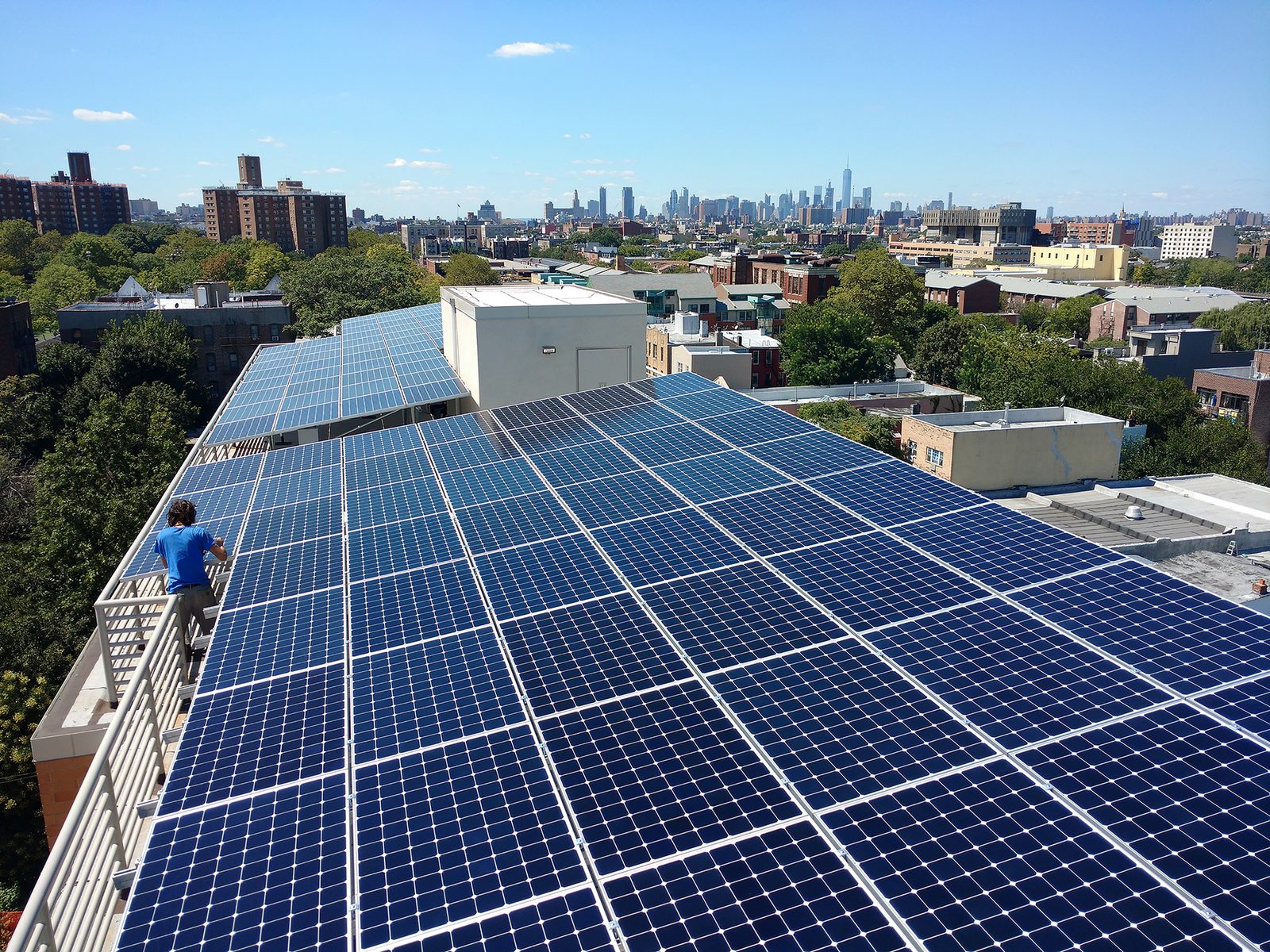
Shared solar puts one larger system on the roof and divides its output between apartments. SolShare, made by Allume Energy, is a device that splits the output between up to 15 single-phase apartments using the existing meters, so owners keep their own electricity retailer and no embedded network is needed, according to SolarQuotes.
An embedded network is a private electricity network inside a building where one operator on-sells power to residents; homes in one cannot join the Solar Sharer plan.
For a worked cost example, SolarQuotes cites a Waverley Council project: a 19.5 kW system shared across 12 apartments and the common area, financed so the strata paid nothing up front. Residents paid roughly $1.25 to $1.50 per apartment per day. That is about $456 to $548 a year per apartment, an example from one project and not a standard price.
What government programs fund solar for apartments and renters?
Most state programs pay the owners corporation or the landlord, not the tenant. This table shows each program as at 12 November 2026, checked on the program pages named in the Sources section. Figures for Queensland, ACT and NT follow our state guides.
| State | Program | Who applies | Worth | Status |
|---|---|---|---|---|
| NSW | Solar for Apartment Residents (and Boost) | Owners corporation | 50% up to $150,000; Boost 80% up to $200,000 | Closes 5 pm 4 Dec 2026 or earlier |
| NSW | Batteries for apartment buildings | Owners corporation or installer quote | About 30 to 40% off a battery with new solar, 20 to 30% battery only | Open from 1 Sep 2026, no closing date |
| NSW | Home Energy Saver discount | Eligible renter or owner | Up to $4,000 | Open, income or concession card test |
| Victoria | Solar for Apartments | Owners corporation | Up to $2,800 per apartment, $140,000 per building | Open to 30 Jun 2027 |
| Victoria | Solar Homes rental rebate | Rental provider | Up to $1,400 plus matching loan | Open |
| Queensland | Supercharged Solar for Renters | Landlord | $2,500 to $3,500, houses and townhouses only | Open until funds run out |
| ACT | Solar for Apartments Program | Owners corporation | Up to $100,000 per complex, half grant, half 0% loan | Open for registration |
| NT | Solar for Multi Dwellings Grant Scheme | Unit management corporation | Up to $7,500 per dwelling, up to 50% of cost | Listed, no closure notice |
Solar for apartments in NSW
The Solar for Apartment Residents grant co-funds shared solar for buildings of 3 to 55 lots managed under the Strata Schemes Management Act 2015. According to the NSW Government, as of October 2026 it had funded 230 projects covering 3,776 households, including 1,344 rented apartments. It is calculated on cost after STCs and excluding GST, and does not fund batteries.
Batteries have a separate apartment batteries incentive for buildings of at least four units. Our NSW solar rebate guide has the detail.
Solar for renters in Victoria
Victorian landlords can claim up to $1,400 per rental property, for up to two properties a financial year, plus an interest-free loan matching the rebate, repaid over four years at $29.17 a month, according to Solar Victoria (page updated 9 November 2026). The landlord and all renters sign an agreement, and renters can agree to pay up to half the repayment, at most $14.58 a month. Installation costs cannot be recovered through rent increases or the bond.
Apartment blocks apply through Solar for Apartments: 3 to 50 lots, up to 8 storeys, no solar in the last 10 years and no embedded network. See our Victorian solar rebate guide.
Solar landlord rebate in Queensland
Queensland’s rebate is for landlords of houses, duplexes, townhouses and granny flats rented at $1,000 a week or less, with tenant consent and a fixed-term lease. Apartments are excluded. See our Queensland solar rebate guide.
ACT and Northern Territory
The ACT Solar for Apartments Program requires an average unimproved value per unit of $300,000 or less, no existing solar and benefits for all residents including tenants, per our ACT solar rebate guide. The ACT page blocked automated access in our check, so confirm terms with the ACT Government. The NT scheme is covered in our Northern Territory solar rebate guide. We have not covered the programs of other states here.
Worked example: a 20-apartment building in NSW
The NSW grant can cover half of a shared system, with owners splitting the rest. These numbers are our assumptions, not quotes.
| Step | Assumption or working | Result |
|---|---|---|
| System cost after STCs, excluding GST | Assumed for a roof system | $60,000 |
| Standard grant | 50% of $60,000, under the $150,000 cap | $30,000 |
| Owners’ share | $60,000 minus $30,000 | $30,000 |
| Share per lot | $30,000 divided by 20 lots | $1,500 per lot |
In a listed Boost suburb, an 80 per cent grant would leave about $600 per lot.
What can renters do without a landlord’s help?
The Solar Sharer Offer gives 3 free hours of power a day, up to 24 kWh, in NSW, South East Queensland and South Australia, and renters can sign up if they have a smart meter and are not in an embedded network. Our Solar Sharer Offer guide has the rates, and Victoria has a separate Midday Power Saver.
GreenPower is accredited renewable electricity bought through most retailers; it supports renewable generation but does not cut your bill.
To get panels on a rented house, ask the landlord with a cost-sharing case: the landlord keeps the asset and the rebate, you save on bills, and in Victoria the agreement can include a capped tenant contribution. In NSW, an eligible renter can apply for the Home Energy Saver discount with the landlord’s approval, and strata or owners corporation permission where it applies.
Is plug-in balcony solar legal in Australia?
No. As at November 2026, plug-in solar, meaning a small panel and inverter plugged into a normal power point, cannot legally be connected in Australia. RenewEconomy reported on 14 September 2026 that kits can be bought but not legally plugged in.
What is confirmed:
- SolarQuotes (17 September 2026) says AS/NZS 4777.1, which covers grid-connected inverters, requires a permanent connection, not a socket.
- Federal, state and territory energy ministers agreed on 11 September 2026 to explore pathways for safe use, with the Commonwealth to report back by the end of 2026.
- Energy Minister Chris Bowen said “this is not happening overnight”.
- SolarQuotes reports that, according to a Standards Australia committee member, no project to amend AS/NZS 4777.1 for plug-and-socket connection was under way as at September 2026.
- Solar Citizens is campaigning for legalisation by 1 July 2027. That is an advocacy goal, not a government target.
We could not confirm any change after mid-September 2026. Do not buy a balcony kit expecting to plug it in.
What to check before you commit
- Confirm the strata vote threshold with your strata manager or state regulator.
- Ask for quotes showing system size, STC deduction, GST and net cost. See how to compare solar quotes.
- Check the installer yourself on the Clean Energy Council approved retailer list and the Solar Accreditation Australia register. Solar Cobber does not verify accreditation.
- Compare installers in our directory of Australian solar installers.
FAQ
Can you get solar panels in an apartment in Australia?
Yes, usually as a shared system approved by the owners corporation, because a resident cannot install panels on common property alone.
Is plug-in balcony solar legal in Australia?
No, not as at November 2026. Energy ministers agreed on 11 September 2026 only to explore a safe pathway, and kits cannot legally be connected to a power point until the standards change.
Can renters get solar panels in Australia?
Only with the landlord’s agreement. Victoria and Queensland pay rebates to landlords, and NSW lets eligible renters apply for a discount with landlord approval.
Is there a solar rebate for apartments in NSW?
Yes, for the owners corporation. The Solar for Apartment Residents grant pays up to 50 per cent of shared solar, up to $150,000, or 80 per cent in Boost suburbs, and closes 4 December 2026 unless funds run out sooner.
Is there a solar landlord rebate in Queensland?
Yes, for houses and townhouses. Supercharged Solar for Renters pays $2,500 to $3,500 depending on system size, and apartments are not eligible. It is open until funds run out.
Can renters use the Solar Sharer free power offer?
Yes, with a smart meter in NSW, South East Queensland or South Australia, outside an embedded network. The first 24 kWh in a 3-hour midday window is free each day.
Sources
- Solar for apartment residents, NSW Government and its FAQs
- Batteries for apartment buildings incentive, NSW Government
- Home Energy Saver discounts, NSW Government
- Solar for Apartments, Solar Victoria
- Solar rebates for rental properties, Solar Victoria
- Supercharged Solar for Renters, Queensland Government
- Solar for Apartments Program, ACT Government
- Solar for Multi Dwellings Grant Scheme, NT Government
- About GreenPower, GreenPower program
- Solar for apartments: options for units and strata, SolarQuotes
- Pros and cons of SolShare, SolarQuotes
- Plug-in solar: has the safety problem been solved? SolarQuotes, 17 September 2026
- Plug-in solar not an overnight proposition, RenewEconomy, 14 September 2026
About this guide
Written by the Solar Cobber editorial team as independent desk research, checked in November 2026. Solar Cobber is a free directory that may earn referral or advertising fees from installers, and commercial relationships never affect our content. This is general information, not financial or legal advice. Spotted an error? Tell us on our contact page.
Filed under Solar Guides
Back to blog