

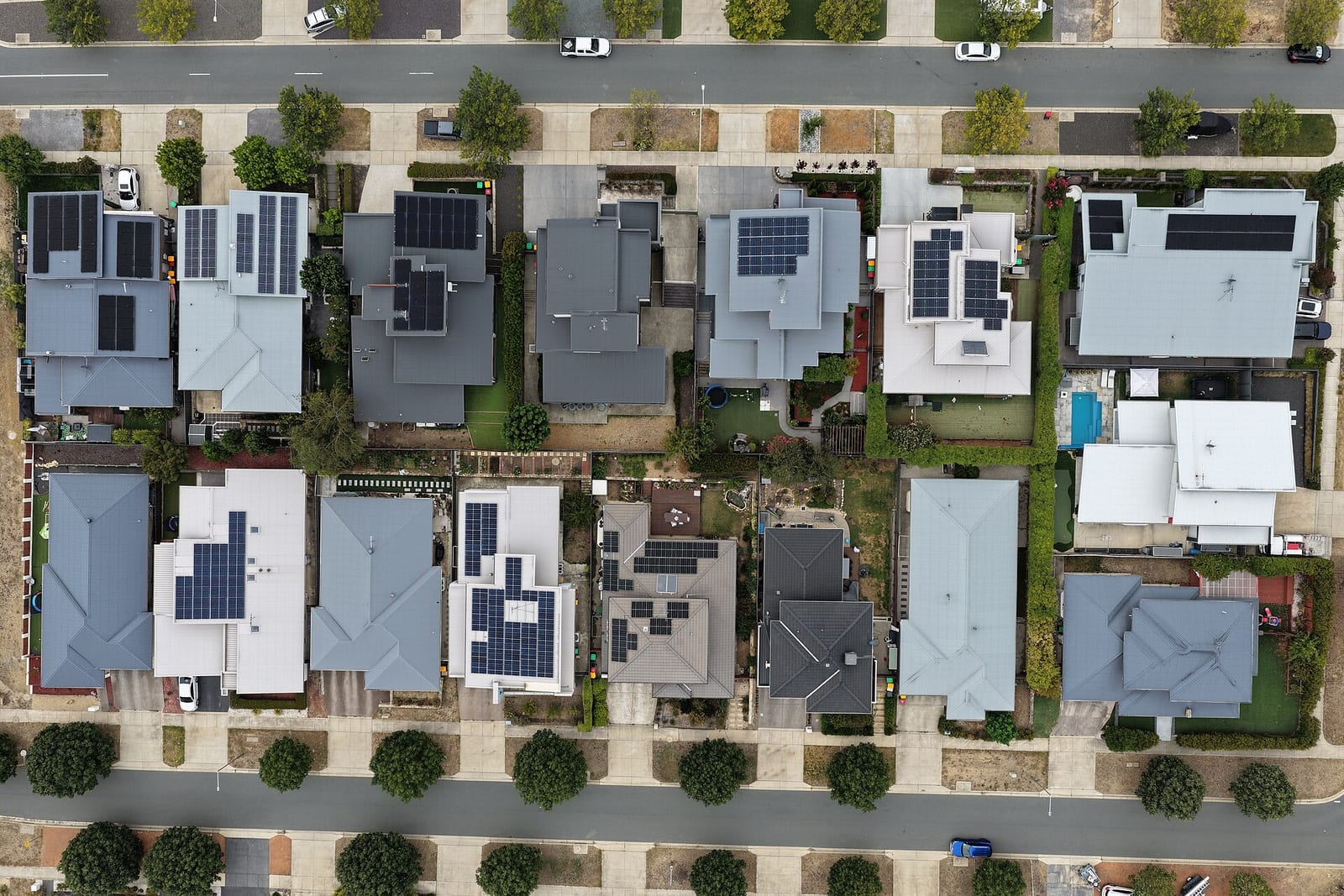
Most Australian homes do not need a premium panel. They need a reliable panel from a large manufacturer with a local office, at a fair price per watt, with warranty terms that actually fit the house. This guide is for buyers comparing standard-tier quotes in 2026 who want to know which budget-friendly panel to accept.
We compared six panels that dominate mainstream quotes: Jinko Tiger Neo 3.0, Trina Vertex S+, JA Solar DeepBlue 4.0 Pro, Canadian Solar TOPHiKu6, LONGi Hi-MO X10 (and the older X6) and AIKO Neostar 3P54. Each was judged on efficiency, heat performance, Australian warranty terms, coastal and labour exclusions, Clean Energy Council (CEC) listing, published prices and owner feedback. If you want the general criteria for judging any panel, read our how-to-choose guide to solar panels first; this article names specific picks.
This is independent desk research built on our full solar panel reviews. Solar Cobber did not test any panel, and no manufacturer paid for inclusion.
Quick picks
- Best overall value: Jinko Tiger Neo 3.0, for near-premium efficiency and heat rating at a budget price.
- Best budget pick: Trina Vertex S+ (NEG9R.28), usually the cheapest, with low current that suits almost any inverter.
- Best dual-glass bargain away from the coast: JA Solar DeepBlue 4.0 Pro.
- Best for hail-prone suburbs: Canadian Solar TOPHiKu6 (CS6.2-48TM), with a 45 mm hail test on the single-glass model.
- Best value all-black look: LONGi Hi-MO X10.
- Best value for small roofs: AIKO Neostar 3P54, with 500 W in a standard-size panel.
Comparison table
| Panel | Power | Max efficiency | Temp. coefficient | Warranty (product / power) | Panel price guide | Weight and glass | Best for |
|---|---|---|---|---|---|---|---|
| Jinko Tiger Neo 3.0 | 460 to 485 W | 24.27% | -0.26%/°C | 25 / 30 yrs, 88.85% | A$95 to A$130 (A$0.25 to A$0.28/W) | 24.4 kg, dual glass | Overall value |
| Trina Vertex S+ NEG9R.28 | 450 to 475 W | 23.8% | -0.29%/°C | 25 / 30 yrs, 87.4% | A$95 to A$110 (about A$0.25/W) | 21.0 kg, dual glass | Lowest price |
| JA Solar DeepBlue 4.0 Pro | 450 to 475 W | 23.8% | -0.29%/°C | 25 with conditions (15 base) / 30 yrs, 87.4% | About A$155 per 475 W | 22 kg, dual glass | Inland suburbs |
| Canadian Solar TOPHiKu6 | 445 to 475 W | 23.8% | -0.29%/°C | 25 on listed black-frame models / 30 yrs, 87.4% | A$130 to A$228 (CHOICE listings) | 21.3 kg single or 24.6 kg dual | Hail areas |
| LONGi Hi-MO X10 | 475 to 505 W | 24.74% | -0.26%/°C | 25 in Australia (confirm) / 30 yrs, 88.85% | Not published | 21.6 kg, single glass | All-black look |
| AIKO Neostar 3P54 | 475 to 500 W | 25.0% | -0.26%/°C | 25 / 30 yrs, 88.85% | A$125 to A$150 (about A$0.31/W) | 20.6 kg, single glass | Small roofs |
Panel prices are hardware only. Jinko, Trina and AIKO figures come from Solar Choice’s October 2026 price index; JA Solar’s is a SolarQuotes estimate and Canadian Solar’s are CHOICE listings, so compare them loosely.
Why panel brand moves the price less than you think
Solar Choice’s October 2026 index put the average standard-tier 6 kW system at A$6,330 after the STC discount, from A$5,030 in Perth to A$6,950 in Hobart, with Darwin at A$9,890. SolarQuotes’ median for a quality 6.6 kW system is A$5,500 to A$8,000, from 1,023 owner-reported prices. Within that, the gap between Jinko and AIKO panels on a 6.6 kW system is only about A$200 to A$400. Installer quality, the inverter and roof complexity usually matter more. Our STC explainer shows how the upfront discount is worked out.
Best Overall Value: Jinko Tiger Neo 3.0
The Tiger Neo 3.0 delivers specifications that were premium territory a few years ago, at a budget price. It fits up to 485 W into the standard 1762 x 1134 mm size, holds a -0.26%/°C heat rating and promises 88.85% of power at year 30. Installers placed Jinko second in the 2026 SolarQuotes Installers’ Choice panel vote with 14%.
Pros
- Up to 24.27% efficiency, so about 14 panels make 6.6 kW
- -0.26%/°C limits loss on hot afternoons
- 4.8 out of 5 from more than 5,000 SolarQuotes owner ratings, and a Sydney office
Cons
- The Australian warranty excludes panels “installed in a marine environment”, without defining a distance from the coast
- Short-circuit current near 16 A can exceed some older inverters’ input limits
- 24.4 kg dual-glass panels are heavier than single-glass rivals
Key specs: N-type TOPCon, 2.0 mm glass front and back, 6000 Pa front test load. Price: about A$95 to A$130 per panel; a 6 kW system typically lands at A$5,000 to A$7,000 installed in a capital city. Warranty fine print: cover starts at the earlier of delivery or 180 days after manufacture, labour to swap a panel is excluded, and claims must be lodged online within 30 days. The 485 W DV and 480 and 485 W DB were not CEC-listed at 2 October 2026. Skip it if: you live beachside, or your inverter accepts less than 16 A per string.
Read our full Jinko Tiger Neo review.
Best Budget Pick: Trina Vertex S+
The NEG9R.28 is usually the cheapest panel from a big brand on an Australian quote. It is a light dual-glass design with unusually low current, which makes it easy to pair with almost any inverter, including older ones. SolarQuotes reports installers have voted Trina Australia’s best value panel.
Pros
- About A$95 to A$110 per panel
- 21.0 kg, light for dual glass
- About 10.9 A short-circuit current suits nearly every string inverter
Cons
- Dual-glass panels within 2,000 m of the coast are covered only after Trina evaluates and approves the site
- -0.29%/°C and 87.4% at year 30 trail Jinko, LONGi X10 and AIKO
- Several Vertex S+ versions are on sale at once, so it is easy to be quoted an older one
Key specs: N-type i-TOPCon, 450 to 475 W, 1.6 mm glass front and back, 5400 Pa front test load. Price: a 6 kW system typically falls in the A$5,000 to A$7,000 standard band. Warranty fine print: the 25-year product term comes from an Australian supplement, so keep a copy. Removal and reinstallation labour is excluded, and the warranty is valid only for panels bought through authorised Australian resellers. Skip it if: you live within 2 km of the sea, or in a hot climate where the -0.26%/°C Gen3 version costs little more.
Read our full Trina Vertex S+ review.
Best Dual-Glass Bargain Away From the Coast: JA Solar DeepBlue 4.0 Pro
DeepBlue 4.0 Pro is a near-twin of the Trina and Canadian Solar panels on paper, with dual glass on both versions and a steady Australian record. SolarQuotes sums JA up as “Cheap, reliable, and well-supported in Australia.” The weakness is paperwork: the 25-year product cover is an Australian extension with strings attached.
Pros
- Dual-glass construction (1.6 mm each side) on the LR and LB versions
- 23.8% efficiency at 475 W in the standard size
- 4.8 out of 5 from 896 SolarQuotes owner ratings, with an Australian subsidiary handling claims
Cons
- The 25-year extension excludes sites within 500 m of sea water unless JA approves them in advance, and requires Solar Panel Validation at install
- The public Australian documents we found do not name the LR version most often quoted; JA’s global LR datasheet shows 15 years
- Lower design load than some rivals (3600 Pa front, 1600 Pa rear)
Key specs: N-type TOPCon, 108 half cells, -0.29%/°C, 22 kg, made in China or Vietnam. Price: SolarQuotes estimates about A$155 per 475 W panel (around A$0.33 per watt); CHOICE lists A$200. Systems are usually quoted in the A$5,500 to A$8,000 median band for 6.6 kW. Warranty fine print: the clock can start six months after factory dispatch, and removal and reinstallation costs fall on the owner. Skip it if: your home is close to the sea, or the installer cannot show the document giving your exact model 25 years.
Read our full JA Solar DeepBlue 4.0 Pro review.
Best for Hail-Prone Suburbs: Canadian Solar TOPHiKu6
TOPHiKu6 is one of the most widely installed value panels in Australia, with a Melbourne warranty team. Canadian Solar says the single-glass CS6.2-48TM passed a 45 mm ice-ball test under IEC 61215, a larger test than many rivals publish. Check the frame colour, because the 25-year product warranty depends on it.
Pros
- 45 mm hail test (48TM) or 35 mm (dual-glass 48TD), per Canadian Solar
- 30-year performance warranty to 87.4%
- 4.8 out of 5 from 2,293 SolarQuotes ratings, and third in SolarQuotes’ 2024 installer awards
Cons
- 25 years of product cover applies only to listed black-frame (and some all-black) models; other variants get 12 or 15 years
- Removal and reinstallation labour is excluded unless Canadian Solar agrees in writing
- Exclusions for “extraordinary hot, salt or chemical exposure” and for designs that cause constant shading
Key specs: N-type TOPCon, 445 to 475 W, -0.29%/°C, about 53 to 54 V open-circuit voltage. Price: CHOICE lists A$130 for the CS6R-440T and A$228 for the CS6.2-48TD-465. Warranty fine print: cover starts the day after installation or 90 days after delivery, whichever is earlier. Hail damage is usually an insurance matter, not a warranty claim; see our hail and insurance guide. Skip it if: your quote is for a silver-frame model or a coastal site.
Read our full Canadian Solar TOPHiKu6 review.
Best Value All-Black Look: LONGi Hi-MO X10
LONGi’s back-contact panels have no front busbars, so they look clean and uniform on the roof. The Hi-MO X10, launched here in late 2025, adds a -0.26%/°C heat rating and a 30-year power guarantee. LONGi holds 5.0 out of 5 from more than 4,300 SolarQuotes owner ratings, and SolarQuotes’ Finn Peacock calls it “pretty cheap, pretty damn good”.
Pros
- Up to 24.74% efficiency and 505 W
- Single glass keeps weight to 21.6 kg
- LONGi says the design limits power loss and hot-spot heating under partial shade, citing TÜV tests
Cons
- LONGi’s global datasheets show a 15-year product warranty, so the 25-year Australian term must be on your certificate
- At 1800 mm long, it may fit fewer panels per row than a 1762 mm panel
- Datasheet hail test is the standard 25 mm, and SolarQuotes reports LONGi guidance requires installation more than 50 m from beaches
Key specs: HPBC 2.0 back contact, 475 to 505 W (CEC-listed to 500 W), 15.03 to 15.62 A short-circuit current. Price: no brand-specific index is published; LONGi systems typically land between A$5,000 and A$8,300 for 6 kW depending on the inverter. Warranty fine print: we found no LONGi document covering removal and reinstallation labour. The older Hi-MO X6 (-0.29%/°C, 25-year power warranty to 88.9%) is worth taking only at a clear discount. Skip it if: your roof is beachfront or tightly sized.
Read our full LONGi Hi-MO X6 and X10 review.
Best Value for Small Roofs: AIKO Neostar 3P54
AIKO costs a little more than TOPCon panels, but on a small roof it can be the better value because each panel makes more power. A roof that holds 6.65 kW of 475 W panels can hold 7 kW of 500 W Neostars. Installers made AIKO the top pick in the SolarQuotes Installers’ Choice panel vote for the second year running in 2026, with 28%.
Pros
- 25.0% efficiency and 500 W in the standard 1762 x 1134 mm size
- 20.6 kg, with a 40 mm hail test on the Australian datasheet
- Written Australia and New Zealand warranty and a Melbourne service centre
Cons
- About A$200 to A$400 more in panel hardware than Jinko for a 6.6 kW system
- Only sold in Australia since March 2024, so local long-term data is thin
- Shade gains are smaller in real-world comparisons than in AIKO’s certified lab tests
Key specs: N-type ABC back contact, -0.26%/°C, 14.76 to 14.96 A short-circuit current. Price: about A$125 to A$150 per panel (Solar Choice, October 2026). Warranty fine print: the warranty can start 90 days after the panel leaves the factory, and labour to swap a panel is excluded. A February 2026 settlement of Maxeon’s patent claims removed a supply risk. Skip it if: your roof is large and unshaded, where cheaper panels give the same output for less.
Read our full AIKO Neostar review.
How we chose
We started with the 10 panels we have reviewed in full and kept those usually quoted in the standard price tier. All six come from large manufacturers with Australian offices. We did not rank them on BloombergNEF’s Tier 1 list, which measures bankability rather than panel quality.
We left out the premium REC Alpha Pure-RX, Maxeon 7 and Australian-made Tindo Walara on price, and the Risen Hyper-ion, a 37.5 kg commercial panel with a 15-year product warranty. Each pick won the use case where its trade-offs hurt least.
What to check on your quote
- Exact model, suffix and frame colour. Warranty terms can change with each.
- CEC listing for that exact wattage. The panel must be listed on install day for STCs.
- Distance from the coast. Trina flags 2,000 m, JA 500 m, LONGi 50 m, and Jinko an undefined “marine environment”.
- Panel current against inverter input. Many of these panels run near 15 to 16 A; see our string inverter vs microinverter guide.
- Manufacture date. Several warranties start before installation.
- Who pays labour on a swap. None of these six makers’ written warranties covers it, so get it in the installer’s workmanship warranty.
- Price per watt after STCs. It makes quotes with different panel sizes comparable.
FAQ
What is the best value solar panel in Australia?
For most homes, the Jinko Tiger Neo 3.0: 24% efficiency, a -0.26%/°C heat rating and a 30-year power guarantee at about A$0.25 to A$0.28 per watt. Trina is cheaper if price is the only priority.
Are cheap solar panels from big brands reliable?
Generally yes. All six hold 4.8 out of 5 or better on SolarQuotes. SolarQuotes notes that low-cost retailers often use Jinko and Trina, so the installer is usually the bigger risk.
Should I worry about TOPCon panel degradation?
It is a watch item, not a reason to avoid them. Kiwa PVEL and UNSW research has flagged UV and damp-heat degradation in some TOPCon modules. A 30-year power warranty and a local office are your protection.
Is it worth paying extra for a back-contact panel?
On a small or partly shaded roof, AIKO or LONGi X10 can be worth a few hundred dollars more. On a large sunny roof, adding one more TOPCon panel is usually cheaper.
Which value panel is best near the coast?
None of the six offers a clear coastal guarantee. Get the manufacturer’s written approval for your address before signing.
How long do budget panels last?
Their power warranties promise 87.4% to 88.85% of output at year 30. Our guide to how long solar panels last covers real-world lifespan.
Related guides
- Best Premium Solar Panels in Australia for 2026: 6 High-End Panels Compared
- The Best Solar Inverters in Australia for 2026: String, Micro and Hybrid Picks
About this guide
Written by the Solar Cobber editorial team. Updated October 2026.
This roundup is independent desk research. We did not test any panel, request quotes or contact manufacturers, and no manufacturer paid to be included. Solar Cobber is a free installer directory and may earn referral or advertising fees from installers; those commercial relationships never affect which products we recommend. Sources include manufacturer datasheets and Australian warranty documents, the CEC approved modules list (October 2026), the Solar Choice price index, SolarQuotes and CHOICE pricing, the SolarQuotes 2026 Installers’ Choice awards and SolarQuotes owner ratings, as cited in each full review. When you are ready, compare installers in our directory and use our guide to comparing solar quotes.