
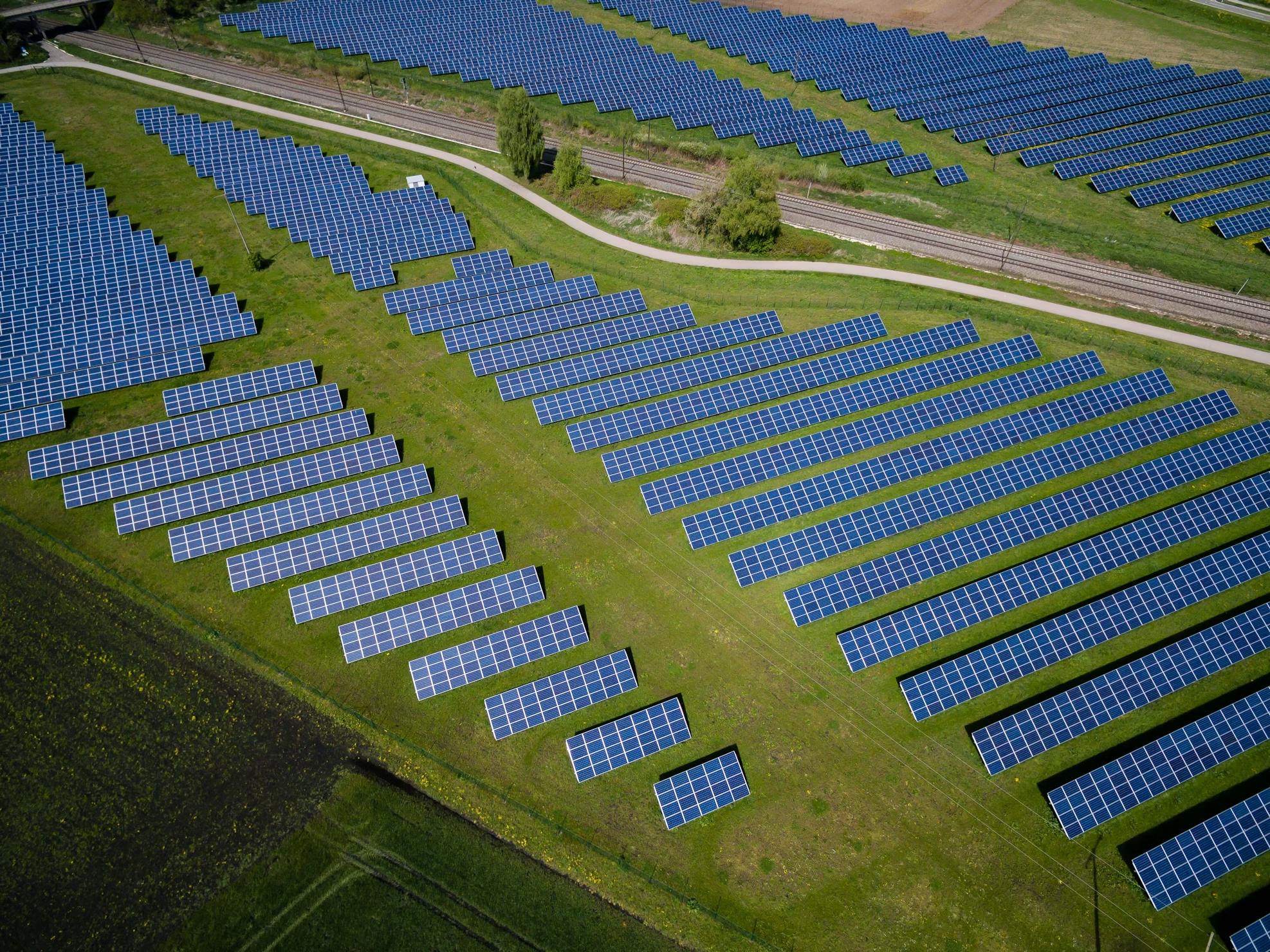
Yes, hail can damage solar panels, and in Australia the repair bill is almost always handled by your home insurance policy, not the panel warranty. Panels are tested against hail, but the test is a minimum standard and big Australian hailstorms go well past it.
Here is how tough panels really are, what damage looks like, whether your policy covers roof mounted solar, and how to lodge a claim so it does not stall.
How much hail are panels built for?
Every panel sold for a grid connected home here must be certified to the international standard IEC 61215. Under AS/NZS 5033, the installation rules, modules must be qualified to that standard and be on the Clean Energy Council approved products list at install. The Clean Energy Council confirms that since 1 April 2025 new installs must use modules certified to the 2021 version of IEC 61215 to qualify for small-scale technology certificates.
The hail part of that test is specific. The lab fires 25 mm ice balls at the panel at 23 metres per second, about 83 km/h, hitting 11 set points including corners and edges. To pass, the glass must not break, output must not drop more than 5 per cent, and the panel must still pass a wet leakage test.
That is why panels shrug off ordinary storms. But look at the numbers. A 25 mm stone is roughly the width of a 20 cent coin. The Bureau of Meteorology calls a thunderstorm severe once hail reaches 2 cm, and adds “giant hail” to warnings at 5 cm and above. Australia regularly gets stones far bigger, and bigger stones fall faster.
So panels handle small and medium hail well. Once you are into golf ball size and up, the certification stops telling you much. Some manufacturers pay for optional testing at larger ice ball sizes and use thicker front glass, so in a hail prone area ask your installer for the test data on that specific module. Our guide to the best solar panels in Australia covers module quality more broadly.
Where hail hits hardest in Australia
Hail is not spread evenly. The Bureau of Meteorology severe storms archive shows the heaviest concentration of large hail reports along the coastal strip between Sydney and southern Queensland, with Brisbane, Ipswich, Logan, Moreton Bay and the Gold Coast hit repeatedly. Northern NSW, the Sydney basin, the ACT and parts of inland Victoria and South Australia also get damaging hail, mostly in spring and summer.
The Insurance Council of Australia reported on 21 April 2026 that extreme weather caused $4.8 billion in insured losses in 2025, more than $4.1 billion of it in Queensland. The late November 2025 storms across Queensland and NSW produced almost 93,000 claims worth $1.78 billion.
What hail damage looks like
Some damage is obvious. When a panel’s front glass fails it usually shatters in a spider web pattern across the whole sheet, often visible from the ground. You may also see dented frames, chipped corners or torn material on the back.
The problem is the damage you cannot see. A hailstone can crack the silicon cells inside without breaking the glass at all. These are microcracks. The panel looks perfect, but the cracked cells have lost part of their electrical connection, so it makes less power. Heat cycling widens the cracks over months, cracked cells can create hot spots, and a damaged seal lets moisture in.
Microcracks cannot be found by looking. Two methods work:
- Infrared or thermal imaging. A thermal camera on the live array shows cells running hotter than their neighbours. Quick, widely offered by Australian service electricians, good at finding hot spots and dead sections.
- Electroluminescence (EL) imaging. Current is pushed through the panel and a camera captures the near infrared light it emits. Cracked areas show up dark. EL is more sensitive, but it needs specialist gear, so not every installer offers it.
Why an output drop is often the first sign
For most homeowners the inverter app is the early warning system, not the roof. After a storm, compare daily generation to the same week beforehand on similar weather. Watch for:
- A sudden drop in daily kWh that does not match the weather.
- One string or MPPT producing clearly less than the other when they used to match.
- New fault codes, especially earth fault or insulation resistance faults, which can mean water is getting into a damaged panel.
- Individual panels lagging, if you have microinverters or optimisers.
If output has dropped and you cannot explain it, get a licensed electrician in before assuming it is dirt or shading. Our maintenance and longevity guide covers the other causes of output loss.
Do not climb on the roof after a storm. A cracked panel still generates dangerous DC voltage in daylight.
Does home insurance cover solar panels?
In Australia roof mounted solar is generally treated as part of the building, not contents, so it is usually covered by the building section of a home and contents policy for insured events like storm, hail, fire and lightning. Consumer group CHOICE makes the same point in its guide to solar and home insurance.
Two things catch people out.
The sum insured. Your building sum insured is the maximum the insurer will pay. If you set that figure before installing a $12,000 solar and battery system and never updated it, the cover may not stretch to replacing the system on top of roof repairs. Tell your insurer when you install solar and ask them to lift it.
The policy wording. Ground mounted arrays, panels on a carport or shed, and standalone battery cabinets are the usual grey areas and may need listing separately. Read the Product Disclosure Statement, which every insurer publishes free online.
Typically covered vs typically excluded
| Usually covered | Usually excluded or conditional |
|---|---|
| Storm and hail damage to roof mounted panels | Wear, tear and gradual deterioration |
| Fire and lightning strike damage | Faults covered by the manufacturer warranty |
| Theft and malicious damage to the system | Poor or non-compliant installation work |
| Inverter damage from an insured event | Accidental damage, unless the policy adds it |
| Making the site safe, removing debris | Flood, unless flood cover is added |
| Lost electricity costs, on some policies | Panels on structures not listed on the policy |
| Re-roofing to reinstate the array | Homes unoccupied beyond the policy limit |
Treat that as a list of questions to ask. Only your own PDS and certificate of insurance decide your claim.
Insurance claim or warranty claim?
These are different systems and mixing them up wastes weeks.
| Insurance claim | Warranty claim | |
|---|---|---|
| Who pays | Your insurer | Panel maker or installer |
| Covers | Sudden damage from an insured event | Manufacturing defects, output below guarantee |
| Hail damage | Yes, this is the right path | Almost never, impact is not a defect |
| Excess payable | Yes | No |
| Time limit | Report promptly after the event | 10 to 25 years product, 25 to 30 performance |
Hail is an external event, not a fault in the panel, so warranties do not cover it. The catch is that many home policies exclude anything already covered by a manufacturer warranty, and insurers sometimes lean on that clause. Get your installer’s report to state plainly that the cause was hail impact, not a defect.
Step by step: lodging a hail damage claim
The Insurance Council of Australia’s advice for storm affected property owners is the baseline. Applied to solar, it looks like this.
- Make it safe. If panels are shattered or water has got into the switchboard, switch the system off at the AC isolator if it is safe to reach, and call a licensed electrician. Do not touch damaged DC cabling.
- Photograph everything before you clean up. Wide shots of the roof, close ups of each damaged panel, hailstones next to a coin for scale, and the inverter screen showing fault codes.
- Screenshot your monitoring. Capture generation for the weeks before and after. Some apps drop old data.
- Write an inventory. List every affected item with brand, model and serial number where you can. Your install paperwork and Certificate of Compliance help.
- Lodge straight away. Tell the insurer there is both roof damage and solar damage. Get a claim number.
- Get written approval before repairs. The ICA is blunt about this. Speak to your insurer before you authorise any building work, including emergency repairs. Unauthorised work may not be covered.
- Do not throw damaged panels away. The assessor may want to see them.
- Get an independent inspection report. A qualified installer should document visible damage, fault codes, string level output loss and ideally a thermal or EL scan. This is what turns “the panels look fine” into a paid claim.
- Ask for an advance payment if you need one. In financial hardship you can ask the insurer to fast track and pay an advance within five business days of showing urgent need.
- Track the timeframes. The General Insurance Code of Practice sets a decision within 10 business days on a straightforward claim once the insurer has all it asked for, updates every 20 business days where more investigation is needed, and a decision within four months in most cases.
- Escalate if it stalls. Lodge a complaint with the insurer’s internal dispute resolution team, which normally must respond within 30 calendar days. After that, take it to the Australian Financial Complaints Authority, free for consumers.
When only part of the system is damaged
Say four panels out of twenty are cracked. You would expect the insurer to replace four. It is rarely that simple, for five reasons.
- Your exact model may not exist any more. Models turn over every couple of years and older modules drop off the Clean Energy Council approved list. An installer cannot sign off a system using a module that is no longer approved.
- Mismatched panels drag down a whole string. Panels wired in series run at the current of the weakest one, and a different spec can push the string outside the inverter’s voltage window.
- Full replacement can cost about the same. Add scaffolding, labour and a fresh compliance sign off, and replacing the lot can land close to a partial repair, with a new warranty across the system.
- Hidden microcracks in the “undamaged” panels. If the storm shattered four panels, the rest took hits too. An EL scan is the argument for replacing more than the obviously broken ones.
- The rebate does not automatically come back. SolarQuotes has reported Clean Energy Regulator guidance that owners generally cannot claim STCs again for replacement panels, because the deeming period was already claimed, unless the full system including the inverter is replaced. That guidance dates from 2020, so confirm the current position. Our STC rebate explainer has the background.
Ask your installer to put the reasoning in writing for the insurer. “Model discontinued, no approved equivalent, mixing modules would breach AS/NZS 5033 and cut array output” is far stronger than “we would prefer to replace the lot”.
Reducing the risk before the next storm
- Update your sum insured now. Free, and the highest value action. Include panels, inverter, battery and mounting.
- Buy on glass and testing, not just brand. In hail prone regions ask for the module’s hail test report and front glass thickness.
- Be careful with hail mesh. Screens shade the array, add wind load, trap heat and leaves, and may void your panel warranty. Get manufacturer approval in writing first.
- Keep a photo of the healthy array with your install paperwork, and check monitoring monthly. You cannot claim for damage you never noticed.
- Use an installer who will back you later. Our guide on choosing a solar installer covers what to ask, and you can browse our directory.
FAQ
My panels look fine but output dropped after the storm. Can I still claim?
Yes, and this is common. Invisible microcracks are real damage. Get a thermal or electroluminescence inspection report from a qualified installer and attach your before and after monitoring data. Report it as soon as you notice rather than waiting.
Does the manufacturer’s warranty cover hail?
Generally no. Product warranties cover manufacturing defects and performance warranties cover output falling below a guaranteed curve. Hail impact is an external event, which is what insurance is for. If an insurer pushes you to the warranty, ask your installer to confirm in writing that the cause was hail.
Do I pay an excess, and are batteries covered too?
Yes to the excess in almost all cases, though it applies to the claim as a whole, so roof, gutters and panels damaged in the same storm are normally one claim and one excess. Batteries and inverters are usually covered if permanently installed and damaged by an insured event, but check your PDS and make sure their value sits in your building sum insured.
How long does a solar hail claim take?
It depends on the event. After a declared insurance catastrophe, thousands of claims land at once and assessors and installers are booked out for months. Lodging quickly and getting your own inspection report done early are the parts within your control.
Related reading
About this research
This is independent desk research by Solar Cobber. We did not visit sites, request quotes or accept payment for inclusion. Figures are dated and sourced, and pricing and policy details change, so confirm current terms directly before you sign anything.