
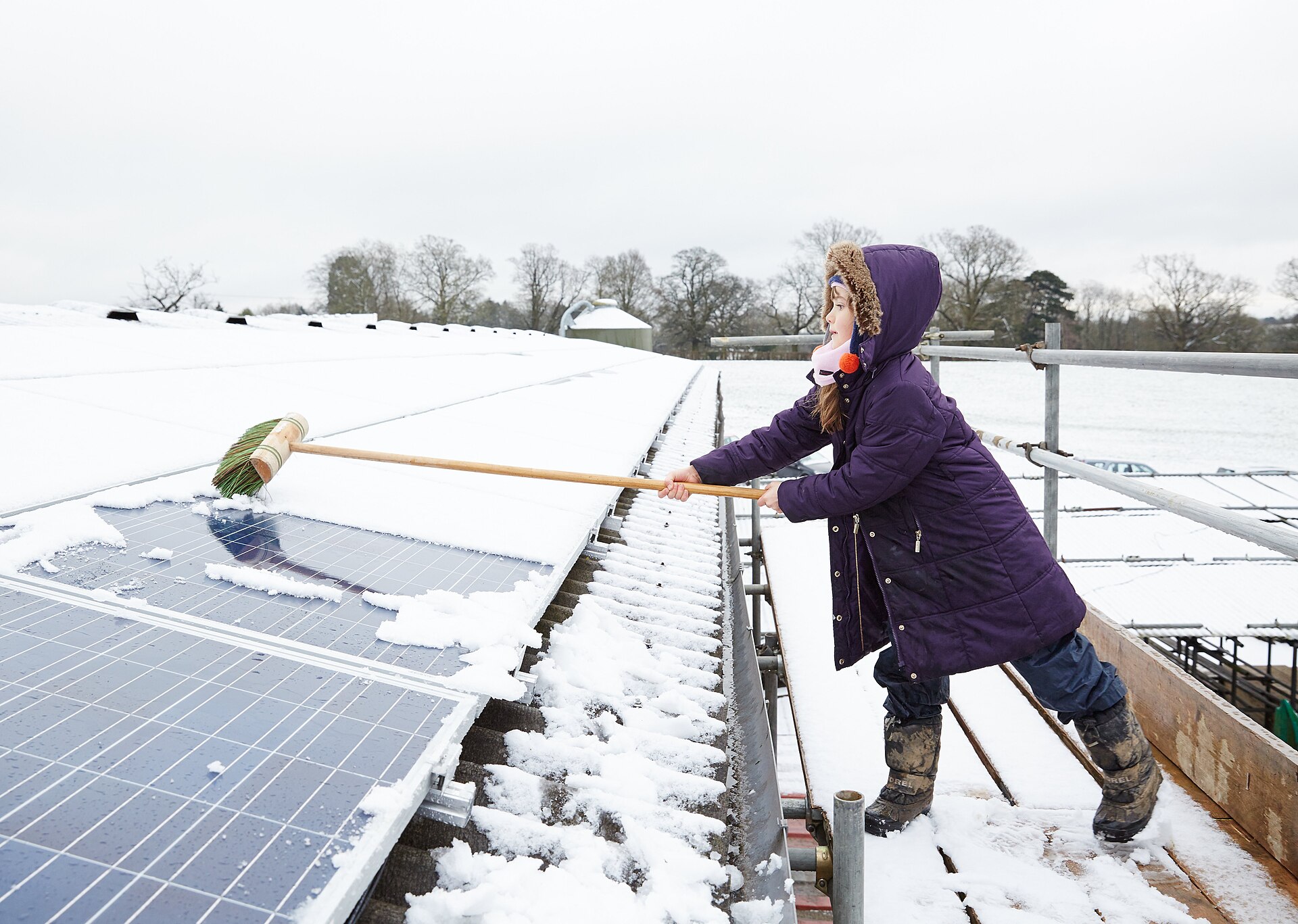
For most Australian homes, solar panel cleaning is optional, not urgent. Rain does most of the job on a tilted roof, and the output you win back from a clean is often worth less than the clean costs.
There are real cases where dirty panels cost you money, and there are ways of cleaning that will damage your system or void your warranty. This guide covers both, plus the part most articles skip: the biggest risk in this job is not the dirt, it is the roof.
Does solar panel cleaning actually do anything?
Sometimes. It depends on what is on the glass and how your panels sit.
Panels tilted at a decent angle shed water, so rain rinses loose dust off them. That is why most Australian rooftop systems stay reasonably clean without help. SolarQuotes notes that panels tilted under about 10 degrees, or in dry areas with little rain, are the ones that really need manual cleaning.
What rain does not remove is anything that sticks. Bird droppings, tree sap, hardened pollen and salt film all stay put. SolarQuotes puts the worst case for dust, pollen and droppings together at up to 30% output loss. That is the top of the range, not the normal case.
One number gets misused a lot here. CSIRO reported that Solar Analytics measured rooftop solar output in Sydney and Canberra falling by 15% to 45% on heavy smoke haze days over the 2019 to 2020 bushfire season. That loss was smoke in the air blocking sunlight, not soot on the glass, so cleaning would not have fixed it. Do not let a cleaning company quote bushfire smoke figures at you as a reason to book a wash.
Do the sum before you book
The honest test is arithmetic. Divide the price of a clean by what your solar saves you in a year. That is the share of a year’s output the clean has to add back to break even.
If a clean costs $220 and your system saves you $1,400 a year, it has to lift output by about 16% for a full year to pay for itself. Almost no residential clean does that. If your panels are genuinely filthy and you recover 10% or more, it stacks up. If they are lightly dusty, it does not.
Check your inverter app before you spend anything. If output is tracking normally for the season, the dirt is cosmetic.
Clean now, or leave it?
| What you are looking at | Why it matters | Verdict |
|---|---|---|
| Light dust film after a dry spell, panels tilted 15 degrees or more | Rain will shift most of it | Leave it |
| Bird droppings sitting on cells | Does not wash off, blocks cells and creates hot spots | Clean it |
| Panels flat or near flat, under about 10 degrees | Water pools and dries in place instead of running off | Clean on a schedule |
| Within a couple of kilometres of surf | Salt film builds up and does not rinse away | Clean more often |
| Farm, unsealed road, quarry or dry inland site | Heavy, repeat dust loading | Clean more often |
| Ash after a bushfire | Reduces output, but is easy to rinse once panels are cool | Rinse when safe |
| Spring pollen | Usually rinses off, rarely worth a paid clean | Watch your output first |
| Overhanging trees, leaves and sap | Sap bonds to glass, leaves trap moisture | Clean, and trim the tree |
| Moss or lichen along the bottom edge | Means water is sitting on the frame, not draining | Book a professional |
| Anything you cannot reach standing on the ground | Roof falls are the real risk here | Do not attempt it |
The real risk is the roof, not the dirt
This is the part worth taking seriously. Falls are the largest single cause of injury hospitalisation in Australia, and AIHW data shows falls accounted for 43% of injury admissions in 2023 to 2024. On the work side, Safe Work Australia recorded 24 worker deaths from falls from a height in 2024, about 13% of all worker fatalities. Trained tradespeople with harnesses still die doing this.
Solar Victoria’s maintenance guide puts it in three words: “Keep your feet on the ground.” Its DIY advice is limited to single-storey homes, using a long-handled soft-bristled broom for anything you can reach, plus a gentle hose.
There is an electrical risk too. The DC side of a solar system is live whenever the sun is on the panels. Energy Safe Victoria warns that DC isolator casings can deteriorate and let moisture in, which is a fire risk. That is a licensed electrician’s job, not a cleaning job.
The rule is simple. Clean what you can reach from the ground, and hand the rest to someone insured to be up there.
How to clean solar panels from the ground
- Check your output first. Note what your system has been producing. Without a before figure you will never know if the clean did anything.
- Pick the right time. Early morning, late afternoon or an overcast day. JinkoSolar’s module manual says not to clean around the middle of the day, and that the temperature difference between the water and the module must not exceed 10 degrees Celsius. Cold water on hot glass can crack it.
- Use the right tools. A long-handled soft-bristled brush or a water-fed pole, and a garden hose. Nothing metal, no blades, no scourers.
- Rinse, then brush, then rinse. Soaking first lifts grit so you are not dragging it across the glass. For dried ash or droppings, let water sit on it for about 10 minutes before you touch it, as SolarQuotes suggests.
- Keep the water gentle. SolarQuotes describes the right pressure well: the water should fall on the panels like rain, not hit them as a single hard stream.
- Use plain water. In almost every case that is enough.
- Check output again a few days later. If nothing changed, you have your answer for next time.
If you find yourself thinking about a ladder, a harness, or stepping onto tiles, stop. Book someone.
What not to do
- No pressure washer. Solar Victoria says plainly, never use a pressure hose, it could damage the panels. High pressure at the wrong angle drives water past the seal between the glass and the frame.
- No dish soap, detergent or solvent. Residue leaves a film that attracts more dirt. Jinko’s manual rules out corrosive chemicals like thinners and strong acids.
- Do not clean hot panels. Thermal shock cracks glass. This is the most common way a DIY clean turns into a replacement panel.
- Do not walk or kneel on panels. Solar Victoria states that cleaners should not stand on, or put anything on top of, the panels. Foot pressure causes microcracks you cannot see until output drops.
- No abrasives. Jinko’s manual lists blades, scouring wire and metal tools as things that scratch the module surface.
- Do not touch wiring, connectors or isolators. That is licensed electrical work.
Will cleaning void your warranty?
It can. JinkoSolar’s manual says outright that damages caused by inappropriate cleaning procedures will void the warranty, and other major manufacturers use similar wording. Pressure washing, harsh chemicals and abrasive tools are the usual triggers.
There is a second trap. Solar Victoria warns that your system warranty could be void if servicing is not done by the company that installed the system, and Energy Safe Victoria gives the same advice. Before you hire anyone, check your paperwork and ask whether their work affects your workmanship warranty.
Also read the manual for your actual panels. Most manufacturers publish them as free PDFs and the cleaning section is usually one page. Our guide to the best solar panels in Australia covers the brands you will run into.
Solar panel cleaning cost in Australia
Professional solar panel cleaning is priced per panel, then adjusted for access. Airtasker puts the Australian average at about $12 per panel, with jobs ranging from $240 to $1,200 and a typical 40 panel clean at around $480. Its state level data shows most metro quotes landing between $10 and $15 per panel, with Sydney the widest spread at $3 to $25.
The table below applies that band to common system sizes. Treat it as a sanity check on quotes, not a price list.
| System size | Panels (roughly) | Typical single storey clean | What pushes it up |
|---|---|---|---|
| 3 kW to 5 kW | 8 to 15 | $120 to $300 | Minimum call-out fees mean small jobs rarely go under about $120 |
| 6.6 kW | 15 to 20 | $180 to $400 | Steep pitch, brittle tile roof, tight side access |
| 10 kW | 22 to 30 | $260 to $600 | Panels split across two or three roof faces |
| 13 kW and up | 30 to 40 | $360 to $900 | Two storey, heavy soiling, bird nesting to clear first |
Two storey homes and steep or fragile roofs sit at the top of these ranges or above them, because the job needs harnesses and roof anchors. Regional addresses often carry a travel premium too.
Before you book, ask three things: what pressure and what water they use, whether they will stand on the panels, and whether they carry current public liability insurance. Ask for the certificate of currency. Anyone who hesitates is not the right person to have on your roof.
Solar panel cleaning frequency: how often is enough?
There is no single correct interval, so be sceptical of anyone selling you one. Cleaning companies commonly recommend every six to twelve months. They also sell cleaning.
Government guidance is different in kind. Solar Victoria says a full service should be carried out by a licensed electrician at least once every two years, and treats cleaning as something you do as needed in between. Energy Safe Victoria makes the same point, that servicing is not simply cleaning your panels, it is electrical testing and inspection.
A practical schedule for most Australian homes:
- Passively: let your monitoring app do the watching.
- Twice a year: a look from the ground, after summer and after a dry spell. Clean only if you can see something stuck.
- Every one to two years: a service by a licensed electrician accredited with Solar Accreditation Australia.
- More often only if: you are coastal, on a farm or unsealed road, under trees, or your panels sit near flat.
When the answer is not cleaning
If output has dropped and a clean did not fix it, the problem is somewhere else. A failed optimiser, a string that has dropped out, a tripped isolator, an inverter fault or shading from a grown tree all look the same on a bill.
Two things are usually better value than repeat cleans. The first is bird proofing. If pigeons are nesting under your array, cleaning is a treadmill, and mesh is a one-off. Why Solar puts a typical residential mesh install at $350 to $700, with large or steep arrays running higher. The second is a real service, where an electrician checks connections, isolators and mounting hardware and finds problems a cleaner never will.
For the wider picture on system life and what a service should include, see our guide to solar panel maintenance and longevity. If you need someone to do the work, our installer directory lists solar companies by region, how to choose a solar installer covers what to check first, and how to compare solar quotes applies to service quotes too.
FAQ
Does rain clean solar panels?
Mostly, yes, if your panels are tilted at 10 degrees or more. Rain rinses off loose dust. It does not remove bird droppings, sap, salt film or hardened pollen, and it does very little for panels mounted flat.
How often should I clean my solar panels?
Only when you can see something rain has not shifted, or when your monitoring shows an unexplained drop. For most suburban homes with tilted panels that is not a fixed schedule at all. Coastal, rural, dusty and low-tilt sites need it more often.
Can I use dish soap or a window cleaning spray?
Do not. Detergent leaves a residue that attracts dirt, and manufacturers rule out chemical cleaners. Plain water and a soft brush handle nearly everything. JinkoSolar’s manual states that damage from inappropriate cleaning voids the warranty.
Can I pressure wash my solar panels?
No. Solar Victoria says never to use a pressure hose on panels. High pressure can force water past the seal between the glass and the aluminium frame, and that damage is not covered by any warranty.
Is professional solar panel cleaning worth the money?
It depends on how dirty the panels really are. At roughly $180 to $400 for a typical home system, the clean has to recover a meaningful share of a year’s generation to break even. If your panels are visibly caked, or you are coastal, rural or near flat, it usually pays. Otherwise it usually does not.
Should I get on the roof myself?
No. Falls from height kill trained workers in Australia every year, and Solar Victoria’s own advice is to keep your feet on the ground. Clean what you can reach with a long-handled brush, and pay an insured operator for the rest.
Related reading
About this research
This is independent desk research by Solar Cobber. We did not visit sites, request quotes or accept payment for inclusion. Figures are dated and sourced, and pricing and policy details change, so confirm current terms directly before you sign anything.