
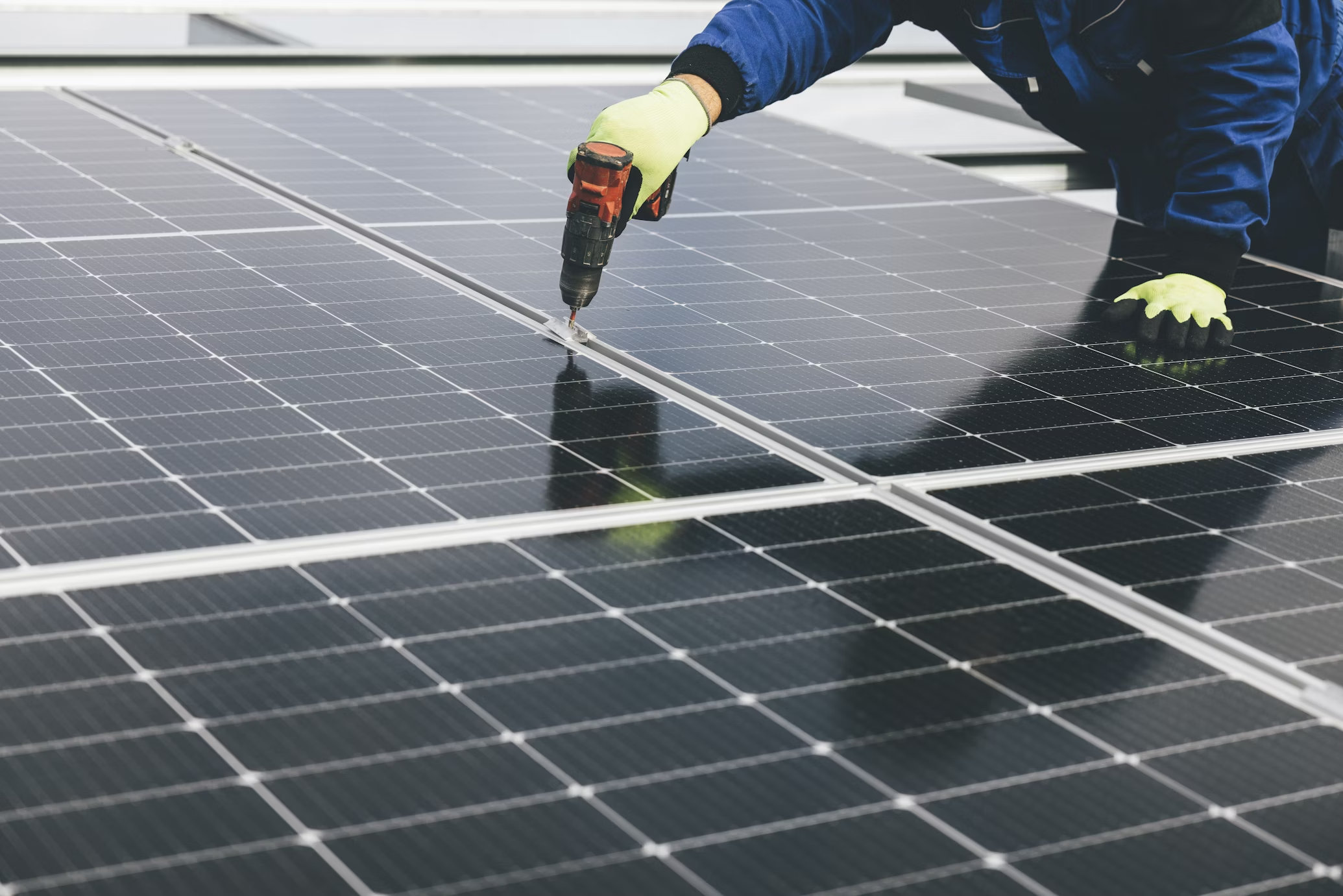
Yes, solar panels work on cloudy days and they work through winter. They just make less power, and how much less depends on how thick the cloud is and where in Australia you live.
This guide puts numbers on it. We cover output under different sky conditions, winter versus summer daily output for every capital city, why cool weather actually helps panels, and why shading from a tree or a chimney is usually a bigger problem than any weather.
How much power do panels make under cloud?
Solar panels run on light, not heat. Cloud does not switch them off, it dims them. Even on a grey day some sunlight still reaches the roof, scattered rather than direct, and the panels turn that into power.
The catch is that thick low cloud blocks a lot of it. Solar Calculator puts the loss from low-level cloud at 70 to 90 per cent, which is the sort of cloud that sits over Melbourne and Hobart for days at a time in winter.
The table below is a rough guide to what you can expect. Treat it as a rule of thumb, not a measurement.
| Sky condition | Roughly what you get vs a clear day | What that feels like |
|---|---|---|
| Clear sky | 100% (the reference point) | Full output through the middle of the day |
| Thin or high cloud | Around 60% to 80% | Bill barely moves, you may not notice |
| Broken cloud, sun in and out | Around 40% to 70% | Output spikes up and down all day |
| Thick low cloud or heavy overcast | Around 10% to 30% | Clearly a bad solar day |
| Steady rain or storm cloud | Around 5% to 20% | Close to nothing for a few hours |
Only the heavy overcast band comes from a published Australian figure (Solar Calculator, above). The other bands are indicative, not measured averages, so use them to set expectations rather than to size a system.
The broken cloud row surprises people. Sun ducking in and out is not a smooth 50 per cent day. Your monitoring app will show a jagged line with brief bursts near full output and deep dips in between.
For context, the Bureau of Meteorology notes that daily global solar exposure across Australia typically falls between 1 and 35 megajoules per square metre. The top of that range is a clear summer day. The bottom is a wet winter day where your system will do very little.
Rain is not all bad news
Rain costs you output for a few hours, but it also cleans the glass. Dust, salt, pollen and bird mess build up on panels over time, and Solar Calculator lists dirt and grime as around a 5 per cent loss in its breakdown of real-world system losses.
A decent downpour washes most of that off for free. In most Australian suburbs, rain does enough of the job that you never need to pay someone to clean panels on a schedule. Our guide on solar panel maintenance and longevity goes into when a clean is actually worth paying for.
Winter versus summer output by capital city
This is where the real seasonal drop shows up, and it varies a lot across the country. The figures below are per kilowatt of installed solar, worked out from Solar Calculator’s seasonal modelling for 8 kW systems in each city.
| City | Summer (kWh per kW per day) | Winter (kWh per kW per day) | Winter as a share of summer | Winter day, 6.6 kW system |
|---|---|---|---|---|
| Darwin | 4.2 | 4.6 | 109% | About 30 kWh |
| Brisbane | 5.4 | 3.2 | 59% | About 21 kWh |
| Sydney | 5.4 | 2.6 | 47% | About 17 kWh |
| Perth | 6.9 | 2.6 | 38% | About 17 kWh |
| Canberra | 6.2 | 2.4 | 39% | About 16 kWh |
| Adelaide | 6.5 | 2.2 | 34% | About 15 kWh |
| Melbourne | 5.9 | 1.9 | 32% | About 13 kWh |
| Hobart | 5.7 | 1.6 | 27% | About 10 kWh |
A few things stand out.
Darwin is the odd one out. It makes slightly more in winter than in summer, because the wet season brings heavy cloud and storms through December and January while the dry season is clear. Winter is Darwin’s good half of the year.
Perth and Adelaide have the biggest summer peaks but fall a long way in winter. Sydney and Brisbane hold up better than their southern neighbours. Hobart has the steepest drop of any capital, at roughly a quarter of its summer output. Even so, a Hobart winter day still runs a fridge, a hot water boost and a load of washing off a 6.6 kW system.
SolarQuotes reached similar conclusions using June output as a share of the annual daily average, putting Brisbane at 75 per cent, Sydney at 71 per cent, Perth at 66 per cent, Melbourne and Adelaide at 57 per cent, and Hobart at 49 per cent. Two different methods, the same ranking.
Why winter output drops
It is not the cold. Winter output falls for three reasons that have nothing to do with temperature:
- Shorter days. Fewer daylight hours means fewer generating hours.
- A lower sun. The sun sits lower in the northern sky, so light hits a rooftop array at a worse angle and travels through more atmosphere.
- More cloud. Southern Australia gets its cloudiest months in winter.
Cool weather actually makes panels more efficient
Here is the part most people get backwards. Heat hurts solar panels. Cold does not.
Every panel has a temperature coefficient, which is how much output it loses for each degree its cell temperature rises above 25C. PSC Energy gives the Trina Vertex S+ as an example at -0.29 per cent per degree, which works out to roughly 3 per cent lost at 35C and 4 to 5 per cent at 40C. In very hot Australian conditions the company puts the loss at up to about 5 per cent of rated output. Solar Calculator allows a wider 8 to 20 per cent for temperature derating across a full system.
Panel temperature is not air temperature. A dark panel in full sun on a 40C day sits well above 40C, so the loss on a scorching afternoon is real.
Flip that around and a clear, cold July day is excellent solar weather. The sun is weaker and the day is shorter, so you make less total energy, but the panels convert what they do get more efficiently than they would in February. That is why a crisp winter morning can produce a surprisingly strong midday peak.
The practical takeaway: do not panic if your summer output looks lower than your system’s rating suggests. Heat derating is normal, and it is one reason installers do not size systems off the rating alone. Our system sizing guide explains how to work from your bill instead.
Shading is the bigger problem
Weather is out of your control and it averages out over a year. Shading does not average out. A tree or a chimney that shades one corner of the roof at 3pm does it every single day, and it can cost far more than a run of cloudy weather.
The reason is how panels are wired. In a standard system, panels are connected in a series string, like old Christmas lights. Current has to flow through every panel in the string. When one panel is heavily shaded, it acts as a bottleneck, and Clean Energy Reviews notes that significant shade on one panel can adversely affect the performance of the entire string because of the reduced current flowing through it.
So a shadow covering one panel out of ten does not cost you 10 per cent. Depending on the shade, it can cost a lot more.
What bypass diodes do
Panels are not defenceless. Every modern panel has bypass diodes built into the junction box on the back.
Clean Energy Reviews explains the layout: a standard 60 cell panel is split into three groups of 20 cells, each with its own bypass diode. Newer split cell panels use six groups, with two groups sharing a diode. When a group of cells is shaded and starts dragging voltage down, its diode switches on at around 0.7 volts and lets the current flow around that group instead of through it.
That means a shaded panel loses a third or so of its own output rather than blocking the string entirely. Diodes also stop shaded cells overheating, which is the hot spot problem that can damage panels over time.
What diodes do not do is recover the lost energy. They limit the damage, they do not fix shading.
When optimisers or microinverters are worth it
If shading is regular and predictable, panel level electronics are the fix.
| Setup | How it works | Best for |
|---|---|---|
| Plain string inverter | One inverter for the whole string, panels share a current path | Clean roof, little to no shade, lowest cost |
| Shade tolerant string inverter | Scans the array voltage regularly to find the best operating point | Light or occasional shade |
| DC optimisers | A small unit on each panel conditions its output before the string inverter | A few panels shaded, most of the roof clear |
| Microinverters | Each panel gets its own inverter and works independently | Heavy or complex shading, multiple roof faces |
Clean Energy Reviews recommends power optimisers where a few panels see regular shading, and microinverters where you want every panel to work independently of the rest of the array. Shade aware string inverters sit in between, scanning the array voltage every few minutes to find a better operating point.
The honest trade-off is cost. Optimisers and microinverters add to the price, and on a clear roof they add very little energy. Some installers fit them by default. Ask what the shading actually costs you first.
Before you sign anything
- Ask for a shade analysis. A good installer will model your roof and show you the losses, not just wave at the trees. Any quote that ignores an obvious shade source is a quote to question.
- Know your shade times. Morning shade matters less than 2pm to 4pm shade, because that afternoon window overlaps with peak household use.
- Compare like with like. If one quote includes microinverters and another does not, the price gap is not a discount. Our guide on comparing solar quotes covers what else to line up.
Does this change whether solar is worth it?
Not in most of Australia. The annual figure is what pays the bill, and winter is a dip rather than a shutdown.
What seasonality does change is how you use the system. In winter you generate less and use more, so more of your solar goes straight into the house and less gets exported. That suits a battery, because a battery earns its keep by cutting what you buy from the grid rather than what you export. If you are weighing that up, see how much a solar battery costs in Australia.
To get quotes that account for your roof and your city, browse installers in our directory.
FAQ
Do solar panels work in the rain?
Yes, but output drops sharply while it is actually raining, roughly to single digit or low double digit percentages of a clear day. The upside is that rain washes dust off the glass, and dirt costs around 5 per cent of output when it builds up.
Do solar panels work in winter in Australia?
Yes, in every capital city. Output ranges from about 27 per cent of summer in Hobart to slightly above summer in Darwin. Sydney and Brisbane sit at roughly half to 60 per cent of their summer output.
Are solar panels better in cold weather?
Panels are more efficient in cool weather, because they lose output as cell temperature rises above 25C. But winter still produces less total energy, because the days are shorter and the sun is lower. Efficiency and total output are two different things.
How much does one shaded panel cost me?
More than its own share. In a string system, one heavily shaded panel restricts current through the whole string. Bypass diodes limit the damage to part of the panel, but they do not recover the lost energy.
Do I need microinverters?
Only if you have real shading, a complex roof, or panels on several different roof faces. On a clear north facing roof a standard string inverter does the same job for less money. Ask the installer to show you the modelled loss before paying for panel level electronics.
Should I tilt panels differently for winter?
For most Australian homes, no. Fixed rooftop systems are usually mounted at the roof pitch, and rebuilding a frame to chase winter sun rarely pays back. Adding a bit more capacity is normally cheaper than adding tilt frames.
Related reading
- what size solar system you need
- string inverters, microinverters and MPPT
- how to clean solar panels safely
About this research
This is independent desk research by Solar Cobber. We did not visit sites, request quotes or accept payment for inclusion. Figures are dated and sourced, and pricing and policy details change, so confirm current terms directly before you sign anything.