
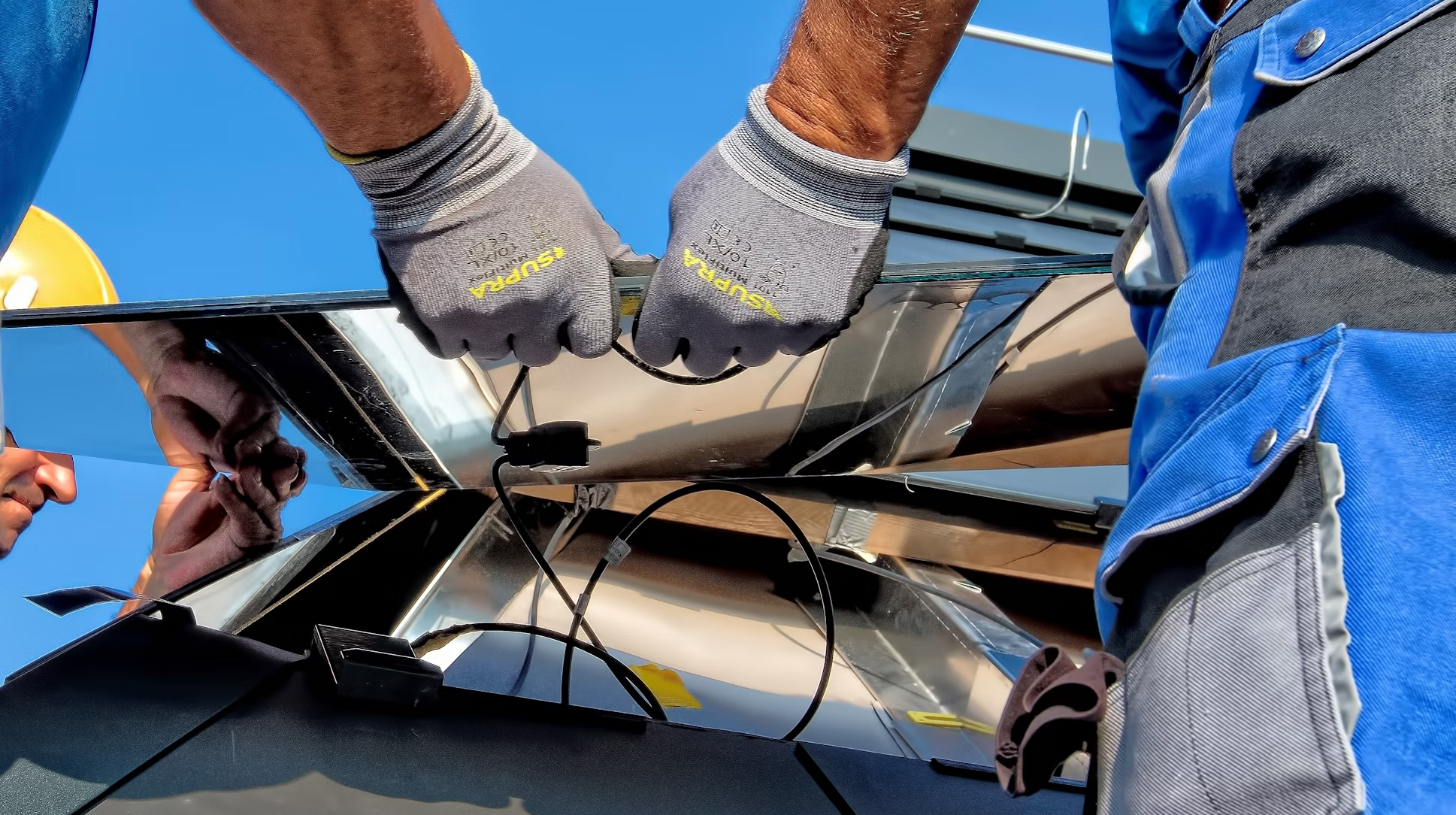
Most old Australian solar panels are not recycled. Industry and government estimates put the recycling rate at around 17 per cent, and much of the rest goes to landfill, sits in a shed, or gets stacked in a warehouse while someone works out what to do with it.
About 95 per cent of a standard panel can be recycled, according to Solar Citizens. The problem is that doing it properly costs more than dumping it, and Australia has only a handful of operators with the right equipment. This guide covers why, what the rules are where you live, and what to actually do with your old panels.
How much solar waste is coming
The first big wave of Australian rooftop solar is now reaching the end of its life. The Smart Energy Council estimates more than 20 million panels were installed across the country by the end of 2025. Panels also come off roofs early, after hail damage or during an upgrade to a bigger system. Roughly 4 million panels are removed from Australian rooftops each year, according to figures cited by RenewEconomy and Solar Citizens.
The projections vary depending on who is counting, which is worth knowing before you trust any single number:
| Estimate | Figure | Source |
|---|---|---|
| Annual panel waste, 2025 | 59,340 tonnes | Cited by Solar Citizens and RenewEconomy |
| Annual panel waste, 2030 | 91,165 tonnes | Same source |
| Cumulative waste by 2035 | About 1.157 million tonnes | UNSW research, via the Australian Energy Council, March 2025 |
| NSW panel waste by 2035 | Up to 63,000 tonnes a year | NSW EPA, October 2025 |
The direction is clear even if the exact numbers are not. Volumes roughly double this decade, and most of it starts as household waste before large solar farms decommission in bulk.
What a solar panel is actually made of
A standard rooftop panel weighs about 20 kilograms. Strip it down and it is mostly glass and aluminium, with small amounts of much more valuable material buried in the middle.
| Material | Share by weight | Recoverable? | Notes |
|---|---|---|---|
| Glass | 70 to 77 per cent | Yes, easily | Most of the weight. Laminated and low value, so hard to sell |
| Aluminium frame | About 10 per cent | Yes, easily | The part almost every operator recovers. Real scrap value |
| Polymers (backsheet, encapsulant) | About 9 per cent | Poorly | The glue that makes everything else hard to separate |
| Silicon cells | 3 to 5 per cent | Yes, with the right kit | Recoverable at high purity, but needs specialist processing |
| Copper (wiring, busbars) | About 1 per cent | Yes | Good value per kilo and widely recycled |
| Silver (cell contacts) | About 0.05 per cent | Yes, chemically | Tiny by weight, roughly 14 per cent of the panel’s material value |
| Junction box and cabling | Small | Yes | Usually removed by hand first |
The Australian Energy Council put the recoverable material in a single 20 kilogram panel at more than $22, as at March 2025. The Smart Energy Council estimates the recoverable value across Australia’s whole fleet at around $6.5 billion by 2040. Those figures sound encouraging until you look at what it costs to get the material out.
Why recycling panels is hard and barely pays
A panel is built to survive 25 years of hail, heat and rain. The layers are bonded with a polymer that will not come apart with heat or water, which is what you want on your roof and not what you want at a recycling plant.
The economics are the bigger issue. According to pv magazine Australia in May 2026, recycling a panel costs around $28 while landfilling it costs around $4.50. The Australian Energy Council put the gap differently in March 2025, at roughly $10 to $20 per panel to recycle versus about $2 to landfill. Either way, the cheap option is much cheaper.
Three things make it worse:
- Glass is 70 per cent of the weight and almost none of the value. There is no strong domestic market for laminated solar glass, so a recycler pays to move heavy material nobody wants.
- Transport eats the margin. Moving a pallet of panels a few hundred kilometres from a regional town can cost more than the material is worth.
- Feedstock is unreliable. Plants need steady supply. When panels get dumped or stockpiled, plants sit idle. Two Australian operators have already stopped: Reclaim PV in 2023 and Sircel in late 2025, according to RenewEconomy.
This is why “up to 90 per cent recovery” and a 17 per cent recycling rate can both be true. The technology exists. The volume flowing into it does not.
Who recycles solar panels in Australia now
The sector is small and changes fast. These names come up most often in government and industry material. Check any of them is still trading and still taking panels before you drive anywhere.
- PV Industries opened a commercial scale plant at Bankstown Airport in Sydney in October 2025, backed by $3.3 million from the NSW EPA’s Circular Solar grant program. The EPA says it can process up to 6,000 tonnes a year, handles a panel in under 90 seconds, and recovers up to 90 per cent of a panel by weight.
- Elecsome is based in Keysborough, Victoria, with drop-off at Keysborough and Kilmany and sites in NSW, Queensland and WA. It collects panels and turns recovered glass into a concrete product.
- Lotus Recycling in Thomastown and the Kilmany Resource Recovery Centre are listed by Solar Victoria as options for Victorian panels.
- Council collection points. Several NSW councils run panel or e-waste drop-off, including Blue Mountains, Newcastle, Mosman and Port Macquarie-Hastings. Queensland has six recovery sites from a state pilot started in September 2024, at Capalaba, North Lakes, the Gold Coast, Rockhampton, Toowoomba and Townsville.
One honest note. Solar Victoria’s published list still included Sircel at Dandenong South, but reporting says Sircel stopped operating in late 2025. Ring first. Lists in this sector go stale quickly.
Solar panel disposal rules by state
This is the part most people get wrong. There is no single national rule, and only one state has an outright ban that clearly covers panels.
| State or territory | Banned from landfill? | What this means for you |
|---|---|---|
| Victoria | Yes, since July 2019 (all e-waste, panels included) | Panels must go to a lawful e-waste point or an EPA authorised recycler. Solar Victoria says non-compliance is an indictable offence |
| South Australia | Yes in effect. Statewide e-waste landfill ban since 1 September 2013 | Take panels to an e-waste drop-off or a recycler. Solarec and PV Industries are named as SA providers |
| ACT | E-waste disposal restrictions apply | Use ACT recycling drop-off facilities, not general waste |
| Western Australia | Not yet. The e-waste ban started 1 July 2024 but phase one excludes solar panels | Landfill is still legal. Recycling is voluntary, later phases flagged |
| New South Wales | No ban | Voluntary. NSW funded recycling capacity instead, via Circular Solar grants |
| Queensland | No ban, and panels are not regulated waste, which makes them cheaper to move | Voluntary, but the state runs recovery sites with the Smart Energy Council |
| Tasmania | No panel-specific rule we could verify | Check with your council or the Tasmanian EPA first |
| Northern Territory | No panel-specific rule we could verify | Check with your council first |
Two caveats. No ban does not mean your council will take panels in a skip or kerbside bin, because most will not. And the rules are moving, so confirm with your state EPA or council before you book anything.
What a homeowner should actually do
If you are replacing or upgrading a system, the practical steps look like this.
- Make removal part of the quote. Ask every installer in writing what happens to the old panels, where they go, and whether disposal is included or charged separately. This is the single most useful thing you can do. Our guide on how to compare solar quotes covers getting this in writing.
- In Victoria, make the installer name the destination. The obligation to manage end-of-life panels responsibly sits with retailers and installers there, not just with you.
- Do not put them in the bin. Panels do not belong in kerbside recycling anywhere in Australia.
- If you are handling them yourself, ring ahead. Ask your council whether it runs an e-waste day or a transfer station that takes panels, and what the fee is. Some are free, some charge per item.
- Budget for it. Expect $10 to $30 per panel if you are paying directly, based on the industry cost figures above. For a 20 panel system that is roughly $200 to $600, and it varies a lot by how far the panels have to travel.
- Do not leave panels stacked in the yard. A panel in daylight is still live and still your problem.
If you are still choosing an installer, our guide on how to choose a solar installer covers the questions worth asking, and you can browse companies by area in our directory.
The second-hand and reuse market
Roughly one third of removed panels could be reused rather than recycled, according to figures cited by RenewEconomy. Many come off roofs still producing 80 per cent or more of their rated output, because someone wanted a bigger system rather than because the panels failed. Used panels turn up on marketplace sites and end up on sheds, pumps, caravans and off-grid cabins. Reuse beats recycling on any environmental measure, because nothing has to be melted down. Be realistic about the limits:
- No rebate. Small-scale technology certificates require new equipment on the approved product list, so used panels earn nothing. Our STC rebate explainer covers how that works.
- No warranty. A product warranty follows the original purchase and installation. Once a panel is removed and resold, you are on your own.
- Mixing old and new is messy. Adding second-hand panels to an existing string can drag down the whole string’s output.
- It still needs a licensed electrician. Grid-connected work needs a qualified person no matter where the panel came from.
Used panels make sense for a shed or an off-grid setup where cost matters more than efficiency. They rarely make sense on a main house roof, where labour costs the same as for new panels but the output and warranty are worse. If you are pricing a main system, our guide to solar panel brands is a better starting point.
Where the policy is heading
Australia has been circling a mandatory product stewardship scheme for years. The idea is simple: make the companies that import and sell panels pay for collecting and recycling them, rather than leaving the cost with the last owner. About 60 industry, council, union and environment groups have publicly called for exactly that, and Commonwealth, state and territory ministers have agreed to progress work towards a national scheme, with NSW leading the policy work.
Progress has been slow. On 16 January 2026 the government announced $24.7 million over three years for a National Solar Panel Recycling Pilot, to set up about 100 collection sites and collect up to 250,000 panels from households and small businesses. A tender for a scheme administrator went out on 31 March 2026. The pilot was then suspended in mid-May 2026 after a complaint about the procurement process, and as at the end of July 2026 no administrator had been appointed and no restart date announced. Environment Minister Murray Watt has said the government remains committed to it.
That delays the point where recycling gets cheap or free for householders, and it starves the few Australian recyclers of the steady feedstock they need. Two have already closed.
Frequently asked questions
Can I put solar panels in my kerbside recycling bin?
No. Panels are far too large, they are laminated glass, and in Victoria, South Australia and the ACT they are covered by e-waste disposal restrictions. Take them to a designated e-waste point, a recycler, or hand them to your installer.
Is it illegal to send solar panels to landfill in Australia?
It depends where you live. Victoria bans all e-waste including panels from landfill and describes non-compliance as an indictable offence. South Australia’s statewide e-waste landfill ban has been in place since 2013. In NSW, Queensland, Western Australia, Tasmania and the NT there is no panel-specific ban as at August 2026, though WA has flagged adding panels in a later phase of its e-waste ban.
How much does it cost to recycle solar panels?
Industry cost estimates sit between about $10 and $28 per panel depending on the source and how far the panels have to travel. As a homeowner you should budget $10 to $30 a panel unless your council or installer covers it. Some councils accept panels free at e-waste events.
Can I sell my old solar panels?
Yes, if they still work. Panels removed during an upgrade are often in fine condition and there is an active second-hand market. Just be honest with the buyer about age and condition, and expect very little money. The buyer gets no warranty and no federal rebate on used panels.
Do panels have to be replaced after 25 years?
No. A 25-year performance warranty is a warranty, not an expiry date. Most panels keep producing past it at reduced output, typically losing around half a per cent a year. Our guide on solar panel maintenance and longevity covers what actually causes panels to fail early.
Related reading
About this research
This is independent desk research by Solar Cobber. We did not visit sites, request quotes or accept payment for inclusion. Figures are dated and sourced, and pricing and policy details change, so confirm current terms directly before you sign anything.