
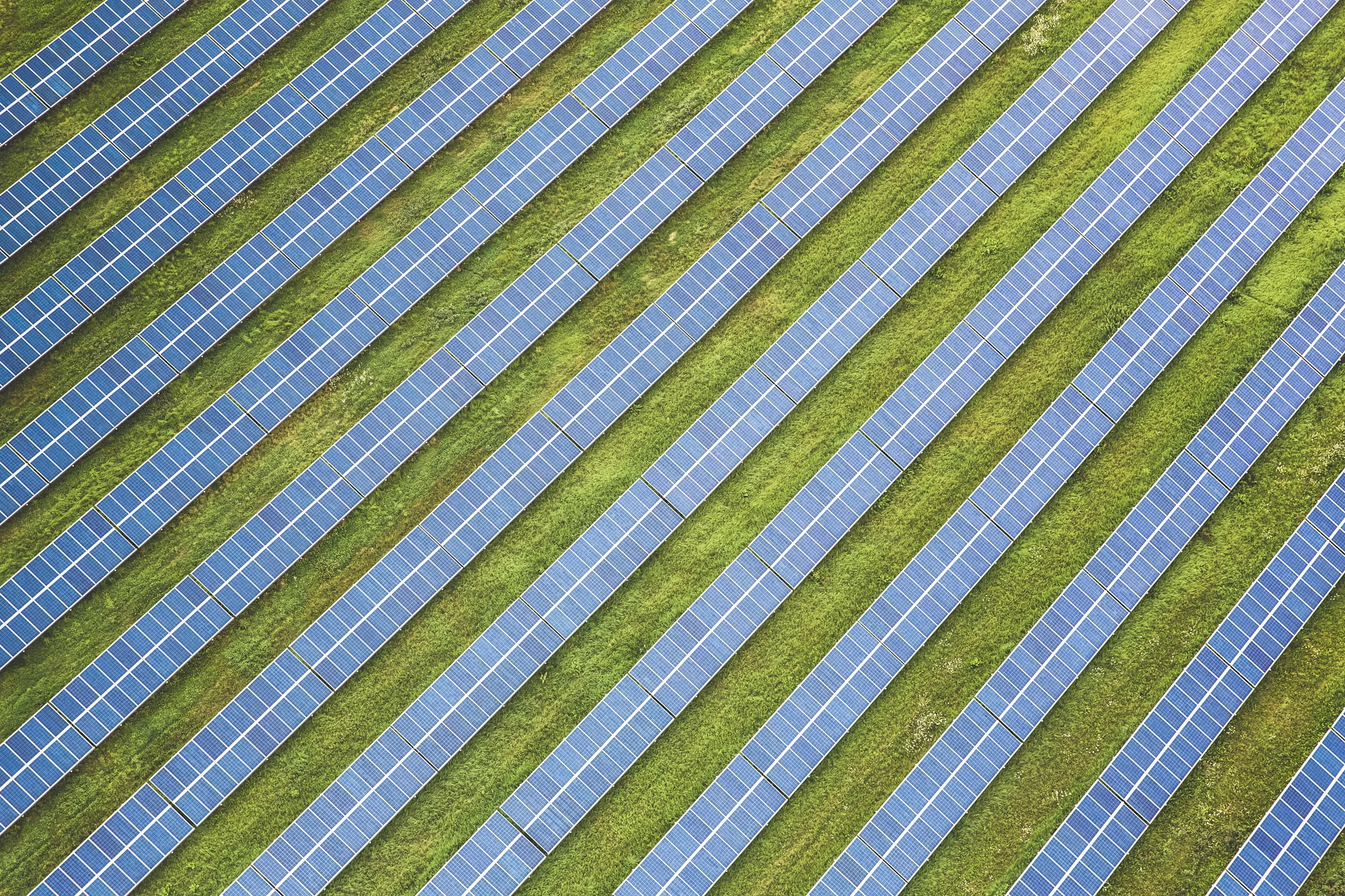
The right size solar system is the one that matches your daily electricity use in kilowatt hours, adjusted for how much sun your city gets and how much power you use during daylight. Most Australian homes land between 6.6 kW and 10 kW, but the number of bedrooms you have tells you almost nothing useful.
This guide gives you the method. You need one thing to start: a recent electricity bill. For the panel count maths, see how many solar panels do I need. If you have already been quoted the most common size in the country, see is a 6.6kW solar system right for you.
The method in five steps
- Find your average daily usage in kWh on your bill.
- Work out roughly how much of that you use while the sun is up.
- Convert kWh into kW of solar using the output figure for your city.
- Check that answer against your roof, your inverter and your network’s export limit.
- Add headroom if a battery or an EV is coming.
Step 1: Find your daily usage on your bill
Australian bills almost always print an average daily usage figure, usually on page one or two near a bar chart comparing you to similar homes. Look for “average daily usage” followed by a number in kWh. If your bill only shows a period total, divide it yourself: 1,638 kWh across 91 days is 18 kWh per day.
One bill is a season, not a year. A summer bill in Darwin and a winter bill in Hobart both overstate the annual average, so average four quarterly bills if you can. Better still, download half-hourly smart meter data from your retailer’s portal, which feeds straight into step 2. You can also compare your usage against plans on Energy Made Easy, the Australian Energy Regulator’s free comparison service.
Step 2: Work out how much you use in daylight
Most sizing guides skip this step, and it decides whether a bigger system pays. Solar generates roughly between 7am and 5pm. Power you use in that window replaces electricity you would have bought at your full usage rate. Power you export earns a feed-in tariff, which is now much smaller, so a kWh used at home is worth several times a kWh exported.
To find your daylight share:
- With half-hourly data: add up consumption between 7am and 5pm and divide by the total.
- On a time of use tariff: the bill splits usage into peak, off-peak and shoulder, which gives a rough guide. See peak and off-peak electricity times.
- With a flat-rate bill only: as a working assumption, use a third if the house is empty on weekdays, and closer to half if someone is home during the day or you run a pool pump or ducted air conditioning at midday.
That number is an assumption to test, and you can change it. Putting the dishwasher, washing machine, pool pump and hot water on a midday timer lifts your daylight share without spending a cent.
Step 3: Convert kWh into kW of solar
A kilowatt of panels does not produce a kilowatt hour. It produces a certain number of kWh per day depending on your location, roof direction and the season. Two Australian sources are useful, and they differ because they measure different things.
The Clean Energy Regulator puts every postcode in one of four zones and gives each a rating in MWh per kW per year. That rating decides how many small-scale technology certificates your system earns, so it is deliberately conservative. The four ratings are 1.622, 1.536, 1.382 and 1.185, published in the Clean Energy Regulator’s postcode zone ratings document and used in its STC entitlement calculation.
The Clean Energy Council publishes indicative average daily production per kW for major cities in its consumer guide to installing solar PV. Those figures are closer to what a well-sited north-facing system should actually deliver.
| City | CER zone | Zone rating (MWh per kW per year) | Deemed output (kWh per kW per day) | CEC guide output (kWh per kW per day) |
|---|---|---|---|---|
| Alice Springs | 1 | 1.622 | 4.4 | 5.0 |
| Darwin | 2 | 1.536 | 4.2 | 4.4 |
| Perth | 3 | 1.382 | 3.8 | 4.4 |
| Canberra | 3 | 1.382 | 3.8 | 4.3 |
| Brisbane | 3 | 1.382 | 3.8 | 4.2 |
| Adelaide | 3 | 1.382 | 3.8 | 4.2 |
| Sydney | 3 | 1.382 | 3.8 | 3.9 |
| Melbourne | 4 | 1.185 | 3.2 | 3.6 |
| Hobart | 4 | 1.185 | 3.2 | 3.5 |
Deemed output is the zone rating converted to a daily figure, and the Clean Energy Council numbers are indicative guides, not a promise. Two things stand out. Darwin sits in zone 2, not zone 1, because the wet season brings months of heavy cloud. And Perth, Brisbane, Adelaide, Sydney and Canberra share a rebate zone even though a Perth roof out-produces a Sydney roof over a year.
Now the conversion. Solar size in kW equals your target daily kWh divided by your city’s output per kW.
| Daily usage (kWh) | Perth or Darwin (kW) | Brisbane, Adelaide, Canberra (kW) | Sydney (kW) | Melbourne (kW) | Hobart (kW) |
|---|---|---|---|---|---|
| 8 | 1.8 | 1.9 | 2.1 | 2.2 | 2.3 |
| 12 | 2.7 | 2.9 | 3.1 | 3.3 | 3.4 |
| 16 | 3.6 | 3.8 | 4.1 | 4.4 | 4.6 |
| 20 | 4.5 | 4.8 | 5.1 | 5.6 | 5.7 |
| 25 | 5.7 | 6.0 | 6.4 | 6.9 | 7.1 |
| 30 | 6.8 | 7.1 | 7.7 | 8.3 | 8.6 |
| 40 | 9.1 | 9.5 | 10.3 | 11.1 | 11.4 |
That is the size that generates about as much energy as your home uses in a day. It is a reference point, not the answer.
Why sizing to self-consumption beats sizing to your bill
The old advice was to size solar to wipe out your bill. That worked when feed-in tariffs were generous.
Victoria shows what changed. The Essential Services Commission no longer sets a minimum feed-in tariff. The 2024-25 minimums applied until 30 June 2025, and since 1 July 2025 retailers set their own rate, which only has to be above zero. Rates elsewhere fell for the same reason: so much rooftop solar now exports at midday that daytime power is worth very little. Our guide to feed-in tariffs covers the state by state picture.
So read the sizing table like this:
- The kW that matches your daytime usage is your value floor. Every kWh up to there is worth your full usage rate.
- Everything above it earns the feed-in rate, which may be a few cents or close to nothing.
- Panels get cheaper per kW as the system grows, because scaffolding, the inverter, the electrician and the paperwork cost about the same for 5 kW as for 10 kW.
That is why most households land above the daytime floor and below the whole-bill number. Going from 6.6 kW to 10 kW usually adds a modest amount to the quote for a solid jump in output, so it often pays even at a poor export rate. Going from 10 kW to 20 kW when you use 15 kWh a day does not.
Step 4: Round to a real system size
Installers sell systems built from whole panels. Round up to the nearest real size.
| Calculated size (kW) | System to ask about (kW) | Panels at 440W | Roof space (sq m) |
|---|---|---|---|
| Under 3 | 3.3 | 8 | About 16 |
| 3 to 4.5 | 5.3 | 12 | About 24 |
| 4.5 to 6 | 6.6 | 15 | About 30 |
| 6 to 8 | 7.9 | 18 | About 36 |
| 8 to 10 | 10.1 | 23 | About 46 |
| 10 to 13 | 13.2 | 30 | About 60 |
Roof space assumes a panel of roughly 1.8 m by 1.1 m and about 2 square metres each once you allow for rails and gaps.
Roof space and orientation set the ceiling
Your roof often caps the system before your usage does.
Usable area, not total area. Plumbing, vents, skylights, whirlybirds and the clearances your installer must leave around edges and ridges all eat space. A roof that looks like 30 panels frequently fits 22.
Which way each face points. North-facing panels catch the most sun across the day in Australia. East and west faces produce less over a year but push output into the morning and evening, which can lift self-consumption for a household that is out at midday. South is the weakest option.
Shade. A tree, chimney or neighbouring second storey shading part of the array in winter can cut output well beyond the panels directly covered, depending on how the strings are wired. If shade is a real problem, ask about optimisers or microinverters, covered in our guide to string inverters versus microinverters.
If your roof cannot hold the size your usage calls for, use higher-wattage panels, prioritise the north and west faces, and shift more load into daylight.
Inverter sizing and the 133 per cent rule
Your system has two sizes: panel capacity in kW DC and inverter capacity in kW AC. They are deliberately mismatched. Panels rarely hit their lab rating because of heat, dust, angle and time of day, so installers fit more panel capacity than inverter capacity. That keeps the inverter near its peak for more hours and lifts morning and afternoon output.
There is a limit. Under the Clean Energy Council’s Grid-Connected Solar PV Systems Design Guidelines, panel capacity cannot exceed inverter capacity by more than one third, which is where the 133 per cent figure comes from. Exceed it and the system does not qualify for small-scale technology certificates at all, which is a large chunk of the discount on your quote. Our STC rebate guide explains how those certificates work.
| Inverter (kW) | Max panel capacity at 133 per cent (kW) | Common real system (kW) |
|---|---|---|
| 3 | 3.99 | 3.96 |
| 5 | 6.65 | 6.6 |
| 6 | 7.98 | 7.9 |
| 8 | 10.64 | 10.5 |
| 10 | 13.30 | 13.2 |
This is why 6.6 kW is the most common system in the country. It is the largest array you can legally hang off a 5 kW inverter, and 5 kW is the standard single-phase allowance in much of Australia.
Export limits can cap your system
Even if your roof fits 13 kW and your usage justifies it, your network may not let you export that much. Export limits are set by the network business, not your retailer, and they vary.
- Queensland. Energex and Ergon apply a 5 kW per phase export limit on a basic connection. A dynamic connection, where the inverter talks to the network, can go up to 10 kW per phase.
- South Australia. SA Power Networks offers a fixed export limit of 1.5 kW (or zero export in some areas), or Flexible Exports, where a compatible internet-connected inverter varies between 1.5 kW and 10 kW per phase based on local network capacity.
Elsewhere, ask your installer to confirm the limit in writing and name your network when you do: Ausgrid, Endeavour Energy or Essential Energy in New South Wales, AusNet Services, CitiPower, Powercor, Jemena or United Energy in Victoria, Western Power or Horizon Power in Western Australia, and TasNetworks in Tasmania.
An export limit is not always a reason to install less, since a system you self-consume heavily still earns its keep. Limits are usually applied per phase, so three phase homes have an advantage. See single phase versus three phase power.
When to go bigger for a battery or an EV
A battery is only as good as the surplus available to charge it. If you export 8 kWh on an average day and buy a 13 kWh battery, it will rarely fill. As a rough rule, aim for daily surplus at least equal to the usable capacity of the battery. The federal Cheaper Home Batteries Program, which started on 1 July 2025, cut the cost of eligible storage, so more households now size the array with the battery in mind. See our solar battery rebate guide.
An electric vehicle adds daily demand that depends on your kilometres and the car’s efficiency. Work out your own figure from the car’s consumption rating and weekly distance, add it to your daily kWh, then go back to step 3. See charging an EV with solar.
Adding panels later costs more per kW, because you pay again for the site visit, scaffolding, paperwork and possibly a new inverter. If either is likely within about five years, build the headroom in now.
A worked example
A Sydney household, four people, single-phase supply, north-east roof.
Step 1. Four quarterly bills average 1,638 kWh per 91 days, which is 18 kWh per day.
Step 2. Smart meter data shows about 5.5 kWh used between 7am and 5pm, roughly 30 per cent. Both adults work away on weekdays.
Step 3. Sydney sits at about 3.9 kWh per kW per day on the Clean Energy Council guide figure. The daytime floor is 5.5 divided by 3.9, or 1.4 kW. The whole-day match is 18 divided by 3.9, or 4.6 kW.
Step 4. They plan to move the dishwasher, washing machine and pool pump to a midday timer, lifting daytime use towards 9 kWh, and they want a battery within two years. So they size above the whole-day match: 6.6 kW of panels with a 5 kW inverter. That is a 132 per cent ratio, inside the rule, and 5 kW of export sits within a standard single-phase connection.
At 3.9 kWh per kW, 6.6 kW generates about 26 kWh on an average day. Roughly 9 kWh goes straight into the house at the full usage rate on their bill, and the rest is exported at whatever feed-in rate their retailer offers. Multiply those two figures by the rates printed on your own bill and you have your own estimate.
Note what never came up: the number of bedrooms.
Frequently asked questions
How many solar panels do I need for a 3 bedroom house?
There is no single answer, because two 3 bedroom houses can use very different amounts of power. A three bedroom home using 16 kWh a day needs roughly 3.6 kW in Perth and 4.6 kW in Hobart to match that usage, which is about 9 to 11 panels at 440W. Most families in that position are quoted 6.6 kW so there is room for a battery or an EV later.
Is it better to oversize or undersize a solar system?
Oversize, within reason. The fixed costs of an installation barely change with system size, so extra kW are cheap, and you cannot add panels later without paying those costs again. The limits are your usable roof, the 133 per cent inverter rule and your network’s export cap.
Can I size a system to zero out my electricity bill?
Rarely, and it is usually not worth chasing. Solar generates in the middle of the day while much of your usage happens at night, and export rates are now low. You can wipe out the usage charges you incur during daylight, but the daily supply charge stays and evening usage needs a battery or grid power.
What size solar system can I fit on a single-phase home?
In much of Australia a single-phase connection allows a 5 kW inverter, which under the 133 per cent rule permits up to 6.65 kW of panels. That is why 6.6 kW systems are everywhere. Some networks allow larger inverters with export limiting, so ask your installer what your network permits.
Should I trust an installer’s sizing recommendation?
Trust it more if they ask for your bill, ideally your interval data, and if the quote shows an estimated annual output for your specific roof. Be wary of anyone who quotes a size before asking about your usage. Three written quotes is the simplest protection, and our guide on how to compare solar quotes sets out what to check. You can also browse installers in our directory.
Related reading
About this research
This is independent desk research by Solar Cobber. We did not visit sites, request quotes or accept payment for inclusion. Figures are dated and sourced, and pricing and policy details change, so confirm current terms directly before you sign anything.