
Solar roof tiles are roof tiles that generate electricity, laid in place of ordinary tiles instead of bolted on top. In Australia in November 2026 the best documented option is the Volt Solar Tile, sold with Bristile Roofing tiles. Volt’s Planum tile is rated at 115 W, so a 6.6 kW roof needs about 58 tiles, and tile systems cost roughly 2 to 3 times a panel system of the same size. Tesla Solar Roof is not a practical option here.
Key facts
- The Volt Planum solar tile is rated at 115 W and measures 1717.3 mm by 443.1 mm, according to the Volt datasheet (checked November 2026).
- A 6.6 kW roof of Volt Planum tiles needs about 43.7 m2 of tile area, against about 30 m2 for a 6.6 kW roof of 440 W panels (Solar Cobber calculation from datasheets).
- The solarcalculator.com.au site says solar tiles are “around 2-3 times more expensive” than a comparable panel system; it does not date that statement.
- Solar Choice’s November 2026 index puts the national average for a 6 kW panel system at A$6,350 installed after the STC discount, which is about A$1,058 per kW.
- Volt reported cumulative revenue of A$2.38 million and tiles installed in six countries in an offer covered by pv magazine Australia on 2 October 2026.
- We could not find a Tesla Solar Roof order page, price or installation in Australia as at November 2026.
Source: Volt Planum datasheet; pv magazine Australia, 2 October 2026; Solar Cobber calculation.
What solar roof tiles are available in Australia?
As at November 2026 we could document three families of building-integrated solar in Australia, and only one is a true roof tile with a recent track record. Product availability changes, and most makers publish no prices, so ask for a written quote before relying on any of this.
| Product | Type | Status in Australia (checked November 2026) | Source |
|---|---|---|---|
| Volt Solar Tile (Planum, Lodge) with Bristile Roofing | Solar tile that sits among ordinary tiles | Sold; Bristile lists it for terracotta Planum (La Escandella) and concrete Prestige, Premiere and Eton profiles | Bristile Roofing product page; Volt datasheet |
| GoodWe Sunshine Series solar tile (distributed by Umax Energy) | Solar tile | Announced for Australia in May 2023; Alspec lists a “Sunshine Series” tile in a September 2024 whitepaper; we could not confirm current stock or price | pv magazine Australia, May 2023; Alspec whitepaper, September 2024 |
| GoodWe Galaxy (335 W, frameless, glued to the roof) | Lightweight panel, not a tile | Launched in Australia in 2023 for roofs that cannot carry racking | SolarQuotes, May 2023 |
| Tractile, Nulok, Monier Solartiles, Bristile (earlier range) | Solar tiles | Reviewed by CHOICE in a page last updated November 2017; we could not confirm any is sold today | CHOICE |
| Tesla Solar Roof | Solar shingle | No Australian order page, price or install found | See below |
Volt Solar Tile
Volt is an Australian-designed tile made by Volt Solar Tile Pty Ltd, a business of the Leeson Group; its datasheet says it is designed in Australia and manufactured in China. The Planum is a 115 W tile with a stated module efficiency of 18.8%, a 10.1 kg weight, a 1500 V system rating and a power temperature coefficient of minus 0.36% per degree Celsius. The datasheet states a 30-year performance warranty and a 15-year product warranty, while Bristile’s own page states 25 years and 10 years. Ask which applies to your roof and get it in writing.
Canstar Blue reports Volt systems in 6, 8, 12 and 15 kW sizes, sold as part of a whole-roof job. RenewEconomy reported in December 2024 that Volt had about 50 partners in Australia, including 17 roofers. The tile is installed by a roofer and a solar installer together, which means two trades and two warranties.
Tesla Solar Roof
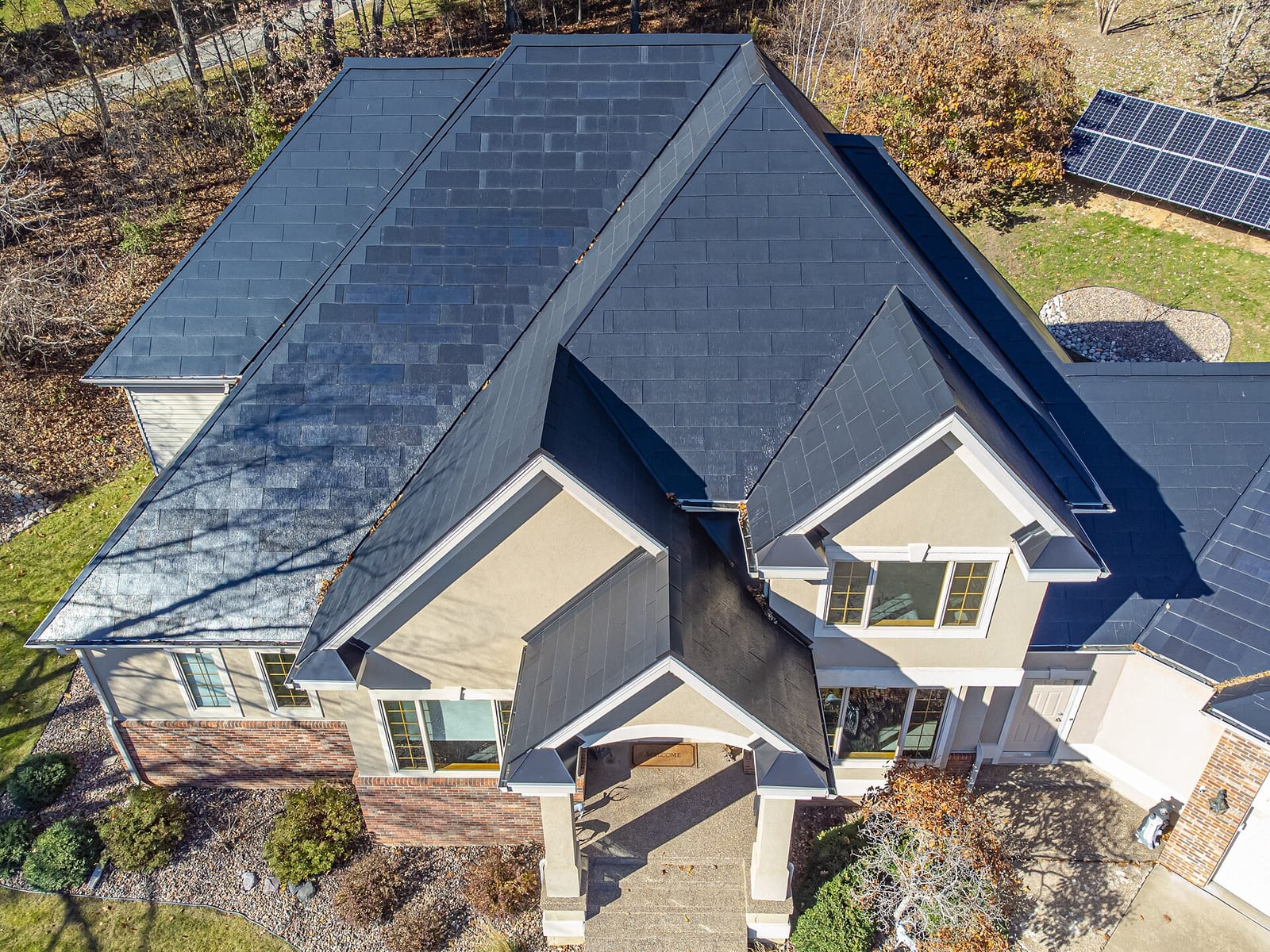
Tesla Solar Roof was open for reservations in Australia in 2017 with a A$1,310 deposit, according to CHOICE, which said at the time it would not be available for some time. We could not find a current Australian price, order page or installation, and Tesla’s Australian site blocked our automated check, so we cannot say it is formally withdrawn. Treat it as unavailable unless an Australian installer shows you a signed quote and a Clean Energy Council listing. Our cover photo shows a Tesla Solar Roof in the United States for illustration only.
How much do solar roof tiles cost in Australia?
A tile system costs roughly 2 to 3 times a panel system of the same size, but no maker publishes a current price list, so treat every dollar figure as an estimate until you hold a quote. The only recent published ratio is solarcalculator.com.au’s “2-3 times”, which carries no date. The older prices we could verify are below.
| Source and date | System | Price quoted | Per kW |
|---|---|---|---|
| One Step Off The Grid, October 2022 (Volt launch) | 5 kW Volt, installed, after STCs | A$12,000 | A$2,400 |
| CHOICE, page updated November 2017 | 4 kW panels, average installed (Solar Choice data) | A$5,697 | A$1,424 |
| CHOICE, November 2017 | 4 kW Tractile Eclipse, with inverter | A$13,000 | A$3,250 |
| CHOICE, November 2017 | 4 kW Bristile solar tiles, with inverter | A$15,675 | A$3,919 |
| CHOICE, November 2017 | 4 kW Monier Solartiles, NSW, with inverter | about A$18,000 | A$4,500 |
| Solar Choice, 1 November 2026 | 6 kW panels, national standard offer | A$6,350 | A$1,058 |
The per-kW column is our division of the quoted price by system size. Nulok’s 2017 figure (A$8,000 to A$14,000 for the solar component only, no inverter or electrical work) is left out because it is not comparable.
The chart uses the one year where CHOICE priced panels and tiles side by side, so the comparison is like for like.
Source: CHOICE, Solar roof tiles (page last updated 1 November 2017); per-kW values are Solar Cobber division. 2017 prices, shown for the size of the gap, not for today's dollars.
View the data as a table
| Installed cost per kW | |
|---|---|
| Monier Solartiles | A$4,500 |
| Bristile tiles | A$3,919 |
| Tractile Eclipse | A$3,250 |
| Conventional panels | A$1,424 |
In the 2017 comparison, the three tile systems cost between 2.3 and 3.2 times the per-kW price of conventional panels.
Solar Cobber calculation: what the premium costs per kWh
A tile roof’s extra cost, spread over what it generates, is the number to compare with your power price. We take Solar Choice’s 6 kW national average of A$6,350 (1 November 2026) as the panel price and apply the 2 to 3 times ratio, which gives A$12,700 to A$19,050 for tiles, an extra A$6,350 to A$12,700.
A 6 kW system in a zone 3 postcode (Sydney, Brisbane, Adelaide, Perth, Canberra) is rated at 1.382 MWh per kW per year by the Clean Energy Regulator, so 6 kW x 1.382 = 8.29 MWh a year, or about 207,000 kWh over 25 years with no allowance for ageing. The extra cost divided by that is 3.1 cents to 6.1 cents per kWh generated.
For comparison, the Default Market Offer in South East Queensland (Energex) is 27.97c per kWh from 1 July 2026 (see electricity cost per kWh). The premium does not erase the savings, but it lengthens the payback. If a roof must be replaced anyway, subtract the plain tiles the solar tiles displace from the extra cost and the figure falls.
How much power do solar roof tiles produce?
Per kW of rated power, a tile produces about the same energy as a panel, but you need about 50% more roof area to reach that kW. The Volt Planum is 115 W over 0.76 m2, or 151 W per m2, while current residential panels deliver 211 to 226 W per m2.
The chart compares nameplate watts per square metre of module, using the length and width on each datasheet.
Source: Manufacturer datasheets (Aiko V4.1 202510, Trina TSM_APAC_EN_2025_D, Jinko, REC 2024-08, Volt Planum, GoodWe via SolarQuotes May 2023); Solar Cobber calculation. Solar Cobber calculation: rated watts divided by length x width in square metres.
View the data as a table
| W per m2 | |
|---|---|
| Aiko Neostar 450 W | 226 W |
| Trina Vertex S+ 440 W | 220 W |
| Jinko Tiger Neo 420 W | 215 W |
| REC Alpha Pure-RX 440 W | 211 W |
| GoodWe Galaxy 335 W | 186 W |
| Volt Planum 115 W | 151 W |
The Volt tile has the lowest power density of the six products, and the GoodWe Galaxy, a glued-on panel, sits in between.
The datasheet efficiency of 18.8% looks higher than this implies. Dividing 115 W by the full tile area at 1000 W per m2 gives 15.1%, so the quoted figure appears to be measured on the active cell area and not the whole tile. We could not confirm the basis, so compare W per m2 and not the headline percentage. Our solar panel efficiency guide explains the measure.
How much roof does a tile system need?
A 6.6 kW Volt roof needs about 58 tiles and 43.7 m2, and a 10 kW roof needs about 87 tiles and 66.2 m2.
| System | Tiles or panels | Module area | Roof area for 6.6 kW | Roof area for 10 kW |
|---|---|---|---|---|
| Volt Planum 115 W | 8.7 tiles per kW | 0.76 m2 per tile | 43.7 m2 | 66.2 m2 |
| GoodWe Galaxy 335 W | 3.0 per kW | 1.80 m2 | 35.5 m2 | 53.8 m2 |
| Trina Vertex S+ 440 W | 2.3 per kW | 2.00 m2 | 30.0 m2 | 45.4 m2 |
| Aiko Neostar 450 W | 2.2 per kW | 1.99 m2 | 29.2 m2 | 44.3 m2 |
Areas are module area only, ignoring gaps, edges and the roof sections that cannot be used. A 10 kW tile system may not fit on a small house.
- 6.6 kW
- 10 kW
Source: Manufacturer datasheets; Solar Cobber calculation (system size divided by rated watts per module, times module area).
View the data as a table
| 6.6 kW | 10 kW | |
|---|---|---|
| Volt Planum | 43.7 m2 | 66.2 m2 |
| GoodWe Galaxy | 35.5 m2 | 53.8 m2 |
| Trina S+ | 30.0 m2 | 45.4 m2 |
| Aiko Neostar | 29.2 m2 | 44.3 m2 |
A 6.6 kW roof of Volt Planum tiles needs about 14 m2 more roof than one of Trina Vertex S+ panels.
Hot-weather performance is similar for tiles and panels on paper: the Volt datasheet gives minus 0.36% per degree Celsius for power. Tiles sit close to the roof deck rather than on a raised frame, and we found no independent Australian measurement of how that affects output.
Are solar roof tiles worth it?
For most existing homes, no: panels on the current roof cost less and produce the same energy. Tiles can be worth it when the roof is being replaced anyway, when the look matters, or when the street or planning rules restrict visible panels. Check whether your site is heritage listed and what the council needs before you decide.
Pros
- A single finished surface with no racking, hooks or roof penetrations for brackets.
- No gap under the array for birds to nest in (see our bird proofing guide).
- Suits new builds and re-roofs, when the tile premium is partly offset by tiles you do not buy.
- CHOICE noted in its 2017 review that tiles can suit heritage areas and awkward roof shapes.
Cons
- Cost: roughly 2 to 3 times panels, with no public price list.
- Lower power per square metre, so more roof is needed.
- Two trades, a roofer and an electrician, and potentially two warranty claims if water gets in.
- Fewer installers and a single main supplier, so replacement tiles depend on one company staying in business.
- Repair is harder: a cracked tile needs the matching profile, and a faulty tile sits inside a string.
How are solar roof tiles installed and what rules apply?
A solar tile roof is a re-roof plus a solar installation, so both parts must be done by qualified people. Volt’s datasheet says its tile “must not be installed using clamps”, screws at the top and interlocks at the nose, which is why it needs a roof tile profile it was designed for.
Check these before signing:
- Clean Energy Council approved product listing: STCs are only available for approved products installed by an accredited installer. Ask for the exact tile model number and check it on the Clean Energy Council’s list yourself. Our STC calculator guide shows the discount for your postcode.
- Roof tile compatibility: Volt lists specific Bristile profiles only. A different tile profile, slate or metal roof will not work.
- Warranty: get the performance and product warranty length, who honours roof leaks, and what happens if either company closes.
- Insurance: ask your insurer how a tile system is treated for hail, as set out in our solar panel hail damage insurance guide.
- Removal and reinstalling: panels can be lifted off for a re-roof; tiles cannot, which matters for the next 30 years. See solar panel removal and reinstallation cost.
What to compare against solar roof tiles
Quote a conventional system for the same roof first, then ask each tile supplier for the like-for-like extra cost. Panels from our best solar panels in Australia list, such as the Trina Vertex S+ or Aiko Neostar, are the benchmark. Use our solar panel cost guide for current panel prices by city, and read how to compare solar quotes and how to choose a solar installer before you sign. Browse accredited installers in the Solar Cobber directory.
FAQ
Are there solar roof tiles in Australia?
Yes, as at November 2026 the Volt Solar Tile is sold in Australia with Bristile Roofing tiles. Other brands, such as the GoodWe Sunshine Series, have been announced or listed, but we could not confirm current stock or price for them. Tesla Solar Roof has no Australian price or install that we could find.
Is Tesla Solar Roof available in Australia?
We could not find any evidence that it is. Tesla took reservations in 2017 with a A$1,310 deposit, according to CHOICE, but we found no Australian price list, order page or install as at November 2026. Ask Tesla directly before paying any deposit.
How much do solar roof tiles cost in Australia?
Roughly 2 to 3 times a panel system, which is about A$12,700 to A$19,050 for 6 kW against A$6,350 for panels. That is our calculation from the Solar Choice price of 1 November 2026 and an undated ratio from solarcalculator.com.au, so get a written quote. Volt’s 2022 launch price was about A$2,400 per kW for 5 kW.
Are solar roof tiles as efficient as solar panels?
No. Per square metre of module, the Volt Planum delivers about 151 W against 211 to 226 W for current panels, by our calculation from datasheets. Per kW of rated power, the energy produced is similar, but the tile roof needs more area.
Do solar roof tiles qualify for the STC discount?
They can if the tile is on the Clean Energy Council approved list and an accredited installer fits it. We did not verify the listing for any tile, so check the exact model on the list. The discount is the same per kW as for panels.
How long do solar roof tiles last?
The Volt datasheet states a 30-year performance warranty and a 15-year product warranty, while Bristile states 25 and 10 years. A warranty is a promise from the company, not a measured lifespan, and no independent Australian long-term data has been published that we found.
Can I put solar roof tiles on an existing roof?
Only by replacing the tiles in the area. Volt tiles work with listed Bristile profiles, so a different tile, slate or metal roof needs panels or a full re-roof. For most existing roofs, panels are simpler and cheaper.
What is the difference between solar tiles and solar shingles?
Solar tiles mimic clay or concrete tiles, while solar shingles mimic flat asphalt or composite shingles. Shingles are common in the United States, and tile roofs are far more common in Australia, so the Australian products are tiles.
Sources
- Volt Planum 115 W datasheet, copy hosted by ENF Solar, checked November 2026
- pv magazine Australia, Volt opens retail investment offer, 2 October 2026
- Bristile Roofing, integrated solar roof tiles, checked November 2026
- One Step Off The Grid, Volt launch, 20 October 2022
- CHOICE, Solar roof tiles, last updated 1 November 2017
- solarcalculator.com.au, Solar roof tiles vs solar panels
- Solar Choice, Solar Panel Price Index, 1 November 2026
- Clean Energy Regulator, postcode zone ratings
- pv magazine Australia, GoodWe and Umax Energy BIPV range, 24 May 2023
- SolarQuotes, GoodWe Galaxy panels, May 2023
- Alspec, BIPV whitepaper, September 2024
- Panel datasheets: Aiko Neostar 2P V4.1 (October 2025), Trina Vertex S+ (2025 D), Jinko Tiger Neo, REC Alpha Pure-RX (2024-08)
About this guide
Written by the Solar Cobber editorial team from independent desk research checked in November 2026. Solar Cobber is a free directory that may earn referral or advertising fees from installers; commercial relationships never affect our content. This is general information, not financial advice. Spotted something out of date? Tell us via /contact.
Filed under Solar Products
Back to blog