
Our verdict
Powerwall 3 is the simplest way to get a big-name 13.5 kWh battery and a 10 kW solar inverter in one box, with strong backup power and a polished app. The trade-offs are a premium price, a 5 kW charging cap and single-phase design that suits three-phase homes poorly.
- Best for
- Single-phase homes installing new solar and a battery together
- Look elsewhere if
- Three-phase homes wanting full three-phase backup
- Price guide
- About A$15,000 to A$17,000 installed for 13.5 kWh before the federal battery discount, roughly A$3,400 less after it (2026 market range)
- Warranty
- 10 years, with retained capacity of 70% (unlimited cycles for self-consumption, time-of-use and backup; 37.8 MWh throughput cap for other uses)
Pros
- Built-in 10 kW hybrid solar inverter with 3 MPPTs and up to 20 kW of panels, so no separate inverter to buy
- Strong backup: 10 kW continuous in most states and 185 A locked-rotor start capability for motors
- Unlimited-cycle warranty for normal solar self-consumption, time-of-use and backup use
- Tesla app is widely rated as one of the best battery apps, and the Australian warranty is handled from a Sydney address
Cons
- Battery charging is capped at 5 kW, which limits how fast it refills on short winter days or cheap overnight tariff windows
- Single-phase only: on a three-phase home it backs up one phase and cannot run three-phase appliances in a blackout
- Premium price, plus a required Backup Gateway 2, and Expansion units cost almost as much as a second Powerwall 3
- Cooling fans can reach about 62 dB(A) at 1 m, so placement near bedrooms needs care
Key specifications
| Usable capacity | 13.5 kWh per unit (14 kWh total) |
|---|---|
| Continuous output | 5, 10 or 11.04 kW configured (10 kW typical in Australia, 5 kW in WA) |
| Battery charge rate | 5 kW (8 kW with Expansion units on future firmware) |
| Solar input | Up to 20 kW DC, 3 MPPTs, 60 to 550 V |
| Round-trip efficiency | 89% solar to battery to home; 97.5% solar to home |
| Grid type | Single phase, 230 V |
| Scalability | Up to 4 Powerwall 3 plus up to 3 Expansion units (7 units total) |
| Operating temperature | -20 to 50 °C (power may derate above 40 °C) |
| Ingress rating | IP67 battery and power electronics, IP55 wiring compartment |
| Dimensions and weight | 1105 x 609 x 193 mm, 130 kg |
| CEC approved battery list | Yes (certificates BAT-553 and BAT-659, with Backup Gateway 2) |
From the manufacturer's Australian datasheet. Check the exact model number on your quote.
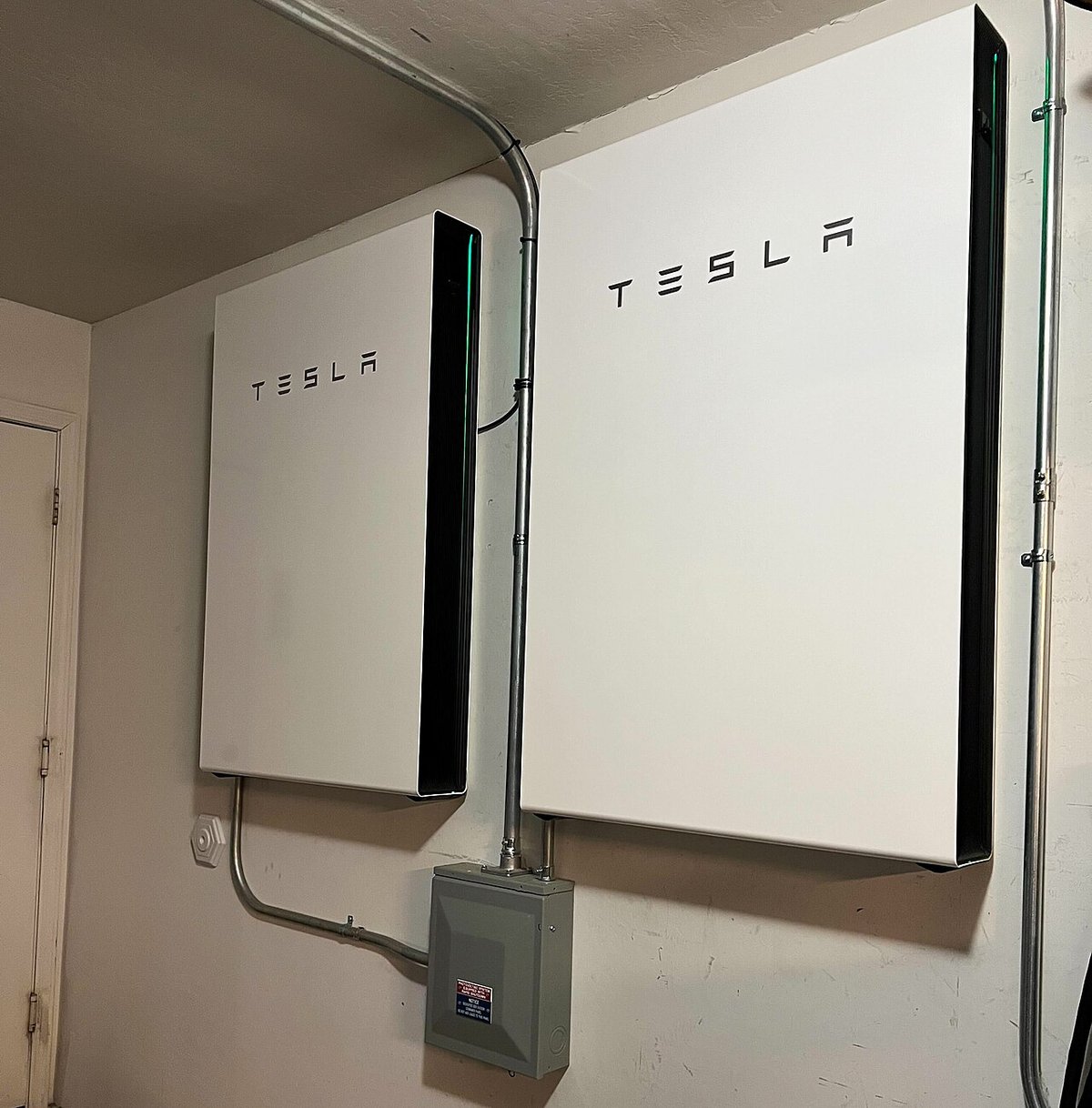
The Tesla Powerwall 3 is a 13.5 kWh lithium iron phosphate (LFP) home battery with a 10 kW hybrid solar inverter built in. It is the battery most Australian homeowners ask for by name, and installers usually quote it to single-phase households putting in new solar and a battery at the same time, or to people who want strong whole-of-home backup from one well-known brand. It replaced the Powerwall 2, which Tesla let lapse from the Clean Energy Council (CEC) approved list in August 2025. This review is based on manufacturer documentation, warranty terms, published pricing and owner/installer feedback; Solar Cobber did not test the product and was not paid by the manufacturer. Below we cover what the spec sheet means for an Australian roof and switchboard, what it costs in October 2026 after the federal battery discount, the warranty fine print and the questions worth putting to your installer.
What it is and how it works
Powerwall 3 is an all-in-one, DC-coupled system. Your solar panels plug straight into the unit’s three maximum power point trackers (MPPTs), the built-in inverter turns that DC power into AC for the house, and surplus solar charges the battery. That means one box on the wall instead of a separate solar inverter plus a battery, which is why it competes most directly with other all-in-one systems such as the Sigenergy SigenStor and with Sungrow or BYD batteries paired with a hybrid inverter.
Two other pieces are part of a typical Australian install. A Backup Gateway 2 is required; it measures grid flows and isolates the home during a blackout. SolarQuotes notes that up to four Powerwall 3 units can share one Gateway, and that the Gateway is roughly half the height of the battery, so it needs its own wall space. For more storage, Tesla sells the Powerwall 3 Expansion, a 13.5 kWh battery with no inverter that mounts behind or beside a Powerwall 3. The AU datasheet allows up to four Powerwall 3 units and up to three Expansion units, a maximum of seven units.
Powerwall 3 can also be AC-coupled to an existing solar system. SolarQuotes reports that this works without extra configuration when the existing inverter is 5 kW or less per Powerwall 3. In early March 2026 Tesla announced that Powerwall 2 and Powerwall 3 would be made compatible on the same site, which matters if you already own a Powerwall 2.
In market terms it sits at the premium end. You pay more per kWh than for budget modular batteries, but you get a built-in inverter, high backup power and Tesla’s software.
Specs that matter in Australia
Power and phase. Tesla’s AU datasheet lists configurations of 5 kW, 10 kW and 11.04 kW continuous output on a single-phase 230 V supply. SolarQuotes reports that Australian units are normally set to 10 kW, and to 5 kW in Western Australia because of local grid rules. Ten kilowatts of continuous backup is enough to run most of a typical home, and the 185 A locked-rotor rating helps start motors in air conditioners and pool pumps during an outage.
Three-phase homes. This is the biggest limitation. Powerwall 3 is a single-phase product. On a three-phase home it can only back up the phase it is connected to, and it cannot run three-phase appliances in a blackout, even if you put one unit on each phase. Penrith Solar Centre also notes that phase-imbalance rules on three-phase sites can cap a single Powerwall 3 at 5 kW. If you have three-phase power and want whole-home backup, read our guide to single vs three phase power for solar before signing. Tesla’s September 2026 AU warranty document lists a three-phase “Powerwall 3P” part number, but we could not confirm it is on sale or being quoted in Australia.
Charging speed. The battery charges at a maximum of 5 kW. The datasheet says 8 kW will be available with Expansion units on a future firmware release, but at the time of writing it is still limited to 5 kW. In winter a 13.5 kWh battery needs nearly three hours of strong surplus solar to fill from empty, and a Powerwall 3 plus one Expansion needs more than five. The 5 kW cap also limits how much you can charge in a short cheap overnight or “solar soak” tariff window.
Solar input. Up to 20 kW of panels across three MPPTs (60 to 550 V). Because the system includes a battery, the usual one-third oversizing rule for STC eligibility can be exceeded, so filling the roof is often sensible.
Heat, sun and noise. The operating range is -20 to 50 °C, with possible power derating above 40 °C. The battery and electronics are IP67 and the wiring compartment IP55, so outdoor installation is allowed. Tesla says direct sun is acceptable, but SolarQuotes recommends shade because heat shortens battery life. Fan noise is under 50 dB(A) typical and up to 62 dB(A) at 1 m, so avoid walls shared with bedrooms.
Efficiency. Tesla quotes 97.5% for solar going straight to the house and 89% for solar stored in the battery and used later. That 89% figure is respectable but not class-leading for a DC-coupled system.
Off-grid and VPPs. Tesla’s installation manual says Powerwall 3 needs a grid connection, so it is not an off-grid product. It can charge from solar during a blackout. To qualify for the federal discount a battery must be VPP-capable, and Powerwall 3 is on the CEC approved list in configurations with Backup Gateway 2. Tesla runs its own VPP retail offers in some states, so check what is available in your area.
Price in Australia
Tesla’s own hardware prices, as reported by SolarQuotes, are A$11,200 for the Powerwall 3 and A$1,950 for the Backup Gateway 2, or A$13,150 before installation. An Expansion unit is about A$10,700. SolarQuotes’ May 2026 price list puts a Powerwall 3 with Gateway at about A$10,000 after the federal discount, before installation. Installer and comparison sites (WhySolar, May 2026) put a typical installed price at A$15,000 to A$17,000 before the discount.
The federal Cheaper Home Batteries Program is applied as a point-of-sale discount through STCs. From May to December 2026 the factor is 6.8 STCs per usable kWh for the first 14 kWh, 60% of that from 14 to 28 kWh, and 15% from 28 to 50 kWh. At STC prices of about A$37 after fees, a single 13.5 kWh Powerwall 3 earns roughly A$3,400 off. An Expansion unit falls almost entirely into the 60% band, so it attracts only about A$2,000. The factor steps down again on 1 January 2027 (to 5.7), so the discount on an identical system will shrink.
Switchboard upgrades, bollards or fire-rated backing for the battery location, long cable runs and regional travel all push the price up. State rebates can stack on top in some states. For a full cost breakdown across brands, read how much a solar battery costs.
Warranty: the fine print
The Australian and New Zealand warranty (effective 3 September 2026) is given by Tesla Motors Netherlands B.V. and covers Powerwall 3 and Powerwall 3 Expansion for 10 years from installation. The key terms:
- Retention: 70% of the 13.5 kWh rated capacity at 10 years.
- Unlimited cycles if the battery is used for solar self-consumption, time-of-use shifting (including grid charging) and backup.
- 37.8 MWh throughput cap, measured at the battery’s AC output, for any other application or combination. SolarQuotes reads this as covering use that exports stored energy to the grid, such as a VPP. Ask your installer how Tesla classifies any VPP you plan to join.
- Internet connection required. If the battery is offline for long periods or not registered, Tesla says it may honour only four years of cover.
- Installer matters. Installation, repair or opening of the case by anyone other than Tesla or a Tesla certified installer can void the warranty. The battery must be bought from Tesla or a Tesla certified installer in Australia or New Zealand.
- Transferable. A later owner with proof of ownership can claim.
- Your responsibility. SolarQuotes points out that the owner’s manual makes the owner responsible for confirming the battery is running (white status light or app). A battery left non-operational for a long time can be damaged.
Claims go first through the installer, then to Tesla. The warranty lists a postal address at 546 Gardners Rd, Alexandria NSW, a 1800 number and an Australian support email. Australian Consumer Law rights apply on top of the written warranty.
What owners and installers report
Praise. Installers rate Tesla highly. In SolarQuotes’ 2025 Installers’ Choice Awards, Tesla tied for first place with Sungrow when installers were asked which battery brand they would put on their own home. SolarQuotes says Powerwall 3 has had few problems so far, describes the app as excellent, and its Powerwall 3 page shows an average of 4.9 out of 5 from 390 ratings.
Complaints. Patterns in owner feedback are different from installer views:
- Owners on Whirlpool’s long-running Powerwall thread and installers such as Penrith Solar Centre point to the 5 kW charge limit, especially with Expansion units, where the extra 13.5 kWh charges through the same 5 kW path.
- The Expansion pack only comes with 0.5 m, 2 m and 4 m cables, which limits where it can go, and Penrith Solar Centre says stacking it behind an existing unit is a two-person job because of the 130 kg weight.
- ProductReview has only six reviews of Powerwall 3, averaging 1.9 out of 5. They complain about limited user control over grid charging and export unless you join a VPP, slow responses from Tesla support, and a few early faulty units that installers had to chase.
- Tesla’s track record includes a September 2025 recall of some Powerwall 2 units in Australia after reports of cells smoking or venting flame. That recall did not cover Powerwall 3, but it is part of the brand’s local history.
The pattern is that the hardware is well regarded, while complaints focus on control limits and support responsiveness rather than battery failures.
Tesla Powerwall 3 vs alternatives
| Tesla Powerwall 3 | Sigenergy SigenStor | Sungrow SBR | BYD Battery-Box Premium HVS/HVM | |
|---|---|---|---|---|
| Usable capacity per unit or stack | 13.5 kWh | 5.2 to 46.8 kWh (5.2 or 7.8 kWh modules) | 9.6 to 25.6 kWh | 5.1 to 12.8 kWh (HVS), 8.3 to 22.1 kWh (HVM) |
| Inverter | Built-in 10 kW hybrid | Built-in hybrid controller, 3 to 30 kW | Separate Sungrow hybrid | Separate compatible hybrid (Fronius, Sungrow, GoodWe and others) |
| Three-phase backup | No (one phase only) | Yes, with three-phase controller | Yes, with three-phase Sungrow hybrid | Yes, with a compatible three-phase inverter |
| Retention and throughput | 70% at 10 years; unlimited cycles for self-use and backup | 70% at 10 years or about 3 MWh per kWh, all uses | 70% at 10 years; unlimited cycles for self-use and backup | 70% at 10 years or about 3 MWh per kWh, all uses |
| Ingress rating | IP67 (wiring IP55) | IP66 | IP55 | IP55 |
| Approx. price after federal discount, before installation (May 2026) | About A$10,000 with Gateway | About A$8,000 for 13 kWh | About A$8,100 for 12.8 kWh, plus inverter | About A$8,100 for HVM 13.8, plus inverter |
Choose Powerwall 3 if you have single-phase power, are installing new solar at the same time and value backup power and app polish over the lowest price per kWh. Choose a SigenStor or a Sungrow system with a three-phase hybrid if you have three-phase power and want the whole house backed up. Choose Sungrow or BYD if you want to add storage in small modules over time, or already have a compatible hybrid inverter.
Questions to ask your installer
- Are you a Tesla certified installer, and will you register the battery with Tesla at commissioning?
- Will my unit be configured at 5 kW, 10 kW or 11.04 kW, and why?
- I have three-phase power: which phase will be backed up, and which circuits will you move onto it?
- How long will the battery take to fill in winter at the 5 kW charge limit, given my panel size and orientation?
- Where will the Powerwall and Backup Gateway 2 go, and does the location need bollards, fire-rated backing or shade?
- Is my existing inverter small enough to AC-couple, or will you connect my panels directly to the Powerwall 3?
- What federal and state discounts have you applied, and how many STCs is that?
- If I join a VPP, will that use count against the 37.8 MWh throughput cap?
FAQ
Does Powerwall 3 work with three-phase power?
Only partly. It connects to one phase and can back up only that phase. It cannot run three-phase appliances during a blackout, even with a unit on each phase.
How long does a Powerwall 3 last in a blackout?
It depends on your loads. At the full 10 kW output, 13.5 kWh lasts about 1 hour 20 minutes. At a typical evening load of 1 to 2 kW, it can last most of a night, and it can recharge from solar the next day.
Can I add a Powerwall 3 to my existing solar system?
Yes. It can be AC-coupled if your existing inverter is 5 kW or less per Powerwall 3. Alternatively, your panels can be rewired into the Powerwall 3’s own inverter.
How much is the federal rebate on a Powerwall 3?
From May to December 2026 a 13.5 kWh Powerwall 3 earns 91.8 STCs, worth roughly A$3,400 at about A$37 each. The amount steps down in January 2027.
Is a Powerwall 3 Expansion cheaper than a second Powerwall 3?
Slightly. SolarQuotes puts it at about A$10,700 against A$11,200, but it adds no inverter power and charges through the main unit’s 5 kW limit.
Does the warranty need an internet connection?
Yes. Tesla says it may honour only four years of the 10-year warranty if the battery is offline for long periods or never registered.
Find an installer
Powerwall 3 has to be installed by a Tesla certified installer for the warranty to apply, so start with installers who can show you recent Powerwall 3 jobs and local reviews. Browse our installer directory to compare local companies, then use our guide on how to compare solar quotes to check that each quote lists the Backup Gateway, configured output power and the discount applied.
Battery buying guides
Often quoted alongside
Sigenergy
SigenStor
Sigenergy
Sigenergy SigenStor
SigenStor packs a hybrid inverter, battery and energy manager into one stack, with genuine three-phase options, IP66 weatherproofing and a very detailed app at a competitive price. The trade-offs are a young company with a 2025 recall on some single-phase controllers, mixed owner experiences with support, and a warranty that caps throughput for all uses.
Best for: Three-phase homes, or anyone wanting an all-in-one battery with room to add EV charging
Sungrow
SBR
Sungrow
Sungrow SBR
The Sungrow SBR is one of the best-value modular batteries in Australia, with easy expansion in 3.2 kWh steps and a warranty that gives normal households unlimited cycles. The trade-off is that you must pair it with a Sungrow hybrid inverter, and Sungrow's app and phone support are weaker than the hardware.
Best for: Homes wanting a modular battery paired with a Sungrow hybrid inverter
BYD
Battery-Box Premium
BYD
BYD Battery-Box Premium
The BYD Battery-Box Premium is a proven, stackable battery that works with more inverter brands than most, which makes it the default partner for Fronius hybrid systems. Its warranty ends at a throughput cap for every type of use, so households that cycle hard every day may run out of cover before 10 years.
Best for: Homes pairing a battery with a Fronius GEN24 Plus or another listed hybrid inverter
Sources
- Tesla Powerwall 3 Datasheet, Australia (PDF)
- Tesla Powerwall Warranty, Australia and New Zealand (PDF)
- Clean Energy Council approved batteries list
- SolarQuotes: Tesla Powerwall 3 review
- SolarQuotes: Solar battery prices and system costs in Australia (May 2026)
- SolarQuotes: Powerwall 3, when it makes sense and when it doesn't
- Penrith Solar Centre: Problems with the Powerwall 3 Expansion pack
- WhySolar: Tesla Powerwall 3 price and review (May 2026)
- ProductReview.com.au: Tesla Powerwall 3 reviews
- Energy Matters: Cheaper Home Batteries Program changes from 1 May 2026
Independent desk research by the Solar Cobber editorial team. We did not test this product and were not paid by the manufacturer. Solar Cobber is a free directory that may earn referral or advertising fees from installers; this never affects our reviews.
Get quotes for Tesla Powerwall 3
Browse rated solar installers in your area, check their Google reviews, and ask at least three for itemised quotes. Our guide to comparing solar quotes explains what to look for.
Find a solar installer