
Plug in solar panels, also called balcony solar, are not legal to connect to a power point anywhere in Australia as at 14 November 2026. Kits can be bought online, but the main inverter standard still requires permanent wiring. Western Australia opened a consultation on 28 October 2026 on legalising kits of up to 800 VA, and federal and state energy ministers are due to report on a national pathway by the end of 2026.
Key facts
- As at November 2026, plug-in solar and battery kits can be sold in Australia but cannot legally be plugged into a power point and used, according to the ABC on 11 September 2026.
- Australian energy ministers agreed on 11 September 2026 to explore pathways for the safe deployment of plug-in solar, and the Commonwealth will report back to them by the end of 2026.
- The Western Australian Government opened a consultation on 28 October 2026, closing at 5 pm AWST on 9 December 2026, on a draft standard for plug-in systems of up to 2 kW of panels and 800 VA of inverter output, with no limit on battery size.
- The Western Australian Government expects to finish its updated standard by February 2027, after which it will prepare the regulatory changes, so the earliest lawful use in Western Australia is after that date.
- Germany had about 1.55 million plug-in solar units registered as in operation on 13 November 2026, according to Marktstammdatenregister data compiled by Ohmnify.
- Solar Cobber calculation: an 800 W kit running at the optimum-tilt rating saves about A$235 to A$463 a year in the eight capital cities at regulated November 2026 rates, so the quoted payback on a A$1,300 kit is 2.8 to 5.5 years before any shading or orientation loss.
Is plug in solar legal in Australia?
No. As at November 2026, you cannot legally use a plug-in solar kit by putting its plug into a normal wall socket in any Australian state or territory. The sale of kits is not the legal problem; connecting them is. The ABC reported on 11 September 2026 that plug-in solar can technically be sold but cannot be plugged in and used.
The reason is the standards. AS/NZS 4777.1:2024 sets the installation rules for grid-connected inverters and, in the words of the Western Australian Government’s consultation paper, requires inverters to be permanently wired. That requirement currently blocks a certification route for any inverter with a plug. A SolarQuotes article from 21 September 2026 reported an engineer’s view that no Standards Australia project was under way to amend the standard for plug-and-socket connection.
There is no single national regulator that rules on this. State electrical safety regulators administer the wiring rules, and the Clean Energy Council approved product lists do not have a plug-in category. Do not buy a kit expecting to use it as it is sold, and do not assume that an installer-fitted version is cheap: a hard-wired 800 W system is just a very small rooftop system.
What has changed in 2026?
Three government steps happened between August and November 2026, and none of them makes plug-in solar legal yet.
| Date | Step | Status |
|---|---|---|
| 12 August 2026 | Victorian parliamentary committee report on renewable energy in apartments tabled; reported by SolarQuotes to recommend investigating standards, safety rules and a registration scheme | Recommendations are not binding on the government |
| 11 September 2026 | Energy ministers agree to explore pathways for safe deployment of plug-in solar and batteries | Commonwealth to report back by end of 2026 |
| 28 October 2026 | Western Australia opens consultation on a Technical Bridging Standard | Submissions close 9 December 2026; updated standard expected by February 2027 |
| Before Christmas 2026 | Energy Minister Chris Bowen promised further announcements, as reported by RenewEconomy on 9 November 2026 | Not yet made as at 14 November 2026 |
Bowen told a Solar Citizens webinar that the issues cannot be rushed. He listed older wiring, circuit loading, residual current protection, fire risk and balcony wind loading as the safety questions, and noted that Germany took six years from announcement to implementation.
The ABC News (Australia) video above covers Western Australia’s plan to lift the ban on balcony solar, the first move of its kind by an Australian state.
What Western Australia is proposing
Western Australia proposes to treat plug-in solar and batteries as ordinary appliances under a new Technical Bridging Standard (TBS), a temporary technical rulebook, modelled on Germany’s standard with additions for batteries. The proposal is a consultation draft, not law, as at November 2026.
The Western Australian Department of Energy and Economic Diversification and the Department of Local Government, Industry Regulation and Safety published the draft on 28 October 2026. The table below sets out the main conditions in the draft TBS, checked November 2026.
| Item | Draft TBS requirement |
|---|---|
| Solar panels | Up to 2 kW (DC) in total |
| Inverter | Up to 800 VA (AC) of apparent power |
| Battery | No upper limit on storage capacity proposed; lithium iron phosphate or sodium-ion chemistries only |
| Number per household | One plug-in generator per household, and none at sites with an existing fixed installation such as rooftop solar |
| Plug | Australian three-pin Type I plug to AS/NZS 3112:2025, with added contact protection so exposed pins cannot be live |
| Grid protection | Inverter must stop output if grid supply is lost (anti-islanding) |
| Notification | Simple notification forms so Western Power and Horizon Power know the numbers of systems |
| Use | Residential only |
Submissions close at 5 pm AWST on 9 December 2026 and the department expects to publish the consultation summary and TBS version 2 by February 2027. The consultation paper also says the department will work on support for renters once the systems are available. If you live in Western Australia, the Western Australian solar rebate guide covers the schemes that apply to fixed systems in the meantime.
How plug in solar works
A plug-in solar kit is one or two solar panels connected to a small inverter that ends in a plug. The inverter converts the panel’s direct current to household alternating current and pushes it into the home’s wiring through a power point, so whatever the house is using at that moment is supplied by the panel first. Power you do not use is exported to the grid, usually unpaid.
Because the inverter must switch off when the grid fails, it has to synchronise with the grid voltage; a correctly built unit has no live pins when unplugged. Typical Australian-quoted kits produce 600 to 800 W and cost up to about A$1,300, according to the ABC on 11 September 2026. For the basics of the technology, see how solar panels work and kW versus kWh explained.
Why is plug in solar legal in Germany?
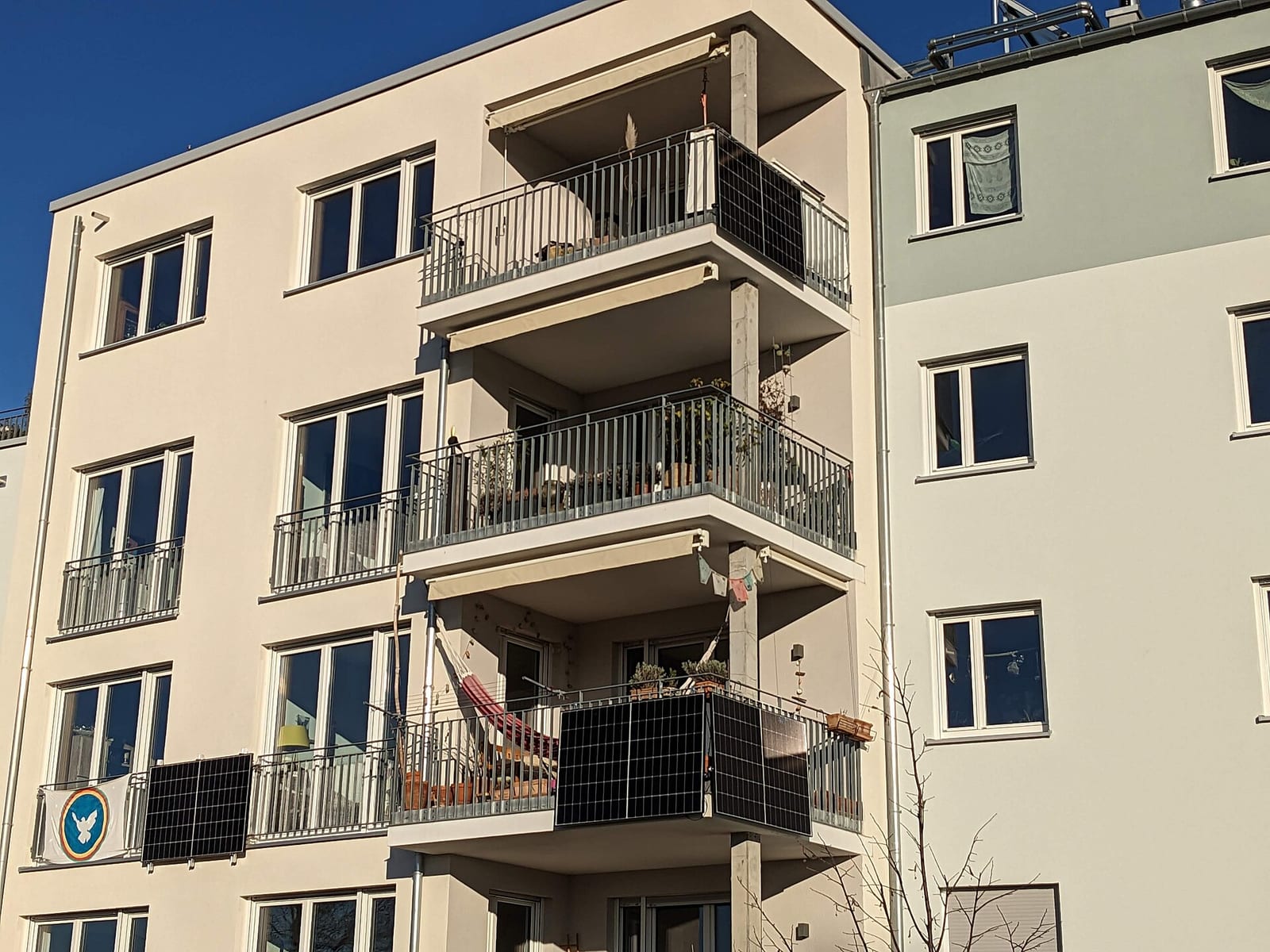
Germany treats kits of up to 800 VA inverter output as simple devices that owners may install themselves. Germany had about 1.55 million plug-in solar units registered as in operation on 13 November 2026 and 1.02 million on 23 June 2025, which shows how quickly the market grew once the rules were simple. Registration is with the national Marktstammdatenregister, and since the Solarpaket I amendment there is no separate notice to the grid operator.
Source: Marktstammdatenregister (Bundesnetzagentur) extracts compiled by Energie Magazin (June 2025), GfK Solar (May 2026), Energie Magazin (September 2026) and Ohmnify (November 2026). Industry associations say the true number is higher because not every device is registered.
View the data as a table
| Registered units | |
|---|---|
| 23 Jun 2025 | 1,022,544 |
| 19 May 2026 | 1,327,455 |
| 3 Sep 2026 | 1,492,531 |
| 13 Nov 2026 | 1,552,477 |
Germany’s registered plug-in solar units grew by about 530,000 in under 17 months, from 1,022,544 to 1,552,477. The table compares the rules in Germany, the United Kingdom and Western Australia as proposed, checked November 2026.
| Item | Germany | United Kingdom | Western Australia (draft) | Rest of Australia |
|---|---|---|---|---|
| Status | Legal | Legal from August 2026 according to the ABC and UK industry guides, not checked on gov.uk | Consultation to 9 December 2026 | Not legal to plug in |
| Inverter limit | 800 VA | About 800 W | 800 VA | Not applicable |
| Panel limit | 2,000 Wp in law; 960 W with a normal household plug under the VDE product standard | Not confirmed | 2 kW DC | Not applicable |
| Registration | Marktstammdatenregister within one month of commissioning | Report to the network operator within 28 days according to UK guides | Notification to the network operator | Not applicable |
| Standard | DIN VDE V 0126-95 (December 2025) | Government interim product specification according to UK guides | Draft Technical Bridging Standard | AS/NZS 4777.1:2024 requires permanent wiring |
The German figures for the product standard come from the DKE FAQ on DIN VDE V 0126-95 published on 17 December 2025. The UK entries are from secondary sources and should be checked at gov.uk before you rely on them.
How much could plug in solar save in Australia?
A kit of about 800 W of panels would save roughly A$235 to A$463 a year at the optimum-tilt rating, if every kilowatt-hour it produced displaced electricity bought at the regulated usage rate. Solar Citizens estimated A$300 to A$400 a year for an average panel, as reported by the ABC on 11 September 2026, which sits inside our range.
Solar Cobber calculation. Annual output equals 0.8 kW multiplied by the Clean Energy Regulator zone rating (MWh per kW per year) multiplied by 1,000. Annual saving equals output multiplied by the November 2026 regulated flat usage rate. We show two cases: all output used in the home, and 70 per cent used (a scenario we chose, not a measured figure, because a kit running at noon may exceed the home’s load). The calculation ignores supply charges, which a kit does not avoid.
| City | CER zone rating (MWh/kW/yr) | Output of 0.8 kW (kWh/yr) | Usage rate (c/kWh) | Saving, all used (A$/yr) | Payback on A$1,300, all used (years) | Payback, 70% used (years) |
|---|---|---|---|---|---|---|
| Adelaide | 1.382 | 1,106 | 41.91 | 463 | 2.8 | 4.0 |
| Canberra | 1.382 | 1,106 | 36.82 | 407 | 3.2 | 4.6 |
| Darwin | 1.536 | 1,229 | 31.68 | 389 | 3.3 | 4.8 |
| Perth | 1.382 | 1,106 | 33.26 | 368 | 3.5 | 5.1 |
| Sydney | 1.382 | 1,106 | 33.14 | 366 | 3.5 | 5.1 |
| Brisbane | 1.382 | 1,106 | 27.97 | 309 | 4.2 | 6.0 |
| Melbourne | 1.185 | 948 | 25.96 | 246 | 5.3 | 7.5 |
| Hobart | 1.185 | 948 | 24.75 | 235 | 5.5 | 7.9 |
Usage rates are the Adelaide SA Power Networks and Sydney Ausgrid Default Market Offer rates, the Energex rate for Brisbane, the CitiPower Victorian Default Offer for Melbourne, the Synergy Home Plan A1 in Perth, Aurora Tariff 32 in Hobart, Jacana in Darwin and the ACT standard contract in Canberra, all from 1 July 2026 including GST. See electricity cost per kWh in Australia for each source. Zone ratings are from the Clean Energy Regulator document “Postcode zone ratings and zones for solar (photovoltaic) systems”, using each city’s central postcode.
- All output used
- 70% of output used
Source: Solar Cobber calculation from Clean Energy Regulator zone ratings and regulated flat usage rates from 1 July 2026. Saving = 0.8 kW x zone rating x 1,000 x usage rate. Zone ratings assume well-oriented rooftop panels.
View the data as a table
| All output used | 70% of output used | |
|---|---|---|
| Adelaide | A$463 | A$324 |
| Canberra | A$407 | A$285 |
| Darwin | A$389 | A$272 |
| Perth | A$368 | A$257 |
| Sydney | A$366 | A$256 |
| Brisbane | A$309 | A$216 |
| Melbourne | A$246 | A$172 |
| Hobart | A$235 | A$164 |
Adelaide’s high regulated usage rate makes it the best city for a kit, and Hobart and Melbourne gain least. Payback is shorter in Adelaide even though Darwin’s panels produce more.
- All output used
- 70% of output used
Source: Solar Cobber calculation; A$1,300 is the upper price quoted by the ABC on 11 September 2026. Payback = A$1,300 divided by annual saving. Excludes shading, orientation loss and any compliance cost.
View the data as a table
| All output used | 70% of output used | |
|---|---|---|
| Adelaide | 2.8 years | 4.0 years |
| Canberra | 3.2 years | 4.6 years |
| Darwin | 3.3 years | 4.8 years |
| Sydney | 3.5 years | 5.1 years |
| Perth | 3.5 years | 5.1 years |
| Brisbane | 4.2 years | 6.0 years |
| Melbourne | 5.3 years | 7.5 years |
| Hobart | 5.5 years | 7.9 years |
Paybacks of about 3 to 8 years in the capitals compare with the 4 to 10 years that experts estimated to the ABC. A balcony facing east or west, shaded by a neighbour, or mounted vertically will produce less than the zone rating assumes, so treat our figures as the best case.
When does a balcony panel produce the most?
Output follows the sun, so a kit produces about three times as much in summer as in winter in southern cities. The Bureau of Meteorology’s averages show Melbourne’s solar exposure at 6.67 kWh per square metre per day in January and 1.78 in June, a ratio of 3.7 to 1.
- Perth
- Brisbane
- Sydney
- Melbourne
Source: Bureau of Meteorology, climate statistics for Australian locations, checked 14 November 2026. Stations: Perth Metro, Brisbane, Sydney Airport, Melbourne Airport. Perth, Brisbane, Sydney and Melbourne are 1990 to 2026 averages.
View the data as a table
| Perth | Brisbane | Sydney | Melbourne | |
|---|---|---|---|---|
| Jan | 8.08 kWh | 6.50 kWh | 6.33 kWh | 6.67 kWh |
| Feb | 7.14 kWh | 5.89 kWh | 5.58 kWh | 5.78 kWh |
| Mar | 5.72 kWh | 5.14 kWh | 4.67 kWh | 4.50 kWh |
| Apr | 4.22 kWh | 4.53 kWh | 3.78 kWh | 3.14 kWh |
| May | 3.17 kWh | 3.69 kWh | 2.89 kWh | 2.17 kWh |
| Jun | 2.64 kWh | 3.31 kWh | 2.42 kWh | 1.78 kWh |
| Jul | 2.83 kWh | 3.64 kWh | 2.75 kWh | 2.00 kWh |
| Aug | 3.64 kWh | 4.44 kWh | 3.61 kWh | 2.81 kWh |
| Sep | 4.78 kWh | 5.39 kWh | 4.69 kWh | 3.78 kWh |
| Oct | 6.31 kWh | 5.94 kWh | 5.58 kWh | 4.94 kWh |
| Nov | 7.44 kWh | 6.53 kWh | 6.06 kWh | 5.86 kWh |
| Dec | 8.31 kWh | 6.67 kWh | 6.53 kWh | 6.61 kWh |
Brisbane has the flattest year and Melbourne the biggest winter dip. A fixed balcony panel facing the wrong way loses more, which is covered in our guide to solar panel angle and orientation.
Is plug in solar safe?
The risks are manageable with the right product rules, but they are real, and they are why governments are moving carefully. The main concerns raised in 2026 are listed below.
| Concern | What it means | How the draft Western Australian standard or experts address it |
|---|---|---|
| Circuit overload | An 800 W inverter adds about 3.5 A to a circuit downstream of the breaker, which the breaker cannot see | SolarQuotes (21 September 2026) quotes an engineer saying 800 W is conservative for Australian 2.5 mm2 circuits; a RACE for 2030 project with RMIT, UNSW and CSIRO plans trials |
| Old wiring and residual current devices | Older wiring and safety switches may behave differently with reverse current | Raised by Bowen and by Allume; trials are planned |
| Live pins | A plug on a live inverter output could shock | Draft TBS requires added contact protection and anti-islanding shutdown |
| Fire risk and batteries | Cheap batteries and unapproved imports | Draft TBS limits chemistries to lithium iron phosphate or sodium-ion |
| Wind loading | Balcony panels can fall | Raised by Bowen; mounting rules are in the draft TBS |
Imported kits that comply with a German or European standard have not been tested against Australian conditions. Using one could also affect your home insurance, so check with your insurer before connecting anything. For a wider view of battery risk, see our guide on whether solar batteries are safe.
Legal alternatives for renters and apartment owners
Until the law changes, the lawful options are shared building solar, a hard-wired system, an off-grid portable power station and midday power plans. Our guide to solar panels for apartments and renters covers grants in detail.
| Option | Who it suits | What it costs or saves | Catch |
|---|---|---|---|
| Shared rooftop solar through the owners corporation | Apartment owners | Victoria pays up to A$2,800 per apartment and A$140,000 per building; NSW pays up to half of a shared system | Needs a strata vote; grants are time-limited (Victoria to 30 June 2027, NSW closes 4 December 2026) |
| Landlord rebate | Tenants in houses | Queensland pays landlords A$2,500 to A$3,500; Victoria up to A$1,400 | The landlord must apply |
| Portable power station charged from a power point | Anyone | Prices vary; it works as an appliance | It does not feed the home’s wiring, so it saves money only if charged in off-peak or free periods |
| Midday free-power plans | Renters | See Solar Sharer Offer | Only helps if you are home at the time |
| Fixed small rooftop system by an accredited installer | Houses with a roof | Normal STC discount applies | Cost of installation and approval |
A portable power station that is only charged from a power point and runs appliances from its own sockets does not feed the home’s wiring, which is why commentators treat it as an ordinary appliance. We could not find a state regulator statement on this, so check with your state electrical safety regulator and your landlord before you buy.
Some renters and apartment owners can also look at community solar or a retailer’s solar-sharing plan. Our list of installers shows accredited installers, and the Western Australia directory may help if you want a hard-wired system now.
When will plug in solar be legal in Australia?
There is no confirmed national date as at November 2026. Western Australia expects its updated standard by February 2027 and then needs to make regulatory changes. Solar Citizens is campaigning for legal use by 1 July 2027, which is their request and not a government commitment, as reported by the ABC and pv magazine. The federal government has not said whether it will fund rebates for plug-in kits.
The next milestones are the energy ministers’ report by the end of 2026, the Western Australian submissions closing on 9 December 2026 and the Western Australian standard in February 2027. We will update this page when any of them changes.
FAQ
Is plug in solar legal in Australia?
No. As at November 2026, plug-in solar kits can be sold in Australia but cannot legally be plugged into a power point and used. Federal and state energy ministers agreed on 11 September 2026 to explore a safe pathway and to report back by the end of 2026.
Is balcony solar legal in Western Australia?
Not yet. The Western Australian Government opened a consultation on 28 October 2026 that closes on 9 December 2026, and it expects to finish its updated standard by February 2027 before preparing regulatory changes. Until those changes are made, plug-in use is still not lawful.
How much does a plug in solar kit cost in Australia?
Typical kits of 600 to 800 W cost up to about A$1,300, according to the ABC on 11 September 2026. Prices for kits that meet an Australian standard do not exist yet, so the final price could differ.
How much power does a plug in solar panel produce?
An 800 W kit produces about 948 kWh a year in Melbourne and Hobart, 1,106 kWh in most other capitals and 1,229 kWh in Darwin at the Clean Energy Regulator zone ratings. A shaded or poorly oriented balcony will produce less.
Can renters use plug in solar?
Not yet in Australia. In Germany, renters can use plug-in kits and landlords can refuse only for a good reason, according to the ABC on 11 September 2026. In Australia, landlords and owners corporations would still need to agree, and Western Australia says it will work on renter access once the systems are available.
Is plug in solar safe?
A properly certified kit is expected to be safe, but Australia has no certified kits yet. The concerns are circuit overload on older wiring, residual current devices, live pins and fire risk, and the draft Western Australian standard addresses them with a plug that cannot expose live pins, anti-islanding shutdown and approved battery chemistries.
What is the limit for plug in solar in Germany and Western Australia?
Germany allows 800 VA of inverter output and up to 2,000 Wp of panels in law, and 960 W of panels with a standard household plug under the VDE product standard. The Western Australian draft proposes up to 2 kW of panels and 800 VA of inverter output.
What can I do instead of plug in solar?
Ask your owners corporation about shared solar, ask your landlord about the state landlord rebate, or use a midday free-power plan. Portable power stations that are only charged from a power point work as appliances, but they do not feed the house.
Sources
- Western Australian Government, Plug in to power up consultation page, updated 4 November 2026
- Western Australian Government, Plug in to power up consultation paper, 28 October 2026
- Western Australian Government, draft Technical Bridging Standard for plug-in solar and battery systems
- ABC News, Balcony solar could soon become legal in Australia, 11 September 2026
- RenewEconomy, Bowen marks 600,000 cheaper home batteries but says balcony solar cannot be rushed, 9 November 2026
- pv magazine Australia, WA to legalise plug-in solar panels and batteries modelled on German standards, 28 October 2026
- SolarQuotes, Plug-in solar: has the safety problem been solved?, September 2026
- Allume Energy, Plug-in solar in Australia: what apartments can do
- DKE, FAQ on DIN VDE V 0126-95, 17 December 2025
- Ohmnify, Balkonkraftwerke in Deutschland (Marktstammdatenregister data), 13 November 2026
- Clean Energy Regulator, Postcode zone ratings and zones for solar systems
- Bureau of Meteorology, climate statistics for Australian locations
- AER, Default Market Offer 2026-27 final determination
About this guide
This guide was written by the Solar Cobber editorial team from independent desk research checked in November 2026. Solar Cobber is a free directory that may earn referral or advertising fees from installers, and commercial relationships never affect our content. This is general information, not financial or electrical advice. Corrections are welcome via /contact.
Filed under Solar Guides
Back to blog