
A solar panel works by turning sunlight directly into direct current (DC) electricity inside silicon cells. An inverter then converts that DC power into the 230 V alternating current (AC) your home uses, your appliances use it first, and any surplus flows out to the grid. At night the panels make nothing and the grid, or a battery, supplies the house.
This guide follows the electricity step by step, from the light hitting a cell to the meter on your wall. It also shows, using Bureau of Meteorology data, how much a rooftop system makes across a day and a year in each Australian capital city. It was checked in November 2026.
Key facts
- A modern residential solar panel is about 1.76 m by 1.13 m and 20.6 to 22.7 kg, and its datasheet efficiency runs from 21.1% (REC Alpha Pure-RX, 440 W) to 24.3% (Aiko Neostar 2P, 485 W), according to the manufacturers’ current datasheets.
- A 6.6 kW rooftop system is 15 panels of 440 W, and the panels produce direct current that a solar inverter converts to 230 V alternating current for the home.
- Rooftop solar produces nothing at night, so a home without a battery buys all of its night-time power from the grid.
- Clean Energy Council guide figures (2011 edition) put average daily output at 3.5 kWh per kW of panels in Hobart, 3.9 in Sydney, 4.2 in Brisbane and 4.4 in Perth and Darwin.
- Bureau of Meteorology data shows Hobart receives about 4.9 times as much solar energy on an average December day as on an average June day, while Darwin receives almost the same in both months.
- A standard grid-connected solar system switches off during a blackout for safety, unless it is paired with a battery and backup gateway designed to run the house.
This five minute animation from TED-Ed explains the physics inside a cell, which the next section covers in plain terms.
How do solar panels turn sunlight into electricity?
Solar cells make electricity through the photovoltaic effect: light knocks electrons loose inside a thin layer of silicon, and the cell’s built-in electric field pushes them in one direction, which is an electric current. There are no moving parts, no fuel and no heat engine involved.
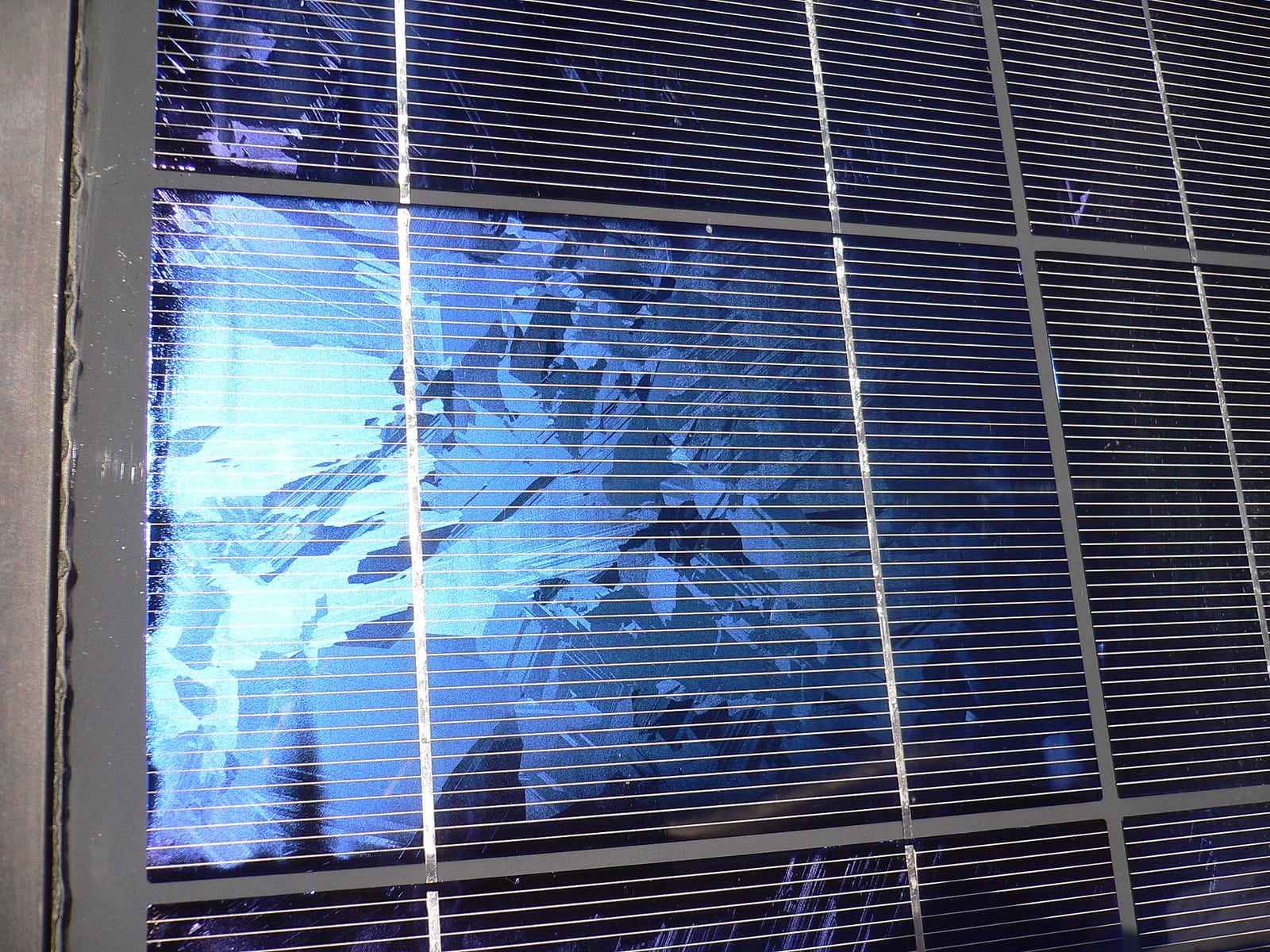
A single silicon cell produces only about half a volt. To get a useful voltage, a panel wires dozens of cells in series behind a sheet of toughened glass, sealed in a polymer layer inside an aluminium frame. The photo below shows a silicon cell as it sits in a panel.
Panel efficiency is the share of the sunlight landing on the panel that becomes electricity. The five residential panel families whose datasheets we read in November 2026 run from 21.1% to 24.3%. The rest of the energy leaves as heat or is reflected. See solar panel efficiency for what the number means when you compare quotes.
What are the parts of a solar system, in order?
A typical Australian rooftop system has six parts in a fixed order: panels, strings, inverter, switchboard, meter and grid. Electricity follows that path every time the sun is up.
| Step | Part | What it does | Kind of power |
|---|---|---|---|
| 1 | Solar cells in a panel | Convert sunlight to electricity | DC |
| 2 | String of panels | Panels wired in series so voltages add up | DC |
| 3 | Solar inverter | Converts DC to 230 V, 50 Hz AC and matches the grid | DC in, AC out |
| 4 | Switchboard | Sends the power to circuits and appliances in your home first | AC |
| 5 | Smart meter | Measures what you import from, and export to, the grid | AC |
| 6 | The grid | Takes any surplus and supplies any shortfall | AC |
A 6.6 kW system is 15 panels of 440 W, since 15 multiplied by 440 W is 6,600 W. Panels are normally wired into one or two strings. A string inverter takes each string as a whole, while microinverters and optimisers handle each panel on its own, which matters if part of your roof is shaded. Our guide to string inverters, microinverters and MPPT covers the trade-offs.
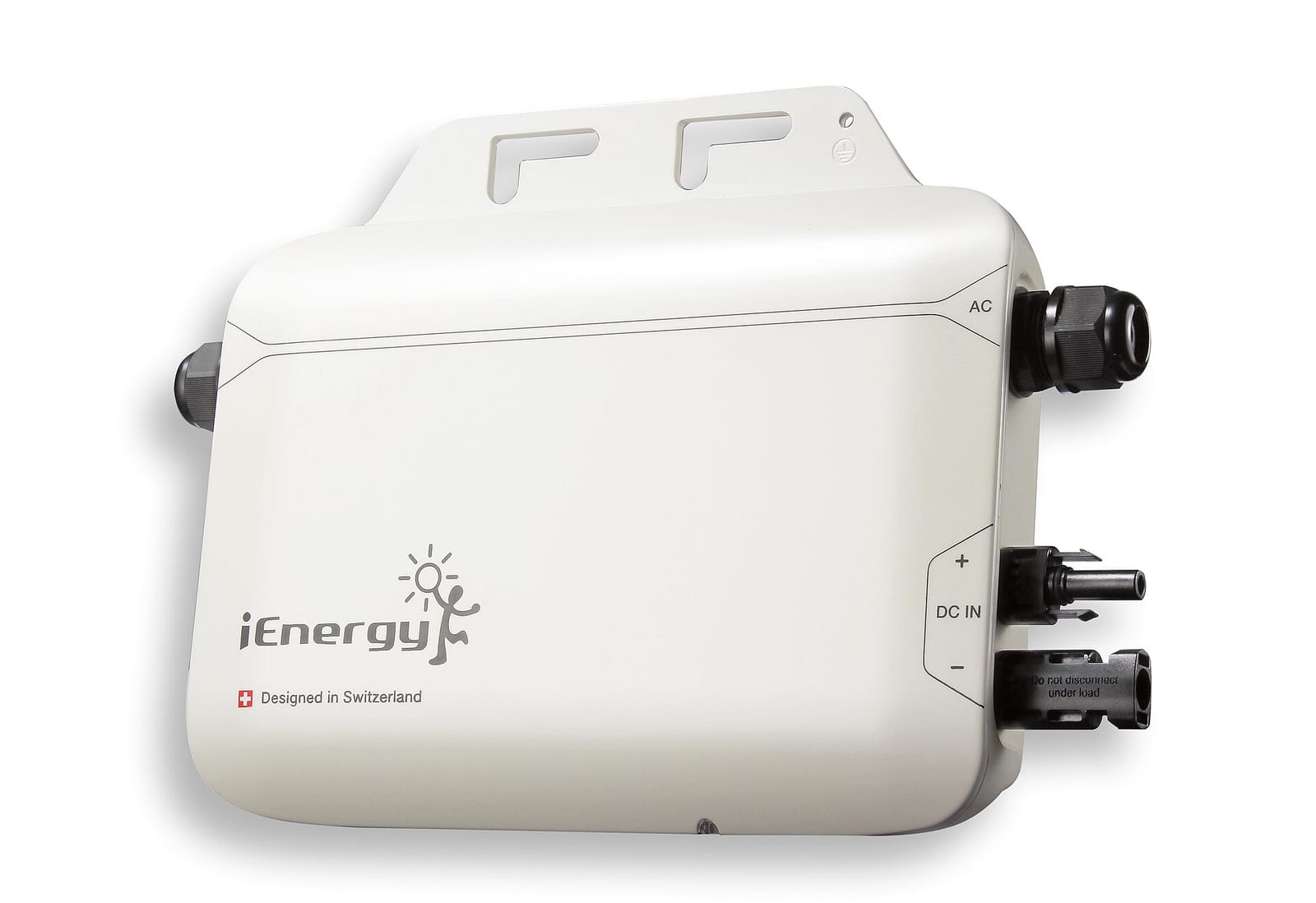
If you add a battery, a hybrid inverter can handle the panels and the battery together. See what is a hybrid inverter for how that changes the wiring.
How do solar panels work with the grid?
A grid-connected system runs in parallel with the grid: your home takes the solar power it needs first, and the grid fills any gap or absorbs any surplus automatically. There is no switch to flick and nothing to store.
On a sunny afternoon with the house mostly idle, the panels may make more than you use. The extra power exports through the meter and your retailer credits you a feed-in tariff, a per-kWh rate that varies by retailer and state. In the evening, when the panels stop, the same meter records imports at your normal usage rate.
Because you are paid far less for exports than you pay for imports, the money is in using solar power yourself during the day. Our feed-in tariff tracker lists current rates, and smart meters and solar explains what the meter on your wall records. To see how kW and kWh differ on the bill, read kW vs kWh explained.
Do solar panels work at night?
No. Solar panels produce no electricity at night, because there is no light to push electrons through the cell. A home with solar and no battery draws all its night-time power from the grid, exactly as it did before it had panels.
There are two ways to cover the night. The simplest is to keep buying from the grid, ideally on a plan with cheap off-peak or overnight rates. The second is a home battery, which stores surplus daytime solar and releases it after sunset. The battery is charged by the sun on the previous day, so the panels still do not work at night, but your power does. See how big a battery you need and AC-coupled vs DC-coupled batteries.
Do solar panels work on cloudy days?
Yes, at reduced output. Cloud scatters and blocks sunlight but does not stop it, so panels keep generating. Thin cloud costs little, while thick low cloud costs most of the output. Our guide to solar panels on cloudy days and in winter has the numbers.
The bigger seasonal driver in Australia is not weather but the sun’s angle and day length, which the charts below show. Cool, clear days are actually good for panels, since silicon loses a little output as it heats.
Do solar panels work in a blackout?
Usually not. A standard grid-connected inverter shuts itself down when the grid fails, so panels alone will not keep your lights on in a blackout. This is deliberate: grid-connected inverters in Australia must meet AS/NZS 4777.2, which includes protection against the inverter feeding power into a dead network where line workers could be working.
To keep power on, you need a battery with a backup gateway or backup circuit, installed so that your home disconnects from the grid and runs on its own. Backup capacity is limited by the battery’s size and output power. See best batteries for blackout backup.
How much power do solar panels make across a day?
A rooftop system follows the sun: output rises from sunrise, peaks around the middle of the day and falls to zero at sunset. On a clear day facing north, the curve is a smooth hump; panels facing east or west shift the peak earlier or later. Orientation and tilt change the shape, as covered in solar panel angle and orientation in Australia.
The midday peak is the reason solar homes export in the afternoon and import in the evening, and why shifting dishwashers, laundry and hot water into daylight hours pays. Peak and shoulder tariff periods are explained in peak and off-peak electricity times.
How much do solar panels make across a year?
Daily output depends on location. The Clean Energy Council guide figures (2011 edition, Clean Energy Council “Consumer guide to buying household solar panels”, 26 August 2011) give average daily production for a 1 kW system in each city. They are older design-guideline figures, so treat them as a guide.
View the data as a table
| kWh per day per kW | |
|---|---|
| Alice Springs | 5.0 kWh |
| Darwin | 4.4 kWh |
| Perth | 4.4 kWh |
| Canberra | 4.3 kWh |
| Adelaide | 4.2 kWh |
| Brisbane | 4.2 kWh |
| Cairns | 4.2 kWh |
| Sydney | 3.9 kWh |
| Melbourne | 3.6 kWh |
| Hobart | 3.5 kWh |
Alice Springs is the best place for solar output per kW and Hobart the weakest of these ten cities, about 30% lower.
Output per kW multiplied by system size gives a daily total. A 6.6 kW system in Perth is rated at about 29 kWh a day on that basis (6.6 multiplied by 4.4), and in Hobart about 23 kWh (6.6 multiplied by 3.5). These are year-round averages. The real figure swings with the seasons.
Solar exposure by month
The Bureau of Meteorology publishes the mean daily solar exposure at weather stations, in MJ per square metre. Dividing by 3.6 converts it to kWh per square metre, which equals peak sun hours: the number of hours of full-strength 1 kW per square metre sunlight a day.
- Perth
- Sydney
- Melbourne
- Hobart
- Darwin
Source: Bureau of Meteorology, Climate statistics for Australian locations, mean daily solar exposure, 1990 to 2026 (MJ/m2 divided by 3.6 by Solar Cobber). Stations: Perth Metro, Sydney Airport, Melbourne Airport, Hobart Airport West, Darwin Airport.
View the data as a table
| Perth | Sydney | Melbourne | Hobart | Darwin | |
|---|---|---|---|---|---|
| Jan | 8.1 | 6.3 | 6.7 | 6.4 | 5.3 |
| Feb | 7.1 | 5.6 | 5.8 | 5.4 | 5.4 |
| Mar | 5.7 | 4.7 | 4.5 | 4.0 | 5.9 |
| Apr | 4.2 | 3.8 | 3.1 | 2.6 | 6.1 |
| May | 3.2 | 2.9 | 2.2 | 1.7 | 5.8 |
| Jun | 2.6 | 2.4 | 1.8 | 1.3 | 5.5 |
| Jul | 2.8 | 2.8 | 2.0 | 1.6 | 5.7 |
| Aug | 3.6 | 3.6 | 2.8 | 2.4 | 6.3 |
| Sep | 4.8 | 4.7 | 3.8 | 3.5 | 6.6 |
| Oct | 6.3 | 5.6 | 4.9 | 4.8 | 6.8 |
| Nov | 7.4 | 6.1 | 5.9 | 5.8 | 6.4 |
| Dec | 8.3 | 6.5 | 6.6 | 6.5 | 5.7 |
Southern cities swing hard between summer and winter, while Darwin stays almost flat. Perth, Sydney, Melbourne and Hobart all get their weakest sun in June, and Darwin dips in the wet season instead.
The table gives the full eight-capital data for the two extremes, the December peak and June trough, and the ratio between them.
| City | Station | December (kWh/m2/day) | June (kWh/m2/day) | December divided by June | Annual mean (kWh/m2/day) |
|---|---|---|---|---|---|
| Hobart | Hobart Airport West | 6.53 | 1.33 | 4.9 | 3.83 |
| Melbourne | Melbourne Airport | 6.61 | 1.78 | 3.7 | 4.17 |
| Adelaide | Adelaide Airport | 7.50 | 2.22 | 3.4 | 4.92 |
| Perth | Perth Metro | 8.31 | 2.64 | 3.1 | 5.36 |
| Canberra | Canberra Airport | 7.03 | 2.28 | 3.1 | 4.67 |
| Sydney | Sydney Airport | 6.53 | 2.42 | 2.7 | 4.58 |
| Brisbane | Brisbane | 6.67 | 3.31 | 2.0 | 5.14 |
| Darwin | Darwin Airport | 5.69 | 5.50 | 1.0 | 5.94 |
Bureau of Meteorology averages, checked 14 November 2026; Canberra uses 20 years of data (2007 to 2026), the others 37 years (1990 to 2026). The ratio column is Solar Cobber arithmetic.
What will a 6.6 kW system produce in summer and winter?
A 6.6 kW system in Melbourne makes roughly 38 kWh on an average December day and roughly 10 kWh on an average June day, a gap of nearly four to one. In Brisbane the same system makes about 36 kWh and 18 kWh. These are Solar Cobber estimates, with the method below.
Solar Cobber calculation. Take each city’s Clean Energy Council figure per kW (the chart above) and divide it by the Bureau of Meteorology annual mean daily exposure, which gives a conversion factor for that city covering tilt, heat and system losses (Melbourne: 3.6 divided by 4.17 is 0.863). Multiply the month’s exposure by that factor and by 6.6 kW. Melbourne in December: 6.61 multiplied by 0.863 multiplied by 6.6 is 37.7 kWh.
- December
- June
Source: Solar Cobber calculation from Bureau of Meteorology station averages (1990 to 2026) and Clean Energy Council guide figures (2011 edition). Mixes datasets from different periods, so treat as a guide within about 10%, not a forecast for one roof.
View the data as a table
| December | June | |
|---|---|---|
| Perth | 45.0 kWh | 14.3 kWh |
| Adelaide | 42.9 kWh | 12.5 kWh |
| Canberra | 42.7 kWh | 13.9 kWh |
| Hobart | 39.4 kWh | 8.0 kWh |
| Melbourne | 37.7 kWh | 10.1 kWh |
| Sydney | 36.7 kWh | 13.6 kWh |
| Brisbane | 36.0 kWh | 17.9 kWh |
| Darwin | 27.8 kWh | 26.9 kWh |
Hobart makes about five times more power in December than June, while Darwin’s 6.6 kW system produces nearly the same each month. Darwin’s December is low because of the wet season, not a lack of sun angle.
The figures show why a southern winter bill can jump even with panels. A Melbourne household using 18 kWh a day in June gets about 10 kWh from a 6.6 kW system on an average day, and less on dull ones. The same home produces double its use in December. Many owners therefore export heavily in summer and import in winter.
The estimates are consistent with the zone ratings the Clean Energy Regulator uses to calculate small-scale technology certificates: 1.382 MWh per kW a year for Zone 3 (Sydney, Brisbane, Perth, Adelaide, Canberra), 1.185 for Zone 4 (Melbourne, Hobart), as at the regulator’s postcode zone document. Our STC calculator guide shows how those ratings turn into the discount on your quote.
How much does it cost to put solar on your roof?
Solar Choice’s November 2026 index puts a fully installed 6 kW system, after the STC discount and including GST, at A$5,230 in Perth and A$5,470 in Adelaide, up to A$9,890 in Darwin. Prices differ by city, and a 6.6 kW system, which is the common size, sits a little above those figures. Source: Solar Choice Solar Panel Price Index, data dated 1 November 2026, standard offers.
| City | 6 kW installed (standard offer) | 10 kW installed (standard offer) |
|---|---|---|
| Perth | A$5,230 | A$8,410 |
| Adelaide | A$5,470 | A$8,610 |
| Melbourne | A$5,750 | A$8,870 |
| Canberra | A$5,790 | A$8,580 |
| Sydney | A$5,800 | A$8,810 |
| Brisbane | A$6,200 | A$9,350 |
| Hobart | A$6,680 | A$11,080 |
| Darwin | A$9,890 | A$14,930 |
Prices from the Solar Choice Solar Panel Price Index, November 2026, which includes GST and the federal STC discount. Read the full figures in what solar costs in Australia.
The federal discount applies as small-scale technology certificates (STCs). For a 6.6 kW system installed in 2026 in a Zone 3 city, system size multiplied by zone rating multiplied by a five-year deeming period gives about 45 certificates (6.6 x 1.382 x 5 = 45.6), according to the Clean Energy Regulator’s method. The deeming period falls by one year each year to 2030, which is a reason the discount shrinks yearly.
What should you check before you buy?
If you now want a system, the three things that decide how well it works are its size, where it faces and who installs it. Before signing a quote, check these:
- The panel and inverter model names, so you can look up their datasheets and warranty terms. Panel sizes are covered in solar panel sizes and dimensions.
- The roof orientation and shading assumptions behind the stated output.
- Whether the quote includes the STC discount and what it assumes, as laid out in how many solar panels you need.
- That the installer holds current accreditation. Check the Solar Accreditation Australia register and the Clean Energy Council approved retailer list yourself rather than relying on a company’s statement.
Compare quotes from installers near you through our directory of solar installers or the top 10 solar panel installers.
FAQ
How do solar panels work in simple terms?
Solar panels turn sunlight into direct current electricity inside silicon cells, and an inverter converts that into the alternating current used in homes. Your appliances use the solar power first, any surplus is exported to the grid, and the grid covers whatever the panels cannot supply.
Do solar panels work at night?
No, solar panels make no electricity at night because they need light. A home without a battery draws night-time power from the grid, while a home with a battery can run on solar energy stored during the day.
How do solar panels work with the grid?
Panels and the grid share the home’s switchboard, with the inverter matching the grid’s voltage and frequency. The home uses solar power first, exports surplus through the meter for a feed-in tariff, and imports from the grid when solar output is too low.
Do solar panels work during a power outage?
Not on their own. Standard grid-connected inverters shut down in a blackout for safety, so you need a battery with a backup gateway to keep the lights on.
Do solar panels work on cloudy days?
Yes, but at reduced output. Light cloud takes a small share of output, while heavy low cloud can remove most of it. Winter in southern cities reduces output more through shorter days than through cloud.
How much electricity does a solar panel make per day?
A single 440 W panel makes about 1.5 to 2 kWh a day on average across most Australian cities, based on 3.5 to 4.4 kWh per kW per day in the Clean Energy Council guide figures. Output is lower in Hobart and Melbourne and higher in Perth and Darwin, and much lower in winter.
Do solar panels need direct sunlight?
No, they use both direct and scattered light, but direct sunlight gives the most output. Shade on even one panel can cut a string’s output unless the system uses microinverters or optimisers.
Do solar panels still work in hot weather?
Yes, though panels lose a small amount of efficiency as they heat up, which is shown as the temperature coefficient on each datasheet. The long summer days more than make up for it, which is why December output is far higher than winter output in most cities.
Sources
- Clean Energy Council, Consumer guide to buying household solar panels (2011), average daily production table
- Bureau of Meteorology, climate statistics, Sydney Airport, mean daily solar exposure
- Bureau of Meteorology, climate statistics, Hobart Airport West
- Clean Energy Regulator, calculate small-scale technology certificate entitlements
- Clean Energy Regulator, postcode zone ratings and zones for solar systems
- Solar Choice, solar panel price index, November 2026
- Trina Solar Vertex S+ datasheet
- Aiko Neostar 2P datasheet
- REC Alpha Pure-RX Australian datasheet
About this guide
Written by the Solar Cobber editorial team from independent desk research, checked in November 2026. Solar Cobber is a free directory that may earn referral or advertising fees from installers, and commercial relationships never affect our content. This is general information, not financial advice. To report a correction, contact us.
Filed under Solar Basics
Back to blog