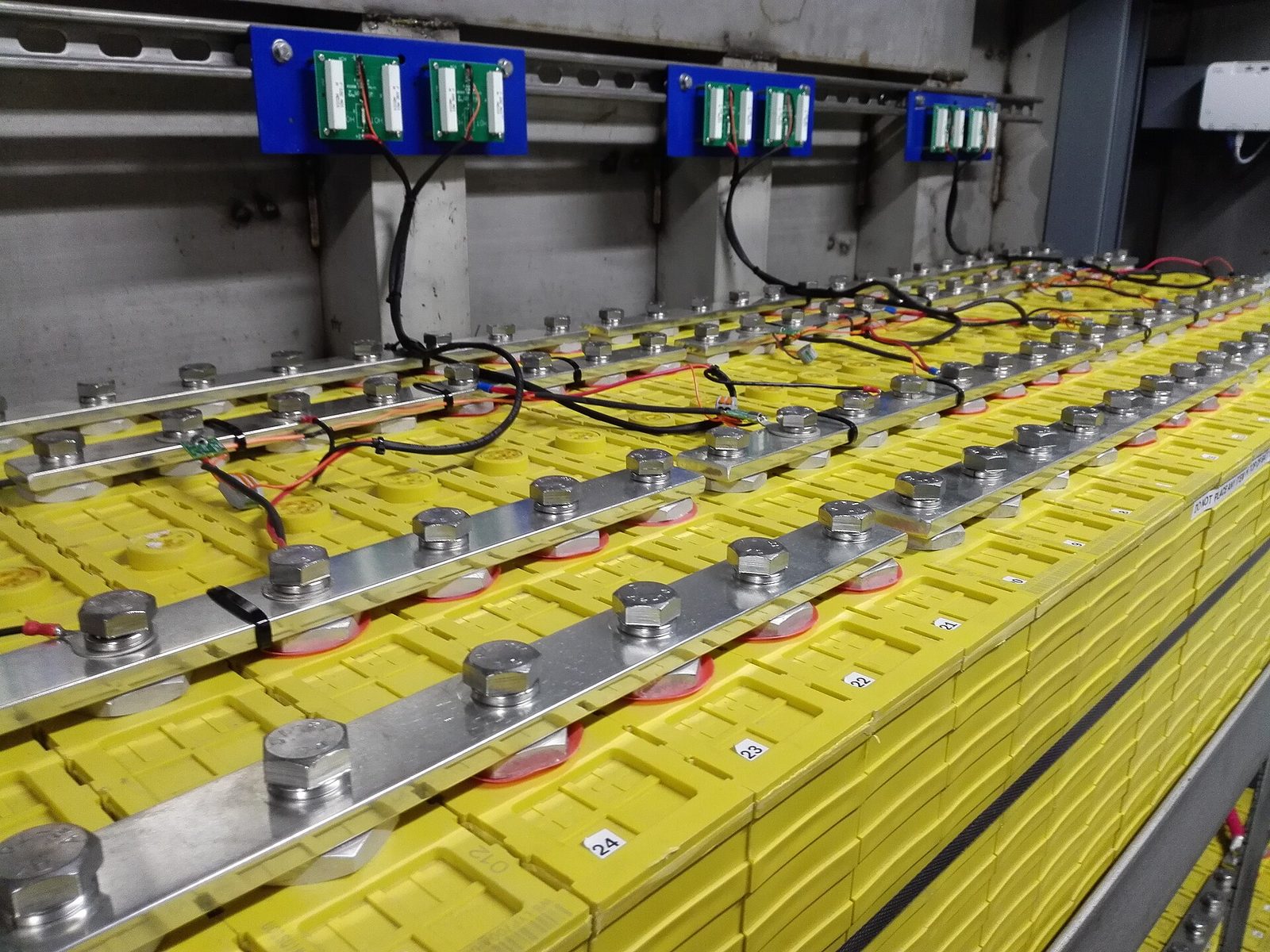
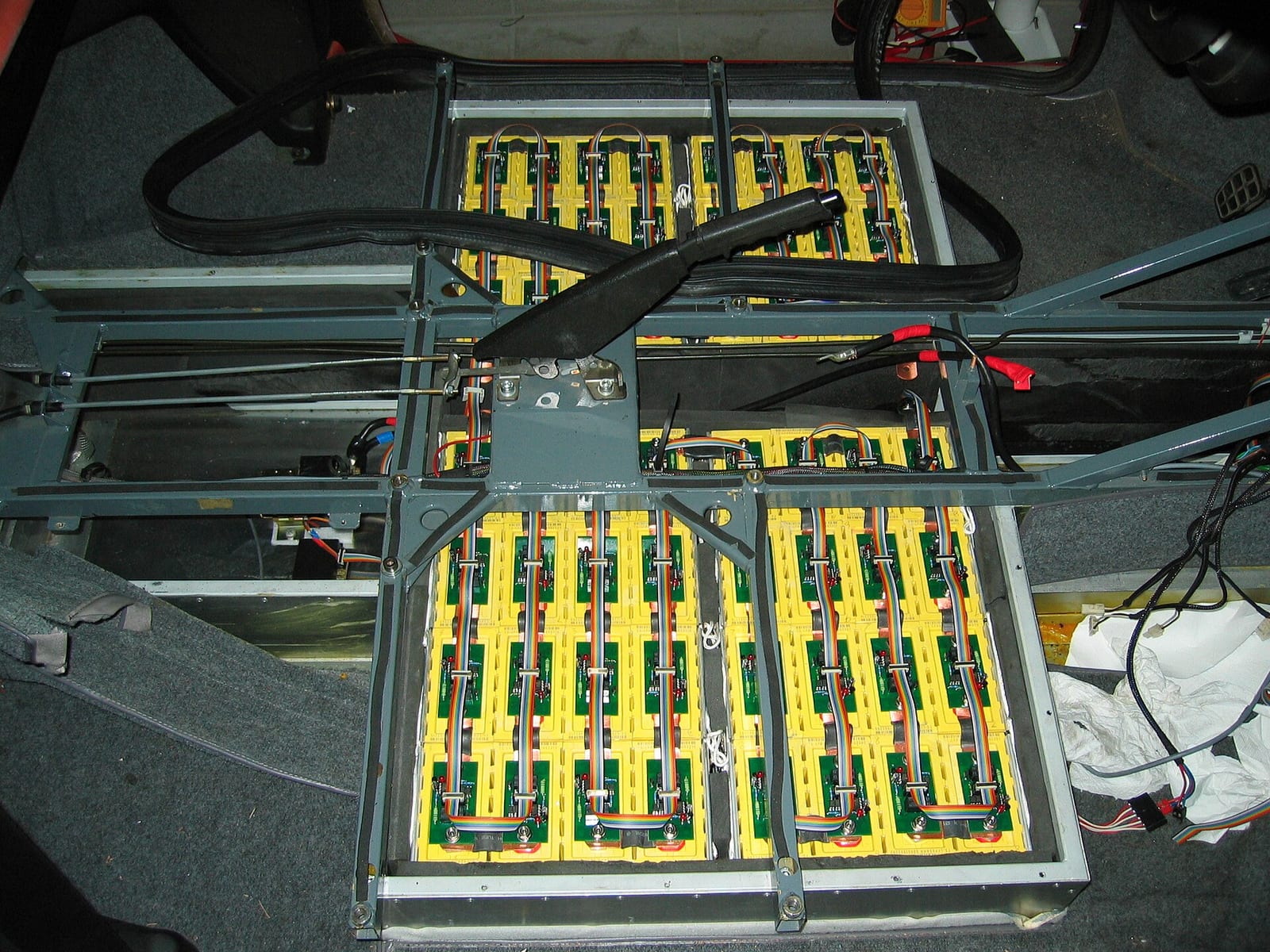
An LFP battery is a lithium-ion battery whose positive electrode (cathode) is lithium iron phosphate (LiFePO4) instead of the nickel, manganese and cobalt used in NMC cells. As at November 2026, LFP is the chemistry in nearly every home battery we have reviewed in Australia, because it is rated for about 3,000 to 6,000 cycles and starts to fail at a higher temperature than NMC. The trade-off is lower energy density, so LFP batteries are heavier for their capacity.
Key facts
- As at November 2026, Energy Matters (October 2026) puts LFP cycle life at 3,000 to 6,000 or more cycles, against 1,000 to 2,500 for NMC, both measured at 80% depth of discharge.
- Energy Matters (October 2026) states that an LFP cathode holds its structure to about 270 degrees Celsius, while NMC starts decomposing between about 150 and 210 degrees Celsius and releases oxygen.
- LFP cells store about 90 to 160 Wh per kg, against about 150 to 250 Wh per kg for NMC (Energy Matters, October 2026), so an LFP home battery is bulkier for the same kWh.
- Every home battery review on Solar Cobber that states a chemistry lists LFP, except the 400V SolarEdge Home Battery, which SolarQuotes lists as NMC.
- Warranty throughput caps on the LFP batteries we reviewed range from about 2.8 to 4.2 MWh per usable kWh, which is roughly 2,800 to 4,200 full cycles (Solar Cobber calculation).
- Standard LFP charging is limited at low temperatures: the Sungrow SBR, Sungrow SBH and Deye AI-W5.1-B datasheets all list charging only from 0 degrees Celsius upwards.
What is an LFP battery?
An LFP battery is a rechargeable lithium-ion battery that uses lithium iron phosphate as its cathode and graphite as its anode. It is also written LiFePO4, LiFePO4 battery or lithium ferrophosphate. It is not a different technology from “lithium-ion”: it is one family member, and the comparison most people mean by “lithium iron phosphate vs lithium-ion” is LFP against NMC or similar nickel-based cells.
A single LFP cell has a nominal voltage of about 3.2 V, which is lower than NMC cells at about 3.6 to 3.7 V. Manufacturers connect cells in series to build modules and stacks. A 5 kWh home battery module is typically many cells wired together with a battery management system that watches voltage, temperature and current.
The chemistry is cobalt free and nickel free, which matters for cost and supply. Wikipedia’s LFP summary notes average assembled LFP cell prices fell to about US$100 per kWh in 2023 from US$137 per kWh in 2020 (a figure it sources to industry reports), and Energy Matters (October 2026) says LFP now costs less per kWh than NMC in the Australian market.
LFP vs NMC: how they compare
LFP wins on safety margin, cycle life and cost; NMC wins on energy density. In a home battery that sits on a wall, weight and size rarely decide the purchase, so LFP has taken over residential storage here.
The table below compares the two with the other chemistries you may see in quotes. Figures are Energy Matters ranges (October 2026), measured at 80% depth of discharge for cycle life. They are industry ranges, not guarantees for any product.
| Measure | LFP | NMC | Lead-acid | Sodium-ion |
|---|---|---|---|---|
| Cycle life (80% depth of discharge) | 3,000 to 6,000+ | 1,000 to 2,500 | 500 to 1,200 | 2,000 to 4,000 |
| Thermal runaway onset | About 270 C | About 150 to 210 C | Not applicable | About 250 C |
| Energy density (Wh per kg) | 90 to 160 | 150 to 250 | 30 to 50 | 75 to 160 |
| Contains cobalt | No | Yes | No | No |
| Cold weather | Needs heating or limits charging near 0 C | Slightly better | Poor | Strong |
How many cycles does an LFP battery last?
The first chart shows why installers prefer LFP for daily cycling. A cycle is one full charge and discharge of the usable capacity.
- Low end
- High end
Source: Energy Matters, LFP vs NMC Battery Chemistry, 1 October 2026 (updated 7 October 2026).
View the data as a table
| Low end | High end | |
|---|---|---|
| LFP | 3,000 cycles | 6,000 cycles |
| Sodium-ion | 2,000 cycles | 4,000 cycles |
| NMC | 1,000 cycles | 2,500 cycles |
| Lead-acid | 500 cycles | 1,200 cycles |
LFP is rated for roughly double to triple the cycles of NMC. Independent academic work agrees on the direction: a 2020 Sandia National Laboratories study in the Journal of the Electrochemical Society, cited by Wikipedia, reported LFP cells lasting 2,500 to more than 9,000 cycles depending on conditions.
At one cycle a day, 3,000 to 6,000 cycles is 8 to 16 years. We found no independent data proving current Australian LFP home batteries last that long, because the models are too new. Our how long do solar batteries last guide covers the Canberra Battery Test Centre results and what to expect.
Is LFP safer than NMC?
LFP is more thermally stable, which gives a larger safety margin, but no lithium battery is risk free and installation quality matters more than chemistry. The cause of the margin is the cathode. LFP holds its structure to about 270 degrees Celsius and releases little oxygen, so a failing cell feeds a fire less. NMC starts decomposing at about 150 to 210 degrees Celsius and releases oxygen (Energy Matters, October 2026).
- Low end
- High end
Source: Energy Matters, LFP vs NMC Battery Chemistry, 1 October 2026.
View the data as a table
| Low end | High end | |
|---|---|---|
| LFP | 270 C | 270 C |
| Sodium-ion | 250 C | 250 C |
| NMC | 150 C | 210 C |
Energy Matters also reports that Fire and Rescue NSW recorded only three residential battery energy storage fires in 2023 across more than 57,000 installed units, with most lithium-ion incidents involving e-bikes, e-scooters and chargers. We could not open the Fire and Rescue NSW page to confirm this, so treat it as reported. Our are solar batteries safe guide covers installation rules and recalls in full.
Safe chemistry does not protect against faulty electronics. In November 2025 Sigenergy recalled some single-phase controllers over AC plugs that could overheat, and in September 2025 Tesla recalled some Powerwall 2 units in Australia because the ACCC notice says third-party lithium-ion cells may fail and overheat. Both are detailed in our Sigenergy SigenStor review and Tesla Powerwall 3 review.
Is LFP less energy dense?
Yes, and that is its main drawback. The best commercial LFP cells reach about 160 to 205 Wh per kg (CATL’s 2024 claim of 205 Wh per kg is cited on Wikipedia), while good NMC cells exceed 250 Wh per kg.
- Low end
- High end
Source: Energy Matters, LFP vs NMC Battery Chemistry, 1 October 2026.
View the data as a table
| Low end | High end | |
|---|---|---|
| NMC | 150 Wh/kg | 250 Wh/kg |
| LFP | 90 Wh/kg | 160 Wh/kg |
| Sodium-ion | 75 Wh/kg | 160 Wh/kg |
| Lead-acid | 30 Wh/kg | 50 Wh/kg |
For a car, extra weight costs range, so NMC still dominates EVs. For a wall or floor mounted home battery, the weight matters mainly for installation. The Sungrow SBR256 stack weighs 279 kg for 25.6 kWh, for example (Sungrow datasheet, as listed in our Sungrow SBR review), and you need a wall or floor that suits it.
Do LFP batteries work in heat and cold?
LFP handles Australian heat better than NMC on safety grounds, but it is the cold that limits it, and every battery derates in a hot, unshaded garage. Datasheets show the practical limits.
| Battery | Charge range | Discharge range | Source |
|---|---|---|---|
| Sungrow SBR | 0 to 50 C | -20 to 50 C | Sungrow datasheet |
| Sungrow SBH | 0 to 50 C | -20 to 50 C | Sungrow datasheet |
| Deye AI-W5.1-B | 0 to 55 C | -20 to 55 C | Deye datasheet |
| Fox ESS EQ4800 | 0 to 55 C | -10 to 55 C | Fox ESS datasheet |
| BYD Battery-Box Premium | -10 to 50 C (derates -10 to 5 C) | -10 to 50 C | BYD datasheet |
| Enphase IQ Battery 5P | -20 to 55 C (derates outside 15 to 45 C when charging) | -20 to 55 C | Enphase datasheet |
Those figures come from the review pages linked in the next section. In most of Australia freezing temperatures at the battery are rare, but cold inland areas such as the Snowy Mountains, Canberra and parts of Tasmania can reach them. Heat is the more common problem: a west facing wall can exceed 45 degrees Celsius in a heatwave, which can reduce charging power and, under some warranties, affect cover. Sungrow’s May 2026 warranty added temperature conditions, and the SolarEdge 48V warranty requires 0 to 40 degrees Celsius ambient for 95% of the term.
Which home batteries sold in Australia use LFP?
Almost all of them. The table lists the batteries we have reviewed, with the chemistry stated in each review’s specifications and the warranty terms from the Australian warranty documents we read. Checked November 2026.
| Battery | Chemistry | Warranty (Australia) |
|---|---|---|
| Tesla Powerwall 3 | LFP | 10 years to 70%; unlimited cycles for self-consumption, time-of-use and backup |
| Sungrow SBR | LFP | 10 years to 70%; unlimited cycles for self-consumption and backup |
| Sungrow SBH | LFP | 10 years to 70%; unlimited cycles for self-consumption and backup |
| Sigenergy SigenStor | LFP | 10 years, 70% or about 3 MWh per usable kWh |
| BYD Battery-Box Premium | LFP | 10 years, 70% or about 3 MWh per usable kWh |
| Enphase IQ Battery 5P | LFP | 15 years or 6,000 cycles; 70% at 10 years, 60% at 15 |
| Deye AI-W5.1-B | LiFePO4 | 10 years, 70% or 6,000 cycles or 16 MWh per 5.12 kWh module |
| ESY Sunhome HM series | LiFePO4 | 10 years, 70% or 21.5 MWh per 5.12 kWh module |
| GoodWe Lynx Home F | LFP | 10 years, 70% or 46.72 MWh for 12.8 kWh |
| Fox ESS EQ4800 | LFP | 10 years, 70% or a throughput cap (39.32 MWh for a two-module stack) |
| Huawei LUNA2000 | LFP | 10 years or 16.45 MWh per 5 kWh module, to 60% |
| Solax batteries | LFP | 10 years, 70%; 6,000 cycles for daily use, caps for other uses |
| Sofar BTS and PowerAll | LFP | 10 years, 70% or 18.25 MWh per BTS 5K module |
| Dyness | LFP | 10 years, 70% or a throughput cap |
| Growatt APX | LFP | 10 years; 70% in years 1 to 5, 50% in years 6 to 10 |
| iStore Smart Battery | LFP | S1: 15 years or 28.84 MWh to 60% |
| SolarEdge Home Battery | LFP (48V); NMC (400V, per SolarQuotes) | 10 years to 70% |
| Anker SOLIX X1, Hinen, SAJ, Solplanet | LFP | See each review |
If your quote names a battery not on this list, ask the installer for the cell chemistry in writing. Every product on the Clean Energy Council approved battery list has a published datasheet, so a vendor that cannot tell you is a red flag. For help choosing, see best solar batteries in Australia.
What do LFP warranties actually guarantee?
Most guarantee 10 years and 70% capacity, but many also cap the energy you may put through the battery, and that cap, not the chemistry, usually ends the warranty first. A throughput cap is the total MWh the battery may deliver before warranty cover stops.
Solar Cobber calculation: we divided each warranty’s MWh cap by the module’s usable kWh to get MWh per usable kWh, then divided by 365 days to get the years to reach the cap at one full cycle a day. Enphase states 6,000 cycles rather than MWh, so we show 6.0 MWh per kWh as the equivalent.
Source: Australian warranty documents and Solar Cobber product reviews, November 2026.
View the data as a table
| MWh per usable kWh | |
|---|---|
| Enphase IQ 5P | 6.00 MWh |
| ESY Sunhome | 4.20 MWh |
| Sofar BTS | 3.70 MWh |
| GoodWe Lynx F | 3.65 MWh |
| Huawei LUNA2000 | 3.29 MWh |
| Deye AI-W5.1-B | 3.13 MWh |
| BYD Premium | 3.00 MWh |
| Solax TSYS-HS51 | 2.96 MWh |
| SolarEdge 48V | 2.87 MWh |
| Tesla Powerwall 3 | 2.80 MWh |
| Sungrow SBR | 2.80 MWh |
The Enphase IQ Battery 5P has the most generous allowance on paper, and the Sungrow and Tesla figures only apply to uses outside self-consumption, time-of-use and backup. At one cycle a day, a 2.8 MWh per kWh cap lasts about 7.7 years, a 3.65 MWh cap about 10 years and a 4.2 MWh cap about 11.5 years. Heavy cycling, for example overnight grid charging or a virtual power plant (what is a VPP), uses the allowance faster.
Should you worry about cost, recycling and supply?
LFP is usually the cheaper chemistry per kWh over its life, and prices of home batteries have also fallen thanks to the federal discount. The federal battery rebate applies per usable kWh regardless of chemistry, and our cost guide shows current installed prices.
Recycling is the open question. LFP has no cobalt or nickel to recover, which makes recycling less valuable economically. The B-cycle scheme, as read in November 2026, says its drop-off points do not accept home energy storage batteries, so use your installer or a specialist recycler.
Sodium-ion is the chemistry to watch as a future alternative; see sodium-ion batteries in Australia. For how an LFP battery connects to your solar, see AC vs DC coupled batteries and what is a hybrid inverter.
What to check on your quote
- Ask for the cell chemistry in writing and confirm it matches the datasheet.
- Check the battery model is on the Clean Energy Council approved battery list on install day, because listings have expiry dates.
- Read the warranty for the MWh cap and the cycles allowed for your use.
- Ask about operating temperature limits and where the battery will be mounted.
- Compare quotes from several installers; browse Solar Cobber’s installer directory or your state page such as New South Wales and Queensland.
FAQ
What does LFP stand for in batteries?
LFP stands for lithium iron phosphate, a lithium-ion battery chemistry whose cathode is LiFePO4. It is also called a LiFePO4 battery. It contains no cobalt or nickel.
Is LFP better than NMC for a home battery?
For a stationary home battery, usually yes. LFP offers longer cycle life (3,000 to 6,000 cycles against 1,000 to 2,500) and a higher thermal runaway onset, and NMC’s energy density advantage matters little on a wall (Energy Matters, October 2026).
How long does an LFP battery last?
LFP cells are rated for about 3,000 to 6,000 or more cycles, which is 8 to 16 years at one cycle a day. Australian warranties are shorter: most run 10 years to 70% capacity, and Enphase offers 15 years.
Is an LFP battery safe to have in my home?
LFP is the safest widely used lithium-ion chemistry for homes, but it is not risk free. Installation to AS/NZS 5139 location rules and an approved product matter as much as chemistry, and Australian home battery recalls have occurred, although ACCC notices do not state the cell chemistry, so we cannot say which involved LFP.
Is a LiFePO4 battery the same as an LFP battery?
Yes. LiFePO4 is the chemical formula of lithium iron phosphate, and LFP is the abbreviation. Datasheets use either term.
Do LFP batteries work in cold weather?
They work but charging is restricted near freezing. Several Australian datasheets, including Sungrow SBR and Deye, allow charging only from 0 degrees Celsius upwards, though discharge continues to -20 degrees Celsius.
Are all home batteries in Australia LFP?
Nearly all. Of the batteries we reviewed that state a chemistry, only the 400V SolarEdge Home Battery is listed as NMC (by SolarQuotes), and the 48V SolarEdge version is LFP.
Does LFP cost less than NMC?
Energy Matters says LFP now costs less per kWh than NMC in Australia (October 2026), helped by the absence of cobalt and higher production volumes.
Sources
- Energy Matters, LFP vs NMC Battery Chemistry (1 October 2026)
- Wikipedia, Lithium iron phosphate battery (accessed November 2026)
- Preger et al., Degradation of Commercial Lithium-Ion Cells as a Function of Chemistry and Cycling Conditions, Journal of the Electrochemical Society, 2020
- Sungrow HV Battery Limited Warranty, Australia, V9.0 (May 2026)
- Clean Energy Council approved battery list
- Solar Cobber product reviews, which cite each manufacturer’s Australian datasheet and warranty document
About this guide
Written by the Solar Cobber editorial team from independent desk research checked in November 2026. Solar Cobber is a free directory that may earn referral or advertising fees from installers; commercial relationships never affect our content. This is general information, not financial advice. Spotted an error? Tell us via /contact.
Filed under Solar Products
Back to blog